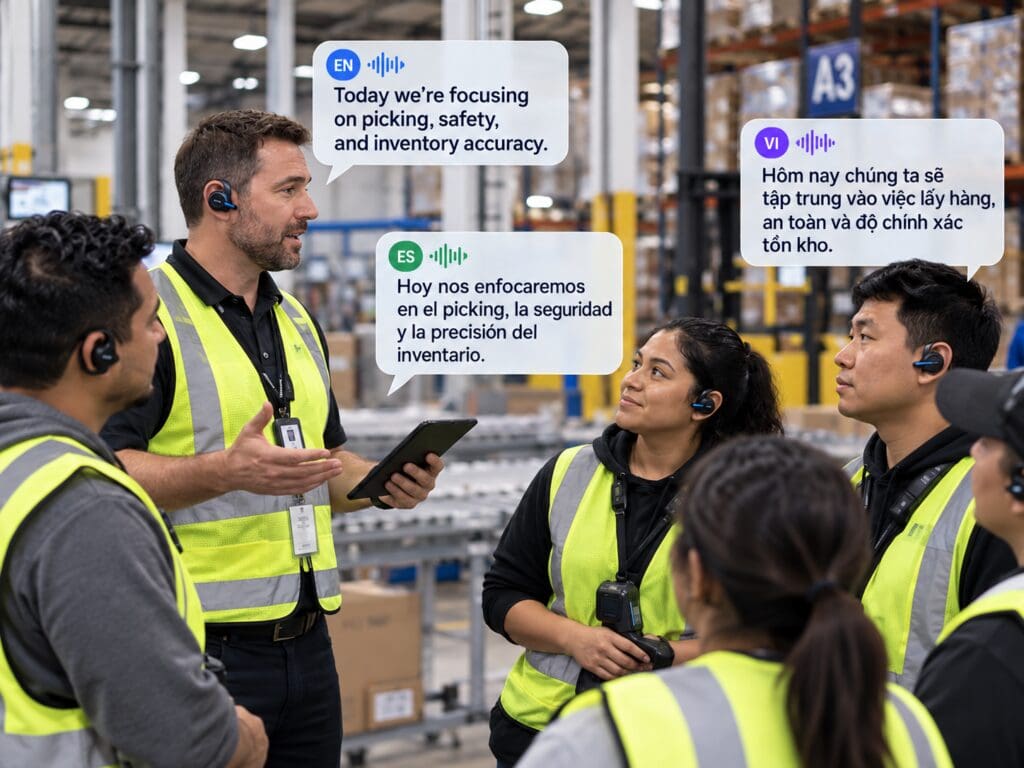
ERP, WMS, TMS, OMS, and planning systems remain essential. But AI is introducing a new layer in supply chain technology: systems that evaluate conditions continuously, incorporate context, weigh tradeoffs, and support or initiate action.
From Systems of Record to Systems of Decision
Supply chain technology has evolved in layers.
The first layer was built around transaction integrity. Orders had to be captured. Inventory had to be recorded. Shipments had to be tendered. Labor had to be scheduled. Invoices had to be matched. Financial and operational records had to reconcile.
This was the era of systems of record.
ERP, warehouse management, transportation management, order management, procurement, and related enterprise systems gave supply chains a durable transactional backbone. They remain essential. No AI architecture can replace the need for accurate orders, inventory positions, receipts, shipments, invoices, and master data.
The second layer extended this foundation into planning. Demand planning, supply planning, inventory optimization, network design, transportation planning, and scenario modeling helped companies move beyond recording what happened toward preparing for what might happen.
Those capabilities also remain essential.
But a third layer is now emerging.
AI is introducing systems of decision.
This new layer does not replace systems of record or systems of planning. It operates across them. It evaluates changing conditions, incorporates context, weighs tradeoffs, and supports or initiates action. It is less concerned with storing transactions than with improving decisions that affect cost, service, inventory, capacity, and execution.
For a deeper look at how AI is moving from architecture to operational execution, download the full ARC Advisory Group white paper: AI in the Supply Chain: From Architecture to Execution.
Systems of Record Still Matter
There is a temptation in AI discussions to talk as if legacy systems are obsolete. That is wrong.
Systems of record remain the foundation of supply chain execution. A warehouse cannot operate on probabilistic inventory. A transportation team cannot tender loads against uncertain shipment records. A finance organization cannot settle invoices against ambiguous transactions. A customer service team cannot make reliable commitments if order status is not accurate.
The core enterprise systems preserve operational truth.
But they were not designed to resolve every decision problem. They are very good at capturing and executing structured transactions. They are less effective at deciding what should happen when conditions change across multiple functions at once.
A supplier misses a commitment. A vessel is delayed. A key SKU is running below safety stock. A customer places an unexpected order. A transportation lane tightens. A facility loses capacity.
The record may show the event.
The decision is something else.
Planning Helps, But the Plan Keeps Changing
Planning systems were designed to help companies make better forward-looking decisions. They improved forecasting, inventory policy, capacity planning, allocation, network modeling, and supply-demand balancing.
But planning has historically been periodic. Monthly. Weekly. Sometimes daily. Even when planning systems use sophisticated optimization, the plan often becomes stale as execution begins.
That is not a failure of planning. It is a function of the operating environment.
Demand shifts faster than planning cycles. Carrier capacity changes faster than procurement processes. Supplier reliability changes faster than static lead-time assumptions. Disruptions can invalidate a plan before it is fully executed.
The supply chain does not need planning less. It needs planning to become more connected to execution.
This is where systems of decision become important.
What a System of Decision Does
A system of decision does not merely report what happened. It helps determine what should happen next.
It may consume data from ERP, TMS, WMS, OMS, planning systems, supplier portals, visibility platforms, risk feeds, and customer systems. It may use machine learning, optimization, business rules, retrieval-augmented generation, graph reasoning, or agentic workflows. But its purpose is not technology for its own sake.
Its purpose is to improve decisions.
A system of decision may support questions such as:
Which late shipments create real customer or production risk?
Which supplier disruption requires action versus monitoring?
Which orders should receive constrained inventory?
Which loads should be expedited, consolidated, delayed, or rerouted?
Which alternate suppliers are operationally feasible, not merely theoretically available?
Which customer commitments should be revised?
Which exception should be escalated to a planner, and which can be resolved automatically?
These are not simple reporting questions. They require context, judgment, constraints, and execution linkage.
The Decision Layer Cuts Across Functions
The reason systems of decision matter is that many important supply chain decisions are cross-functional.
A transportation delay is not only a transportation issue. It may affect inventory, customer service, warehouse scheduling, production sequencing, procurement, and finance.
A supplier disruption is not only a procurement issue. It may affect manufacturing, fulfillment, substitution rules, customer commitments, working capital, and risk exposure.
A demand spike is not only a planning issue. It may affect allocation, replenishment, labor, freight capacity, production capacity, and customer prioritization.
Traditional systems tend to see the problem through functional lenses. A decision system must evaluate the broader operating consequence.
This is one reason AI has strategic relevance. AI can help connect signals across systems, identify relationships, evaluate tradeoffs, and surface recommended actions faster than manual coordination can typically support.
The goal is not to remove human judgment. The goal is to reduce decision latency.
Decision Latency Is the Real Constraint
Most large supply chains already have more data than they can use effectively.
They have orders, shipments, inventory positions, forecasts, carrier events, supplier records, risk alerts, customer commitments, and exception reports. The problem is not always lack of visibility. Increasingly, the problem is the time required to convert visibility into coordinated action.
A shipment delay is detected. Transportation sees the issue. Inventory planning checks exposure. Procurement considers alternatives. Customer service updates expectations. Finance evaluates cost. Operations weighs feasibility.
Each function may respond rationally from its own position. But the response is often sequential, fragmented, and slow.
That is decision latency.
AI’s value is not simply faster analysis. Its higher value is reducing the time between signal, judgment, and execution.
A system of decision is useful only if it shortens that gap.
Not Every AI System Belongs in the Decision Layer
As AI moves closer to execution, the stakes change.
A chatbot that summarizes policy documents is one thing. A system that changes a transportation route, reallocates inventory, recommends a supplier switch, or revises a customer commitment is something else.
The closer AI operates to financial or physical consequence, the greater the requirement for determinism, context, governance, and auditability.
A planning recommendation can be reviewed and adjusted. A warehouse movement, routing change, purchase order, supplier substitution, or customer commitment carries immediate consequence. In those environments, probabilistic output must be constrained by rules, thresholds, approval paths, and domain-specific validation.
This is why supply chain AI should not be treated as a single category.
Different decision environments require different levels of autonomy, oversight, explainability, and control. A low-risk recommendation may be suitable for automation. A high-impact decision may require human approval. A regulated or customer-sensitive decision may require audit trails, access controls, and documented rationale.
The suitability of AI depends on domain, consequence, and governance.
What Changes for Technology Buyers
The emergence of systems of decision changes how buyers should evaluate supply chain technology.
The traditional questions remain useful: what function the system supports, what workflows it automates, what integrations it offers, what data it manages, and what reports it produces.
But those questions are no longer sufficient.
Buyers need to ask a second set of questions:
What decisions does the system improve?
Which roles are involved in those decisions?
What data and context are required?
How does the system evaluate tradeoffs?
Does it recommend action, initiate action, or simply report conditions?
What execution systems does it connect to?
What approval thresholds are configurable?
How are outcomes measured?
How are overrides captured?
Can the decision logic be audited?
This shifts evaluation from software functionality to operational impact.
A system that improves a dashboard may be useful. A system that improves a decision that affects service, inventory, capacity, or cost is more valuable.
What Changes for Vendors
This shift also changes the market structure for supply chain software vendors.
Planning vendors, transportation platforms, warehouse systems, visibility providers, procurement platforms, risk intelligence firms, and enterprise software companies are all embedding AI into their offerings. Their starting points differ, but the direction is similar.
They are moving toward decision support, decision automation, or decision orchestration.
This creates overlap between software categories that were once more distinct. A visibility provider may move into exception resolution. A planning vendor may move closer to execution. A TMS vendor may embed real-time decision support. A procurement platform may incorporate supplier risk intelligence and autonomous sourcing recommendations. An ERP vendor may position its AI layer as the enterprise decision fabric.
The market will not be defined only by functional labels. It will increasingly be defined by decision environments: procurement and commercial orchestration, network planning and resilience, logistics and fulfillment execution, exception management, inventory allocation, supplier risk response, customer commitment management, and planning-execution synchronization.
These are not merely software categories. They are operating problems.
Why AI Programs Stall
Many AI programs stall not because the technology is weak, but because the organization is not prepared to absorb it.
Common failure modes include AI insights that are not connected to execution systems, data that is available but not decision-ready, recommendations that are not trusted, unclear decision ownership, governance introduced too late, and workflows that remain manual after the AI output is generated.
In these cases, the enterprise may have AI capability without operational change.
That distinction matters.
The value is not in producing a better recommendation in isolation. The value is in changing the decision process in a way that improves cost, service, resilience, inventory, or speed.
The most successful organizations will not be those that deploy the most AI features. They will be those that redesign decision workflows around AI-supported execution.
Conclusion: The New Layer of Supply Chain Technology
Supply chain technology is not moving away from systems of record. It is building on them.
ERP, WMS, TMS, OMS, procurement, planning, and visibility systems remain essential. They provide the transactional and operational foundation that supply chains require.
But AI is creating a new layer above and across these systems.
That layer is focused on decisions.
It connects signals, context, reasoning, governance, and execution. It helps organizations move from knowing what happened to deciding what should happen next. It reduces decision latency. It supports coordination across functions. It creates the possibility of more adaptive, resilient, and responsive supply chains.
The next competitive advantage in supply chain technology will not come from better dashboards alone.
It will come from better decisions, connected to execution.
That is the shift from systems of record to systems of decision.
The post From Systems of Record to Systems of Decision: How AI Is Changing Supply Chain Technology appeared first on Logistics Viewpoints.