
Non classé
AI Is Reshaping the TMS Market. Deployment Will Determine the Winners.

Published
2 heures agoon
By
The transportation management systems (TMS) market is entering a period of significant change as artificial intelligence moves beyond analytical assistance toward more automated execution. Suppliers are introducing AI agents, intelligent freight procurement, automated exception management, and capabilities that connect transportation planning with operational decisions. Yet a distinction is emerging between the pace of innovation and the rate at which transportation organizations can deploy these capabilities effectively.
The numbers provide perspective. Descartes’ 2026 Transportation Management Benchmark Survey, based on responses from 300 senior transportation decision-makers in the United States and Canada, found that just 19% of shippers and 15% of logistics service providers (LSPs) reported using AI at scale. At the same time, 82% of shippers expected to increase transportation management IT spending over the next two years. The contrast suggests substantial investment appetite but considerable work still required to convert innovation into operating performance.
For transportation executives, the question is no longer simply whether AI can help with planning, carrier management, freight audit, or exception resolution. It is how these capabilities can be incorporated into existing operations while preserving reliability, controlling costs, and delivering measurable returns. For software suppliers, implementation economics may become as important as technological sophistication.
A Market Pursuing Different Paths to Intelligent Transportation
Recent announcements illustrate that AI-enabled transportation management is not developing around a single architectural model. Established vendors are extending existing applications, while others are consolidating platforms or placing transportation intelligence within broader enterprise and logistics networks.
At its September 2026 Insight conference, Trimble announced agent-ready modernization of its TMW.Suite, TruckMate, Innovative, and Fuel Dispatch carrier TMS platforms. Browser-accessible interfaces and cloud-hosted architectures preserve underlying operational logic while making room for AI-enabled workflows. Trimble Arc Agent addresses activities including order entry, contract intake, and freight RFQ preparation, with final approval retained by transportation personnel.
The significance lies in protecting investments that customers have made over years of configuration, integration, and process development. Replacing a carrier TMS can carry considerable expense and execution risk. Modernization within established workflows offers a potential route to new capabilities without requiring a wholesale operational reset.
FreightWise took a different approach with its October 2026 launch of Kuebix AI. Following its acquisition of Kuebix, the company is bringing its transportation technology onto a single platform and roadmap for small and midsize shippers. The offering combines less-than-truckload, truckload, and parcel execution with carrier connectivity, analytics, and integrations. Its AI-supported capabilities include multistop routing, service-time planning, and freight audit exception resolution. Customer migrations are underway, so the benefits of the consolidated architecture will depend in part on how smoothly those transitions proceed.
Oracle’s October announcement points to another direction: governed agentic applications embedded in enterprise processes. Its Fusion Claw-powered Shipment Load Planning Workspace evaluates consolidation opportunities, equipment capacity, timing, and service constraints to develop load recommendations for planner review and approval. Importantly, the workspace supports supply planning decisions; it does not itself execute transportation or replace Oracle Transportation Management. The strategic proposition is tighter coordination between enterprise planning data and decisions that eventually influence transportation execution.
Blue Yonder’s Logistics Ops Agent emphasizes decision support within transportation operations. It helps identify unroutable shipments, uncover backhaul opportunities, assess disruptions, and explain recommended actions in natural language while leaving transportation professionals in control. The approach combines operational context with more accessible analysis rather than treating an AI agent as a substitute for established optimization and execution processes.
project44’s Intelligent TMS, introduced in 2025, represents a network-centered approach. The platform brings freight procurement, planning, execution, visibility, and freight audit together using the company’s logistics data foundation. It can serve as a standalone TMS or operate alongside an incumbent platform, giving enterprises more than one path to adoption.
These are different market segments and technology layers, not five interchangeable products. Trimble’s carrier systems, FreightWise’s shipper-focused platform, Oracle’s planning workspace, Blue Yonder’s enterprise transportation capabilities, and project44’s integrated offering address overlapping but distinct requirements. Their announcements establish strategic direction and claimed functionality, not a uniform basis for comparing independently verified production results.
The Implementation Gap Is an Enterprise Challenge
The Descartes findings help explain why adoption remains uneven. Data quality was identified as a barrier to scaling AI by 33% of shippers and 45% of LSPs, while integration complexity was cited by 39% and 38%, respectively. These are survey respondents’ reported obstacles, not measurements of any individual supplier’s implementation performance.
Nevertheless, the findings identify a structural constraint. A system recommending carriers, consolidating loads, or revising a transportation plan needs dependable information about rates, capacity, delivery commitments, equipment, and operating restrictions. When those inputs are fragmented or inconsistent, even sophisticated recommendations can produce poor operational decisions.
The stakes also change as AI moves from administrative assistance toward action. Extracting information from transportation documents is a relatively bounded task. Changing a carrier assignment, revising a load plan, or responding to a service exception can introduce contractual, financial, and customer-service consequences. Reliable automation therefore depends on business rules, permissions, approval boundaries, exception handling, and auditability, not simply the intelligence of the underlying model.
Incremental deployment can be economically sensible. Organizations may achieve meaningful value from automating order entry, freight audit, communications, or monitoring before extending decision-making authority across a network. The opportunity for suppliers is to make those transitions easier through simpler integration, transparent recommendations, configurable controls, and support for existing processes.
What Transportation Buyers Should Measure
Transportation executives should broaden their software evaluation criteria without abandoning traditional TMS fundamentals. Functional breadth, optimization, multimodal coverage, carrier connectivity, and integration remain essential. AI adds new questions about implementation effort, decision reliability, oversight requirements, usage costs, and the consequences of automated actions.
A product demonstration can show that a workflow is technically possible. It says less about how the workflow behaves across thousands of transactions, difficult exceptions, and variable operating conditions. Buyers should ask suppliers for production evidence: exception rates, the frequency of human intervention, implementation effort, control mechanisms, and results achieved in comparable environments. They should also distinguish features available today from capabilities still on a product roadmap.
Commercial terms warrant similar scrutiny. AI capabilities may be included in subscriptions, priced by usage, or separately licensed. A pilot that looks inexpensive may have different economics when processing volume grows. The relevant measure is total cost to operate the capability, including integration, monitoring, support, and corrective intervention.
Most importantly, benefits should be assessed through transportation outcomes rather than counts of automated tasks. Shippers might track freight cost per shipment, tender acceptance, planner productivity, on-time delivery, and exception resolution costs. LSPs may focus on operating expense per load, revenue per employee, carrier-management productivity, and customer service performance. Improvements should be measured against a defined baseline and over enough time to capture operational variability.
A platform with sophisticated AI but extensive customization requirements may be less attractive for some organizations than one offering narrower functionality with faster deployment and predictable performance. The appropriate choice depends on network complexity, existing technology, and operating maturity, not the number of AI features on a slide.
Deployment Economics Will Shape the Next Competitive Phase
The TMS market is moving toward more intelligent transportation operations, but the transition will not be uniform. Large enterprises must balance innovation with continuity across complex systems and trading-partner relationships. Smaller shippers and service providers may place more immediate value on speed to implementation, integration simplicity, and demonstrable productivity gains.
Suppliers that align their technology and commercial models with these realities will have an advantage. Preserving useful customer configurations, improving data accessibility, reducing integration effort, and introducing automation within governed boundaries can be as important as adding capabilities. Buyers, meanwhile, should insist that the degree of autonomy matches the reliability of the data, the maturity of the workflow, and the cost of a wrong decision.
The Descartes survey points to a market where AI investment intent is strong but scaled deployment remains limited. That gap is an opportunity, not an indictment of existing technology. It shifts attention from what AI can demonstrate to what transportation organizations can reliably implement and measure. The next generation of TMS leaders will not necessarily be determined by how many AI features they introduce, but by their ability to make intelligent transportation execution practical, dependable, and economically valuable at scale.
The post AI Is Reshaping the TMS Market. Deployment Will Determine the Winners. appeared first on Logistics Viewpoints.
You may like
Non classé
Cutter & Buck, Kardex, and AutoStore: Why the Second Automated Warehouse May Matter More Than the First
Published
21 heures agoon
5 novembre 2026By
Warehouse automation announcements tend to celebrate the beginning. A new distribution center opens. Robots arrive. An automated storage and retrieval system goes live. Executives talk about throughput, labor savings, and future growth. But perhaps the more revealing warehouse automation story begins several years later, when a company decides whether to do it again. That is what makes the latest development involving Cutter & Buck, Kardex, and AutoStore particularly interesting.
Cutter & Buck, the apparel company, recently opened a new distribution center in Grand Prairie, Texas, featuring its second AutoStore goods-to-person system implemented by Kardex. The system includes 50,502 storage bins, 32 R5 Pro robots, and 13 ports, with Kardex FulfillX warehouse execution software coordinating the operation. It is designed for 1,256 bin presentations per hour, with simulation results averaging 1,284.
Those numbers are interesting. But the more important number may be two. This is not Cutter & Buck’s first attempt at warehouse automation. And that changes the story.
The First Warehouse Was the Experiment
Cutter & Buck began its earlier automation journey at its Renton, Washington, distribution center, where a Kardex-deployed AutoStore system went live in July 2023 with more than 34,000 bins and 54 robots. As the operation grew, the company later added another 9,962 storage bins along with additional ports and infrastructure. That evolution matters because the Texas facility was not designed simply by copying Renton.
According to Kardex, the companies used several years of operating experience, performance data, and lessons from the first deployment to shape the new distribution center around Cutter & Buck’s changing fulfillment requirements. This is where the story becomes much more useful for warehouse executives. There is an enormous difference between asking, “Should we automate?” and asking, “Knowing what we know after three years of automation, how should we automate the next building?” The second question may tell us far more about automation maturity.
What Happened After the Robots Arrived?
The publicly reported results from the original Renton deployment provide important context. In its case study, Kardex reports that Cutter & Buck reduced peak-season labor requirements by 60%, with 12 associates handling workloads that previously required 30. The company also reports that online orders can move from order to shipment in as little as 10 minutes.
Those are precisely the kinds of metrics automation buyers should be looking for. A warehouse can look highly automated without necessarily being highly productive. The business case ultimately depends on what happens to labor requirements, order cycle time, accuracy, capacity, service levels, and cost per order. That is especially important for Cutter & Buck because its fulfillment profile involves more than simply retrieving apparel from storage.
Nearly half of picking activity at the Renton operation supports embroidery workflows, according to the Kardex case study. That means products have to flow not just from storage to shipping, but through value-added customization processes as well. The Texas facility reflects that complexity. Its conveyor system connects AutoStore output with embroidery, order routing, Print & Apply, and shipping processes. In other words, the interesting technology story is no longer simply automated storage. It is automated flow.
The Second Warehouse Is the Real Vote of Confidence
Warehouse automation vendors understandably highlight initial customer wins. From an analyst perspective, however, repeat investment can be more revealing. A first implementation is based largely on expectations: projected throughput, anticipated labor savings, simulations, reference customers, and a calculated ROI. A second investment can be based on something much more valuable: the customer’s own operating data.
Cutter & Buck had several years to see how its first AutoStore deployment performed, expand that system as SKU requirements increased, identify where workflows could be improved, and then decide how to approach its next distribution center. It chose automation again. That does not mean every warehouse operator should reach the same conclusion. But it does suggest an important way customers should evaluate suppliers. Do not look only at how many new customers a technology provider wins. Look at how many existing customers expand, add robots or ports, increase storage capacity, or deploy the technology in another building. Those decisions occur after the sales presentation is over.
Modular Automation Changes the Economics
There is another important aspect of the Cutter & Buck example: scalability. At Grand Prairie, the number of robots and ports can be expanded independently as demand changes. That matters because one of the hardest parts of warehouse automation investment is forecasting the future.
Volumes change. SKU counts increase. Customer expectations shift. Peak seasons become more pronounced. A system designed perfectly for today’s demand may be poorly sized five years from now. Modular systems potentially give operators another way to think about ROI. Instead of asking whether they can perfectly forecast requirements over the entire investment horizon, they can ask whether the underlying automation architecture gives them enough room to respond when that forecast inevitably changes.
Cutter & Buck’s Renton facility illustrates that point particularly well. The original system was not frozen in its 2023 configuration. It subsequently expanded by nearly 10,000 additional bins as the business required more capacity. That ability to expand deserves more attention in automation business cases.
Stop Asking Only About Day-One Throughput
The warehouse automation market often focuses heavily on commissioning and initial throughput. Those metrics matter. But mature automation decisions should examine a longer timeline. What happened after year one?
Did the operation require more people than anticipated? What happened during peak? Could the system absorb additional SKUs? How expensive was maintenance? Could throughput be expanded without redesigning the facility? And most importantly, when the company needed another distribution center, did management choose the technology again? Research suggests these questions remain relevant. The 2026 Intralogistics Robotics Study surveyed 166 warehouse, distribution, and manufacturing professionals involved in robotic automation decisions. While 74% of organizations already deploying robots said they achieved their business goals, the study found a more complicated picture around cost and time to value.
That is an important distinction. Successful automation is not simply automation that works. It is automation capable of continuing to make economic sense as the operation changes.
Takeaway
The most interesting part of the Cutter & Buck, Kardex, and AutoStore story is not 32 robots or 50,502 bins. It is repeatability. Cutter & Buck implemented warehouse automation, operated it for several years, expanded it, learned from it, and then used those lessons to build another automated distribution operation. For companies evaluating AS/RS and goods-to-person technologies, that provides a useful lesson. Don’t just ask a supplier to show you its newest installation. Ask to see the customer that came back for the second one. That may be one of the clearest indicators that warehouse automation has moved from an impressive technology project to a sustainable operating strategy.
The post Cutter & Buck, Kardex, and AutoStore: Why the Second Automated Warehouse May Matter More Than the First appeared first on Logistics Viewpoints.
Non classé
Cutter & Buck, Kardex, and AutoStore: Why the Second Automated Warehouse May Matter More Than the First
Published
21 heures agoon
5 novembre 2026By
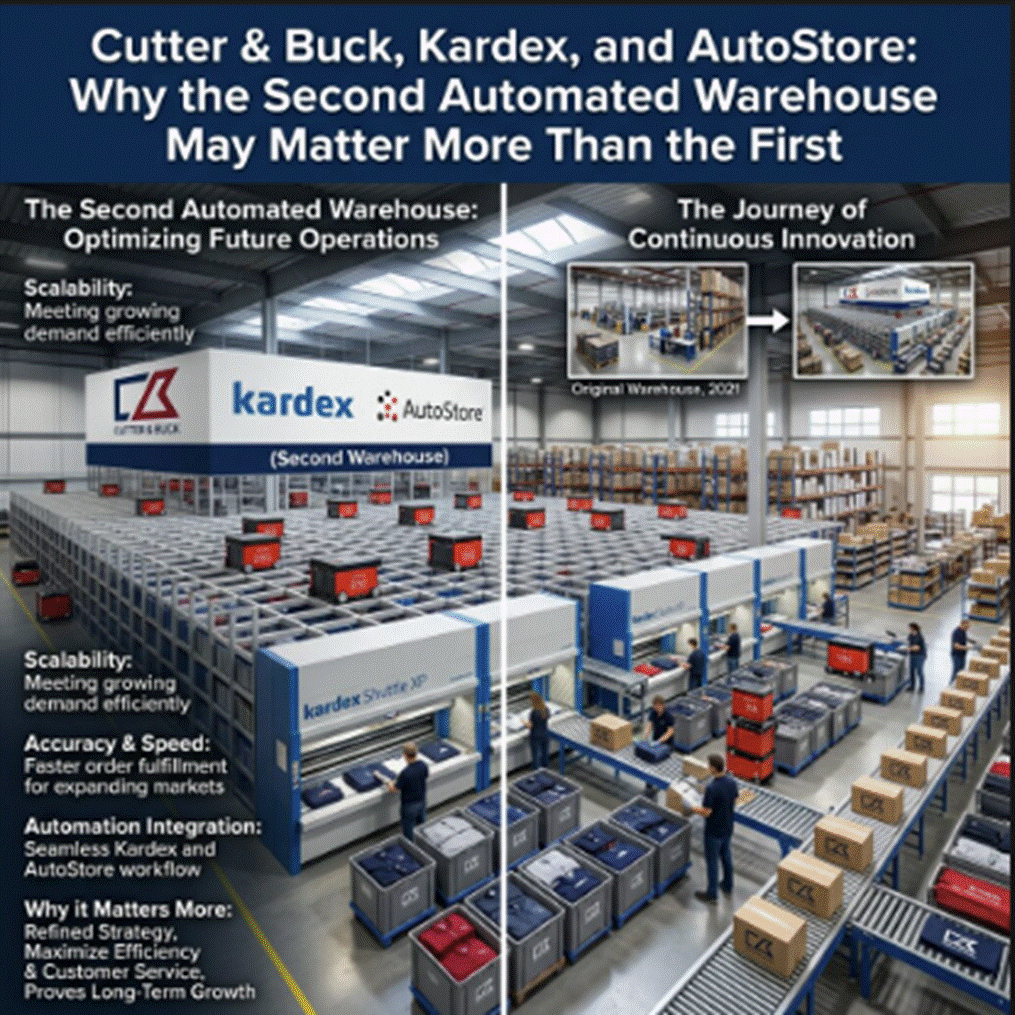
Warehouse automation announcements tend to celebrate the beginning. A new distribution center opens. Robots arrive. An automated storage and retrieval system goes live. Executives talk about throughput, labor savings, and future growth. But perhaps the more revealing warehouse automation story begins several years later, when a company decides whether to do it again. That is what makes the latest development involving Cutter & Buck, Kardex, and AutoStore particularly interesting.
Cutter & Buck, the apparel company, recently opened a new distribution center in Grand Prairie, Texas, featuring its second AutoStore goods-to-person system implemented by Kardex. The system includes 50,502 storage bins, 32 R5 Pro robots, and 13 ports, with Kardex FulfillX warehouse execution software coordinating the operation. It is designed for 1,256 bin presentations per hour, with simulation results averaging 1,284.
Those numbers are interesting. But the more important number may be two. This is not Cutter & Buck’s first attempt at warehouse automation. And that changes the story.
The First Warehouse Was the Experiment
Cutter & Buck began its earlier automation journey at its Renton, Washington, distribution center, where a Kardex-deployed AutoStore system went live in July 2023 with more than 34,000 bins and 54 robots. As the operation grew, the company later added another 9,962 storage bins along with additional ports and infrastructure. That evolution matters because the Texas facility was not designed simply by copying Renton.
According to Kardex, the companies used several years of operating experience, performance data, and lessons from the first deployment to shape the new distribution center around Cutter & Buck’s changing fulfillment requirements. This is where the story becomes much more useful for warehouse executives. There is an enormous difference between asking, “Should we automate?” and asking, “Knowing what we know after three years of automation, how should we automate the next building?” The second question may tell us far more about automation maturity.
What Happened After the Robots Arrived?
The publicly reported results from the original Renton deployment provide important context. In its case study, Kardex reports that Cutter & Buck reduced peak-season labor requirements by 60%, with 12 associates handling workloads that previously required 30. The company also reports that online orders can move from order to shipment in as little as 10 minutes.
Those are precisely the kinds of metrics automation buyers should be looking for. A warehouse can look highly automated without necessarily being highly productive. The business case ultimately depends on what happens to labor requirements, order cycle time, accuracy, capacity, service levels, and cost per order. That is especially important for Cutter & Buck because its fulfillment profile involves more than simply retrieving apparel from storage.
Nearly half of picking activity at the Renton operation supports embroidery workflows, according to the Kardex case study. That means products have to flow not just from storage to shipping, but through value-added customization processes as well. The Texas facility reflects that complexity. Its conveyor system connects AutoStore output with embroidery, order routing, Print & Apply, and shipping processes. In other words, the interesting technology story is no longer simply automated storage. It is automated flow.
The Second Warehouse Is the Real Vote of Confidence
Warehouse automation vendors understandably highlight initial customer wins. From an analyst perspective, however, repeat investment can be more revealing. A first implementation is based largely on expectations: projected throughput, anticipated labor savings, simulations, reference customers, and a calculated ROI. A second investment can be based on something much more valuable: the customer’s own operating data.
Cutter & Buck had several years to see how its first AutoStore deployment performed, expand that system as SKU requirements increased, identify where workflows could be improved, and then decide how to approach its next distribution center. It chose automation again. That does not mean every warehouse operator should reach the same conclusion. But it does suggest an important way customers should evaluate suppliers. Do not look only at how many new customers a technology provider wins. Look at how many existing customers expand, add robots or ports, increase storage capacity, or deploy the technology in another building. Those decisions occur after the sales presentation is over.
Modular Automation Changes the Economics
There is another important aspect of the Cutter & Buck example: scalability. At Grand Prairie, the number of robots and ports can be expanded independently as demand changes. That matters because one of the hardest parts of warehouse automation investment is forecasting the future.
Volumes change. SKU counts increase. Customer expectations shift. Peak seasons become more pronounced. A system designed perfectly for today’s demand may be poorly sized five years from now. Modular systems potentially give operators another way to think about ROI. Instead of asking whether they can perfectly forecast requirements over the entire investment horizon, they can ask whether the underlying automation architecture gives them enough room to respond when that forecast inevitably changes.
Cutter & Buck’s Renton facility illustrates that point particularly well. The original system was not frozen in its 2023 configuration. It subsequently expanded by nearly 10,000 additional bins as the business required more capacity. That ability to expand deserves more attention in automation business cases.
Stop Asking Only About Day-One Throughput
The warehouse automation market often focuses heavily on commissioning and initial throughput. Those metrics matter. But mature automation decisions should examine a longer timeline. What happened after year one?
Did the operation require more people than anticipated? What happened during peak? Could the system absorb additional SKUs? How expensive was maintenance? Could throughput be expanded without redesigning the facility? And most importantly, when the company needed another distribution center, did management choose the technology again? Research suggests these questions remain relevant. The 2026 Intralogistics Robotics Study surveyed 166 warehouse, distribution, and manufacturing professionals involved in robotic automation decisions. While 74% of organizations already deploying robots said they achieved their business goals, the study found a more complicated picture around cost and time to value.
That is an important distinction. Successful automation is not simply automation that works. It is automation capable of continuing to make economic sense as the operation changes.
Takeaway
The most interesting part of the Cutter & Buck, Kardex, and AutoStore story is not 32 robots or 50,502 bins. It is repeatability. Cutter & Buck implemented warehouse automation, operated it for several years, expanded it, learned from it, and then used those lessons to build another automated distribution operation. For companies evaluating AS/RS and goods-to-person technologies, that provides a useful lesson. Don’t just ask a supplier to show you its newest installation. Ask to see the customer that came back for the second one. That may be one of the clearest indicators that warehouse automation has moved from an impressive technology project to a sustainable operating strategy.
The post Cutter & Buck, Kardex, and AutoStore: Why the Second Automated Warehouse May Matter More Than the First appeared first on Logistics Viewpoints.
Non classé
Kinaxis Reports 22% SaaS Growth in Q3 2026, Raises Full-Year Outlook
Published
23 heures agoon
5 novembre 2026By
Kinaxis reported strong third-quarter 2026 financial results, with continued growth in cloud-based supply chain software, expanding customer adoption, and an increased full-year financial outlook. The results reflect sustained demand for supply chain planning and orchestration technology as manufacturers and distributors seek greater visibility, agility, and coordination across increasingly complex operations.
For the quarter ended September 30, Kinaxis generated $160.3 million in total revenue, an increase of 19% year-over-year. SaaS revenue rose 22% to $112.3 million, while annual recurring revenue (ARR) increased 19% to $483.9 million. Remaining performance obligations exceeded $1 billion, rising 21% from the prior year.
The company also reported $20.1 million in profit and adjusted EBITDA of $42 million, representing a 26% adjusted EBITDA margin.
Customer Growth Across Industries
Kinaxis continued to expand adoption of its Maestro supply chain orchestration platform across multiple industries and geographies.
New customer wins included Dr. Squatch, Sterlite Technologies, and WAI Global, along with organizations in luxury goods, biotechnology, and consumer health. The company also reported renewals and expansions involving Clariant and Sanofi.
More than 40 customer deployments went live during the quarter, including Asahi Beverages, with additional implementations across aviation, energy, healthcare, and manufacturing.
AI and Supply Chain Orchestration
Beyond its financial performance, Kinaxis is expanding its investment in AI-driven supply chain decision-making.
At Kinexions EMEA in October, the company introduced additional agentic AI capabilities, advanced inventory optimization, and enhancements to its Kinaxis Data Fabric. These developments are designed to help organizations move beyond traditional planning toward more connected and responsive operational execution.
The emphasis on AI-enabled workflows and improved inventory optimization reflects a broader industry transition toward systems that can identify changing conditions, evaluate alternatives, and support faster operational decisions.
Raised 2026 Outlook
Following its third consecutive quarter of outperformance, Kinaxis raised its full-year revenue guidance to $640 million–$650 million, increased its expected SaaS revenue growth to 20%–21%, and lifted its adjusted EBITDA margin outlook to 26.5%–27.5%.
The results highlight continued enterprise investment in supply chain planning technology, particularly platforms combining advanced optimization, real-time decision support, and emerging AI capabilities. For technology providers, the challenge increasingly extends beyond offering sophisticated planning tools to demonstrating how those capabilities translate into measurable operational improvements.
Read the full Kinaxis Q3 2026 financial results.
The post Kinaxis Reports 22% SaaS Growth in Q3 2026, Raises Full-Year Outlook appeared first on Logistics Viewpoints.

AI Is Reshaping the TMS Market. Deployment Will Determine the Winners.
Cutter & Buck, Kardex, and AutoStore: Why the Second Automated Warehouse May Matter More Than the First
Cutter & Buck, Kardex, and AutoStore: Why the Second Automated Warehouse May Matter More Than the First
Freightos Global Freight Outlook – September 2026
Container rates jump another $1k/FEU – but is demand peaking? – July 8, 2026 Update

Walmart and the New Supply Chain Reality: AI, Automation, and Resilience
Trending
- Non classé2 mois ago
Freightos Global Freight Outlook – September 2026
- Non classé4 mois ago
Container rates jump another $1k/FEU – but is demand peaking? – July 8, 2026 Update
-
 Non classé2 ans ago
Walmart and the New Supply Chain Reality: AI, Automation, and Resilience
-

 Non classé7 mois ago
Why Sulfuric Acid Is Emerging as a Supply Chain Constraint in Copper
- Non classé5 mois ago
Container rates starting to spike on peak season rush – June 2, 2026 Update
- Non classé1 an ago
13 Books Logistics And Supply Chain Experts Need To Read
- Non classé1 an ago
Ex-Asia ocean rates climb on GRIs, despite slowing demand – October 22, 2025 Update
- Non classé4 mois ago
LCL Shipping Cost Calculator: Calculate Air and Sea Shipping Freight Rates