
Non classé
Tesla’s Cybercab Is Really a Logistics Network

Published
2 mois agoon
By
Tesla’s Cybercab is being treated as an autonomous-vehicle story. That misses what may become the more interesting problem. Building a vehicle that can drive itself is one challenge. Building a national operating network that can finance, charge, maintain, clean, stage, reposition, and continuously utilize hundreds of thousands of those vehicles is another.
Tesla is beginning to acknowledge that distinction. The company is soliciting interest from potential partners in “Cybercab fleet vehicle purchasing” and “mobility hubs and infrastructure.” The implication is important: Tesla may not intend to own every vehicle, charging location, maintenance facility, and piece of supporting infrastructure required to build a national Robotaxi network. That moves Cybercab squarely into the world of logistics.
The Vehicle Is Only Part of the System
Autonomous driving concentrates attention on what happens inside the vehicle. At scale, however, the economics will increasingly be determined by what happens around it. A Cybercab waiting to charge is not generating revenue. Neither is one sitting in the wrong part of a city, waiting for cleaning, undergoing maintenance, or parked because demand has temporarily disappeared.
Once autonomous fleets grow large enough, Tesla will face many of the same questions transportation and logistics companies have dealt with for decades. Where should assets be positioned? How much capacity is required? How quickly can assets be turned? Where are the bottlenecks, and how much idle time can the economics tolerate?
Removing the driver changes the cost structure dramatically, but it does not eliminate fleet economics. In some ways, it makes asset utilization even more important because a larger share of the business case shifts toward maximizing the productive use of the physical asset.
Tesla Could Separate the Platform From the Assets
There is another potentially significant piece of Tesla’s approach. The company could own the intelligence layer while other businesses own portions of the physical network. Tesla would manufacture the Cybercab, provide the autonomous-driving technology, control the Robotaxi application, assign rides, establish operating standards, and coordinate the network. Independent operators could provide capital, purchase vehicles, operate local fleets, and potentially develop charging and mobility hubs.
The comparison with Amazon’s Delivery Service Partner model is not exact, but the architecture is familiar. Amazon built an enormous last-mile delivery network without directly owning every vehicle or employing every driver. It controls much of the demand, technology, process, and orchestration while independent businesses provide substantial amounts of physical operating capacity.
Tesla could potentially do something similar with autonomous mobility. That would allow the company to scale the network using outside capital while retaining control of the platform. For Tesla, that could be extraordinarily powerful. For the entrepreneurs supplying the capital, it could be considerably more complicated.
Utilization Will Determine the Economics
Assume an entrepreneur eventually buys 20 or 30 Cybercabs. The business case will not be determined primarily by how impressive the autonomous-driving system is. It will depend on vehicle acquisition costs, financing, insurance, electricity, maintenance, cleaning, facility costs, downtime, Tesla’s share of revenue, and—above all—utilization.
Transportation companies know this equation well. A truck can contain exceptional technology and still be a bad asset if it spends too much time sitting. The same will be true for autonomous vehicles. Cybercab could remove one of the largest operating expenses in passenger transportation—the driver—but the remaining asset still has to earn enough revenue across enough hours of the day to generate an acceptable return on invested capital.
That makes orchestration central to the business model. Tesla will need to predict where demand will develop, position vehicles before that demand arrives, balance charging requirements against passenger demand, schedule maintenance with minimal disruption, and continuously redistribute capacity across the network. At that point, this starts looking less like a taxi operation and more like a highly automated transportation network.
Mobility Hubs Become Logistics Facilities
Tesla’s reference to “mobility hubs and infrastructure” may ultimately be as important as Cybercab itself. A large autonomous fleet needs somewhere to go. Vehicles need charging, cleaning, inspection, maintenance, tire service, repairs, and occasionally temporary storage. They will also need to be staged near predicted demand.
At sufficient scale, these mobility hubs effectively become fleet terminals. Hundreds of vehicles could arrive and depart throughout the day. Charging capacity must be allocated, maintenance must be prioritized, and vehicles needed near peak-demand areas may have to be returned to service ahead of others. Electricity prices could even influence when charging occurs.
The hub therefore becomes another node in the network that must be optimized. This is exactly where artificial intelligence begins moving beyond the vehicle. ARC’s AI in the Supply Chain research describes a future based on connected intelligence: systems that sense changing conditions, reason across constraints, coordinate decisions, and increasingly act across interconnected operational environments.
Cybercab could become a very visible example of that architecture. The AI is not simply driving the car. Eventually, AI may be determining which car should move, where it should move, whether it should take a passenger or charge, when maintenance should occur, and how thousands of vehicles should be balanced across a metropolitan network. That is a logistics control problem.
The Network May Matter More Than the Car
This is where Cybercab becomes strategically interesting. Tesla may sell vehicles, but the network coordinating those vehicles could ultimately be much more valuable. The platform knows passenger demand, controls dispatching, and knows vehicle location, battery state, expected trip duration, charging availability, and potentially maintenance condition. As the system grows, every trip generates additional information that can improve future decisions.
More vehicles increase coverage. Better coverage attracts more passengers. More trips create better operating data, and better operating data improves positioning and utilization. Improved utilization, in turn, makes owning additional vehicles more attractive.
That is the network effect Tesla wants. If outside operators finance much of the vehicle fleet and supporting infrastructure, Tesla could potentially accelerate that effect without financing the entire physical network itself. The strategic prize would no longer be simply an autonomous car. It would be a transportation operating system sitting above a distributed fleet of physical assets.
But Someone Still Owns the Risk
There is an obvious problem for prospective Cybercab operators: Tesla would likely control many of the variables determining their economics. The platform could influence pricing, revenue sharing, dispatch priority, operating requirements, software charges, and potentially the balance between Tesla-owned and independently owned vehicles.
That is also familiar territory in logistics. Independent contractors and small transportation companies frequently operate inside networks controlled by much larger platforms. The platform brings demand and infrastructure, but it also establishes many of the rules.
Before Cybercab becomes a meaningful entrepreneurial opportunity, operators will need to understand the actual economics: vehicle price, revenue split, utilization expectations, financing, insurance, maintenance responsibility, charging costs, and contractual protections. Until then, this remains an interesting architecture rather than a proven business model.
The Bigger Logistics Story
Tesla still has significant hurdles ahead. Cybercab deployments remain limited, production must scale, regulatory questions remain, and the economics of the partner model have not yet been disclosed. But the direction is worth watching because autonomous transportation is often described too narrowly as the elimination of the driver.
The larger change may be the emergence of transportation networks in which software increasingly separates intelligence from physical asset ownership. Central platforms could control demand, routing, optimization, and customer interaction while distributed operators supply capital and physical capacity. That architecture already exists in pieces across logistics.
Tesla may be preparing to apply it to autonomous mobility at enormous scale. If it succeeds, Cybercab will be more than a self-driving taxi. It will be a logistics network that happens to move people.
The post Tesla’s Cybercab Is Really a Logistics Network appeared first on Logistics Viewpoints.
You may like
Non classé
Cutter & Buck, Kardex, and AutoStore: Why the Second Automated Warehouse May Matter More Than the First
Published
8 heures agoon
5 novembre 2026By
Warehouse automation announcements tend to celebrate the beginning. A new distribution center opens. Robots arrive. An automated storage and retrieval system goes live. Executives talk about throughput, labor savings, and future growth. But perhaps the more revealing warehouse automation story begins several years later, when a company decides whether to do it again. That is what makes the latest development involving Cutter & Buck, Kardex, and AutoStore particularly interesting.
Cutter & Buck, the apparel company, recently opened a new distribution center in Grand Prairie, Texas, featuring its second AutoStore goods-to-person system implemented by Kardex. The system includes 50,502 storage bins, 32 R5 Pro robots, and 13 ports, with Kardex FulfillX warehouse execution software coordinating the operation. It is designed for 1,256 bin presentations per hour, with simulation results averaging 1,284.
Those numbers are interesting. But the more important number may be two. This is not Cutter & Buck’s first attempt at warehouse automation. And that changes the story.
The First Warehouse Was the Experiment
Cutter & Buck began its earlier automation journey at its Renton, Washington, distribution center, where a Kardex-deployed AutoStore system went live in July 2023 with more than 34,000 bins and 54 robots. As the operation grew, the company later added another 9,962 storage bins along with additional ports and infrastructure. That evolution matters because the Texas facility was not designed simply by copying Renton.
According to Kardex, the companies used several years of operating experience, performance data, and lessons from the first deployment to shape the new distribution center around Cutter & Buck’s changing fulfillment requirements. This is where the story becomes much more useful for warehouse executives. There is an enormous difference between asking, “Should we automate?” and asking, “Knowing what we know after three years of automation, how should we automate the next building?” The second question may tell us far more about automation maturity.
What Happened After the Robots Arrived?
The publicly reported results from the original Renton deployment provide important context. In its case study, Kardex reports that Cutter & Buck reduced peak-season labor requirements by 60%, with 12 associates handling workloads that previously required 30. The company also reports that online orders can move from order to shipment in as little as 10 minutes.
Those are precisely the kinds of metrics automation buyers should be looking for. A warehouse can look highly automated without necessarily being highly productive. The business case ultimately depends on what happens to labor requirements, order cycle time, accuracy, capacity, service levels, and cost per order. That is especially important for Cutter & Buck because its fulfillment profile involves more than simply retrieving apparel from storage.
Nearly half of picking activity at the Renton operation supports embroidery workflows, according to the Kardex case study. That means products have to flow not just from storage to shipping, but through value-added customization processes as well. The Texas facility reflects that complexity. Its conveyor system connects AutoStore output with embroidery, order routing, Print & Apply, and shipping processes. In other words, the interesting technology story is no longer simply automated storage. It is automated flow.
The Second Warehouse Is the Real Vote of Confidence
Warehouse automation vendors understandably highlight initial customer wins. From an analyst perspective, however, repeat investment can be more revealing. A first implementation is based largely on expectations: projected throughput, anticipated labor savings, simulations, reference customers, and a calculated ROI. A second investment can be based on something much more valuable: the customer’s own operating data.
Cutter & Buck had several years to see how its first AutoStore deployment performed, expand that system as SKU requirements increased, identify where workflows could be improved, and then decide how to approach its next distribution center. It chose automation again. That does not mean every warehouse operator should reach the same conclusion. But it does suggest an important way customers should evaluate suppliers. Do not look only at how many new customers a technology provider wins. Look at how many existing customers expand, add robots or ports, increase storage capacity, or deploy the technology in another building. Those decisions occur after the sales presentation is over.
Modular Automation Changes the Economics
There is another important aspect of the Cutter & Buck example: scalability. At Grand Prairie, the number of robots and ports can be expanded independently as demand changes. That matters because one of the hardest parts of warehouse automation investment is forecasting the future.
Volumes change. SKU counts increase. Customer expectations shift. Peak seasons become more pronounced. A system designed perfectly for today’s demand may be poorly sized five years from now. Modular systems potentially give operators another way to think about ROI. Instead of asking whether they can perfectly forecast requirements over the entire investment horizon, they can ask whether the underlying automation architecture gives them enough room to respond when that forecast inevitably changes.
Cutter & Buck’s Renton facility illustrates that point particularly well. The original system was not frozen in its 2023 configuration. It subsequently expanded by nearly 10,000 additional bins as the business required more capacity. That ability to expand deserves more attention in automation business cases.
Stop Asking Only About Day-One Throughput
The warehouse automation market often focuses heavily on commissioning and initial throughput. Those metrics matter. But mature automation decisions should examine a longer timeline. What happened after year one?
Did the operation require more people than anticipated? What happened during peak? Could the system absorb additional SKUs? How expensive was maintenance? Could throughput be expanded without redesigning the facility? And most importantly, when the company needed another distribution center, did management choose the technology again? Research suggests these questions remain relevant. The 2026 Intralogistics Robotics Study surveyed 166 warehouse, distribution, and manufacturing professionals involved in robotic automation decisions. While 74% of organizations already deploying robots said they achieved their business goals, the study found a more complicated picture around cost and time to value.
That is an important distinction. Successful automation is not simply automation that works. It is automation capable of continuing to make economic sense as the operation changes.
Takeaway
The most interesting part of the Cutter & Buck, Kardex, and AutoStore story is not 32 robots or 50,502 bins. It is repeatability. Cutter & Buck implemented warehouse automation, operated it for several years, expanded it, learned from it, and then used those lessons to build another automated distribution operation. For companies evaluating AS/RS and goods-to-person technologies, that provides a useful lesson. Don’t just ask a supplier to show you its newest installation. Ask to see the customer that came back for the second one. That may be one of the clearest indicators that warehouse automation has moved from an impressive technology project to a sustainable operating strategy.
The post Cutter & Buck, Kardex, and AutoStore: Why the Second Automated Warehouse May Matter More Than the First appeared first on Logistics Viewpoints.
Non classé
Cutter & Buck, Kardex, and AutoStore: Why the Second Automated Warehouse May Matter More Than the First
Published
8 heures agoon
5 novembre 2026By
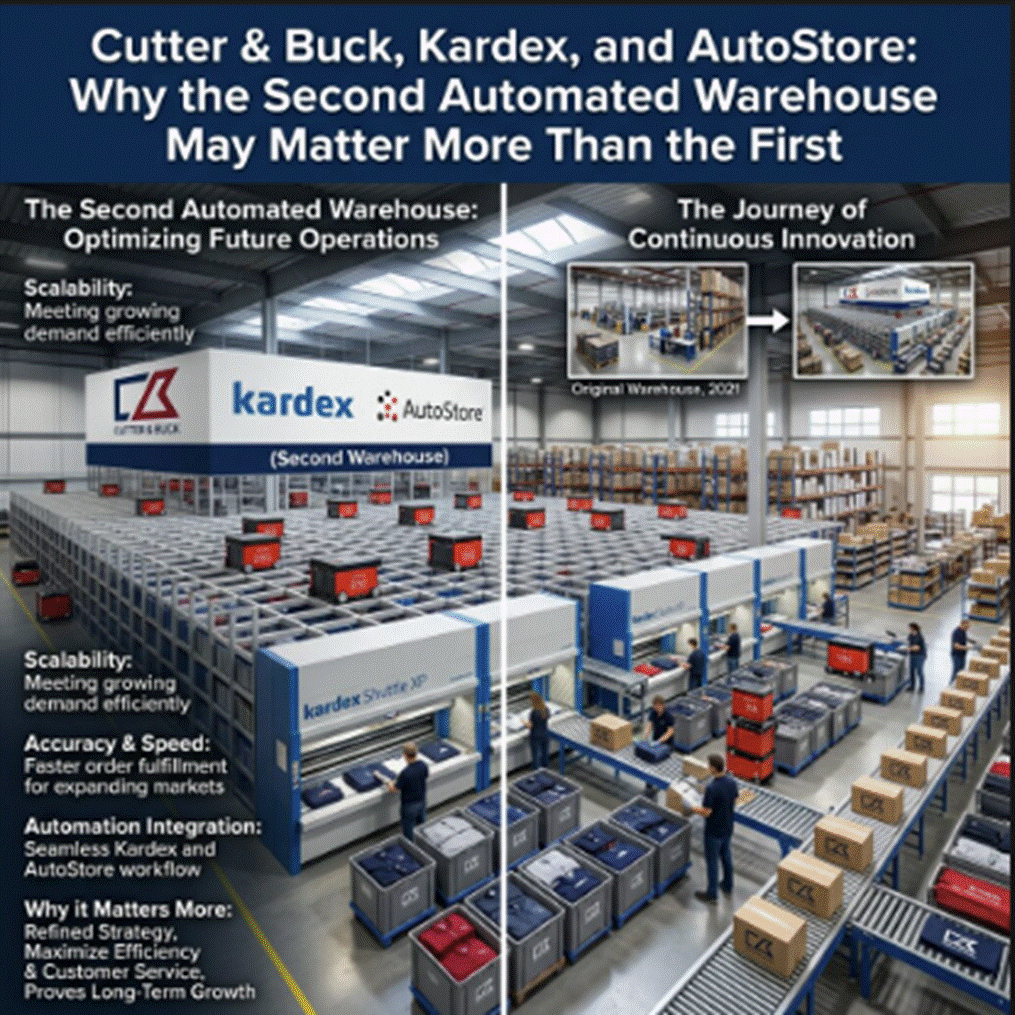
Warehouse automation announcements tend to celebrate the beginning. A new distribution center opens. Robots arrive. An automated storage and retrieval system goes live. Executives talk about throughput, labor savings, and future growth. But perhaps the more revealing warehouse automation story begins several years later, when a company decides whether to do it again. That is what makes the latest development involving Cutter & Buck, Kardex, and AutoStore particularly interesting.
Cutter & Buck, the apparel company, recently opened a new distribution center in Grand Prairie, Texas, featuring its second AutoStore goods-to-person system implemented by Kardex. The system includes 50,502 storage bins, 32 R5 Pro robots, and 13 ports, with Kardex FulfillX warehouse execution software coordinating the operation. It is designed for 1,256 bin presentations per hour, with simulation results averaging 1,284.
Those numbers are interesting. But the more important number may be two. This is not Cutter & Buck’s first attempt at warehouse automation. And that changes the story.
The First Warehouse Was the Experiment
Cutter & Buck began its earlier automation journey at its Renton, Washington, distribution center, where a Kardex-deployed AutoStore system went live in July 2023 with more than 34,000 bins and 54 robots. As the operation grew, the company later added another 9,962 storage bins along with additional ports and infrastructure. That evolution matters because the Texas facility was not designed simply by copying Renton.
According to Kardex, the companies used several years of operating experience, performance data, and lessons from the first deployment to shape the new distribution center around Cutter & Buck’s changing fulfillment requirements. This is where the story becomes much more useful for warehouse executives. There is an enormous difference between asking, “Should we automate?” and asking, “Knowing what we know after three years of automation, how should we automate the next building?” The second question may tell us far more about automation maturity.
What Happened After the Robots Arrived?
The publicly reported results from the original Renton deployment provide important context. In its case study, Kardex reports that Cutter & Buck reduced peak-season labor requirements by 60%, with 12 associates handling workloads that previously required 30. The company also reports that online orders can move from order to shipment in as little as 10 minutes.
Those are precisely the kinds of metrics automation buyers should be looking for. A warehouse can look highly automated without necessarily being highly productive. The business case ultimately depends on what happens to labor requirements, order cycle time, accuracy, capacity, service levels, and cost per order. That is especially important for Cutter & Buck because its fulfillment profile involves more than simply retrieving apparel from storage.
Nearly half of picking activity at the Renton operation supports embroidery workflows, according to the Kardex case study. That means products have to flow not just from storage to shipping, but through value-added customization processes as well. The Texas facility reflects that complexity. Its conveyor system connects AutoStore output with embroidery, order routing, Print & Apply, and shipping processes. In other words, the interesting technology story is no longer simply automated storage. It is automated flow.
The Second Warehouse Is the Real Vote of Confidence
Warehouse automation vendors understandably highlight initial customer wins. From an analyst perspective, however, repeat investment can be more revealing. A first implementation is based largely on expectations: projected throughput, anticipated labor savings, simulations, reference customers, and a calculated ROI. A second investment can be based on something much more valuable: the customer’s own operating data.
Cutter & Buck had several years to see how its first AutoStore deployment performed, expand that system as SKU requirements increased, identify where workflows could be improved, and then decide how to approach its next distribution center. It chose automation again. That does not mean every warehouse operator should reach the same conclusion. But it does suggest an important way customers should evaluate suppliers. Do not look only at how many new customers a technology provider wins. Look at how many existing customers expand, add robots or ports, increase storage capacity, or deploy the technology in another building. Those decisions occur after the sales presentation is over.
Modular Automation Changes the Economics
There is another important aspect of the Cutter & Buck example: scalability. At Grand Prairie, the number of robots and ports can be expanded independently as demand changes. That matters because one of the hardest parts of warehouse automation investment is forecasting the future.
Volumes change. SKU counts increase. Customer expectations shift. Peak seasons become more pronounced. A system designed perfectly for today’s demand may be poorly sized five years from now. Modular systems potentially give operators another way to think about ROI. Instead of asking whether they can perfectly forecast requirements over the entire investment horizon, they can ask whether the underlying automation architecture gives them enough room to respond when that forecast inevitably changes.
Cutter & Buck’s Renton facility illustrates that point particularly well. The original system was not frozen in its 2023 configuration. It subsequently expanded by nearly 10,000 additional bins as the business required more capacity. That ability to expand deserves more attention in automation business cases.
Stop Asking Only About Day-One Throughput
The warehouse automation market often focuses heavily on commissioning and initial throughput. Those metrics matter. But mature automation decisions should examine a longer timeline. What happened after year one?
Did the operation require more people than anticipated? What happened during peak? Could the system absorb additional SKUs? How expensive was maintenance? Could throughput be expanded without redesigning the facility? And most importantly, when the company needed another distribution center, did management choose the technology again? Research suggests these questions remain relevant. The 2026 Intralogistics Robotics Study surveyed 166 warehouse, distribution, and manufacturing professionals involved in robotic automation decisions. While 74% of organizations already deploying robots said they achieved their business goals, the study found a more complicated picture around cost and time to value.
That is an important distinction. Successful automation is not simply automation that works. It is automation capable of continuing to make economic sense as the operation changes.
Takeaway
The most interesting part of the Cutter & Buck, Kardex, and AutoStore story is not 32 robots or 50,502 bins. It is repeatability. Cutter & Buck implemented warehouse automation, operated it for several years, expanded it, learned from it, and then used those lessons to build another automated distribution operation. For companies evaluating AS/RS and goods-to-person technologies, that provides a useful lesson. Don’t just ask a supplier to show you its newest installation. Ask to see the customer that came back for the second one. That may be one of the clearest indicators that warehouse automation has moved from an impressive technology project to a sustainable operating strategy.
The post Cutter & Buck, Kardex, and AutoStore: Why the Second Automated Warehouse May Matter More Than the First appeared first on Logistics Viewpoints.
Non classé
Kinaxis Reports 22% SaaS Growth in Q3 2026, Raises Full-Year Outlook
Published
10 heures agoon
5 novembre 2026By
Kinaxis reported strong third-quarter 2026 financial results, with continued growth in cloud-based supply chain software, expanding customer adoption, and an increased full-year financial outlook. The results reflect sustained demand for supply chain planning and orchestration technology as manufacturers and distributors seek greater visibility, agility, and coordination across increasingly complex operations.
For the quarter ended September 30, Kinaxis generated $160.3 million in total revenue, an increase of 19% year-over-year. SaaS revenue rose 22% to $112.3 million, while annual recurring revenue (ARR) increased 19% to $483.9 million. Remaining performance obligations exceeded $1 billion, rising 21% from the prior year.
The company also reported $20.1 million in profit and adjusted EBITDA of $42 million, representing a 26% adjusted EBITDA margin.
Customer Growth Across Industries
Kinaxis continued to expand adoption of its Maestro supply chain orchestration platform across multiple industries and geographies.
New customer wins included Dr. Squatch, Sterlite Technologies, and WAI Global, along with organizations in luxury goods, biotechnology, and consumer health. The company also reported renewals and expansions involving Clariant and Sanofi.
More than 40 customer deployments went live during the quarter, including Asahi Beverages, with additional implementations across aviation, energy, healthcare, and manufacturing.
AI and Supply Chain Orchestration
Beyond its financial performance, Kinaxis is expanding its investment in AI-driven supply chain decision-making.
At Kinexions EMEA in October, the company introduced additional agentic AI capabilities, advanced inventory optimization, and enhancements to its Kinaxis Data Fabric. These developments are designed to help organizations move beyond traditional planning toward more connected and responsive operational execution.
The emphasis on AI-enabled workflows and improved inventory optimization reflects a broader industry transition toward systems that can identify changing conditions, evaluate alternatives, and support faster operational decisions.
Raised 2026 Outlook
Following its third consecutive quarter of outperformance, Kinaxis raised its full-year revenue guidance to $640 million–$650 million, increased its expected SaaS revenue growth to 20%–21%, and lifted its adjusted EBITDA margin outlook to 26.5%–27.5%.
The results highlight continued enterprise investment in supply chain planning technology, particularly platforms combining advanced optimization, real-time decision support, and emerging AI capabilities. For technology providers, the challenge increasingly extends beyond offering sophisticated planning tools to demonstrating how those capabilities translate into measurable operational improvements.
Read the full Kinaxis Q3 2026 financial results.
The post Kinaxis Reports 22% SaaS Growth in Q3 2026, Raises Full-Year Outlook appeared first on Logistics Viewpoints.

Cutter & Buck, Kardex, and AutoStore: Why the Second Automated Warehouse May Matter More Than the First
Cutter & Buck, Kardex, and AutoStore: Why the Second Automated Warehouse May Matter More Than the First
Kinaxis Reports 22% SaaS Growth in Q3 2026, Raises Full-Year Outlook
Freightos Global Freight Outlook – September 2026
Container rates jump another $1k/FEU – but is demand peaking? – July 8, 2026 Update

Walmart and the New Supply Chain Reality: AI, Automation, and Resilience
Trending
- Non classé2 mois ago
Freightos Global Freight Outlook – September 2026
- Non classé4 mois ago
Container rates jump another $1k/FEU – but is demand peaking? – July 8, 2026 Update
-
 Non classé2 ans ago
Walmart and the New Supply Chain Reality: AI, Automation, and Resilience
-

 Non classé7 mois ago
Why Sulfuric Acid Is Emerging as a Supply Chain Constraint in Copper
- Non classé5 mois ago
Container rates starting to spike on peak season rush – June 2, 2026 Update
- Non classé1 an ago
13 Books Logistics And Supply Chain Experts Need To Read
- Non classé1 an ago
Ex-Asia ocean rates climb on GRIs, despite slowing demand – October 22, 2025 Update
- Non classé4 mois ago
LCL Shipping Cost Calculator: Calculate Air and Sea Shipping Freight Rates