
Non classé
Drone Warfare Is Exposing a New Critical-Minerals Logistics Problem

Published
2 mois agoon
By
Some of the most consequential logistics dependencies in the world are almost invisible. A container of steel is visible. A shipment of automobiles is visible. A tanker carrying oil is visible. Their scale makes their importance obvious.
Germanium is different.
The amount embedded in an individual system can be measured in grams. Yet germanium is used in technologies where losing access to a tiny quantity of material can prevent a much more valuable product from being manufactured at all. That is exactly the kind of dependency traditional logistics metrics tend to underestimate.
The war in Ukraine is now providing a particularly dramatic demonstration. Recent estimates cited by BMO Capital Markets suggest that roughly 15 million drones deployed in the conflict during 2026 could consume approximately 15 metric tons of germanium if an average system contains around one gram. Against estimated global demand of roughly 343 tons, that would represent more than 4 percent of annual demand from an application that barely existed at this scale several years ago.
The number is interesting. The logistics lesson is more important.
A Gram That Enables the System
Germanium is a brittle, grayish-white semiconductor metal with a peculiar combination of optical and electrical properties. Those properties make it valuable in fiber-optic communications, infrared optics, semiconductor applications, specialized solar cells and radiation detectors. In infrared systems, germanium can transmit wavelengths that ordinary glass cannot, making it useful in thermal imaging and night-vision equipment.
That makes germanium relevant well beyond drones. It sits inside telecommunications infrastructure, sensors, defense systems, advanced electronics and portions of the space economy. The problem is that the amount of material required for any individual system can be deceptively small.
Traditional materials management tends to focus naturally on large flows: steel, aluminum, plastics, batteries, packaging, fuel. These consume enormous volumes, occupy warehouse capacity and generate obvious transportation requirements. But volume and operational criticality are not the same thing. One gram of material can have almost no impact on transportation cost and an enormous impact on production continuity. If a manufacturer has 99.9 percent of the material required to build a sensor but lacks the tiny quantity of germanium required for an infrared component, it does not have 99.9 percent of a finished product.
It has zero finished products.
The Byproduct Problem
Germanium presents another logistics complication: production cannot necessarily respond quickly to higher prices. It is principally recovered as a byproduct of zinc processing, with additional recovery possible from certain coal ashes and secondary sources. That means germanium output is partly constrained by the economics and processing infrastructure of another material. A sharp increase in germanium demand does not automatically produce a corresponding increase in mined germanium supply. This creates a different kind of supply elasticity problem.
If demand suddenly rises for a conventional commodity with substantial dedicated production capacity, higher prices can eventually stimulate additional production. For a byproduct mineral, the response may depend on whether sufficient host material is being mined, whether processors possess recovery capability, whether refining capacity exists and whether the economics justify extracting relatively small concentrations. The logistics chain is therefore longer than the material itself suggests.
Germanium does not simply move from mine to factory. It can depend on zinc production, concentrate flows, smelting economics, recovery technology, refining capacity, geopolitical access and the facilities capable of producing the specialized form required by the final application.
And concentration matters. USGS reports that China remained the leading global producer and exporter of germanium metal in 2025. China introduced export licensing in 2023 and subsequently banned exports of germanium to the United States in December 2024, while reported Chinese exports declined sharply. This turns an obscure material dependency into a geopolitical one.
The Logistics Network Is a Graph
Most companies still understand their materials network primarily through tiers. Tier-one supplier. Tier-two supplier. Tier-three supplier. That structure is useful, but it can hide the real dependency.
A better representation increasingly looks like a graph: Germanium -> processor -> infrared component -> sensor -> finished system -> manufacturing facility -> distribution network -> customer. Now add alternate processors, substitute components, national boundaries, export controls, transportation lanes, inventory buffers and production lead times. The real question is no longer, “Who supplies us with germanium?” It is, “Which finished products, customers and operational commitments become impossible if this node disappears?”
That is a much more important question.
AI and modern graph technologies should eventually make this type of multi-hop dependency analysis far more practical. Instead of building static supplier maps, logistics organizations can model how materials, components, facilities, regulations and customers interact and then calculate where small upstream disruptions create disproportionately large downstream consequences. The most dangerous node in a network may not be the largest. It may be the node with no substitute.
Resilience Begins With Engineering
The response to these dependencies cannot simply be “hold more inventory.” Inventory is one resilience mechanism, but critical-material exposure ultimately requires engineering choices as well.
Can the component be redesigned to use less germanium? Can another optical material substitute? Can germanium be recovered through recycling? Can alternative refining capacity be qualified? Can specifications be changed without degrading system performance? Can products be redesigned around components with more geographically diverse inputs?
These are engineering questions, but they are also logistics questions because product architecture determines logistics architecture. A product designed around a single highly concentrated material creates one type of logistics network. A product designed around interchangeable inputs creates another. The Department of Defense has already demonstrated part of this logic through efforts to recycle germanium lenses from decommissioned equipment, while U.S. industrial initiatives are attempting to expand domestic recovery and refining capacity. Those efforts reflect a broader realization: resilience can be engineered upstream rather than purchased entirely through inventory downstream.
Tiny Flows, Large Consequences
The germanium story is not really about germanium. It is about a class of dependencies that will become more important as products become more technologically sophisticated.
Advanced manufacturing increasingly depends on small quantities of highly specialized materials. Semiconductors, sensors, robotics, communications equipment, batteries, aerospace systems and defense platforms contain materials whose physical volume bears little relationship to their economic importance. Logistics organizations therefore need a different way to rank risk.
Annual spend is not enough. Shipment volume is not enough. Supplier count is not enough. The more useful question is what happens to the system when the flow disappears.
A component that costs $20 but stops a $200,000 machine deserves more attention than its purchasing value suggests. A material measured in kilograms that controls billions of dollars of downstream production deserves more attention than its freight volume suggests.
That is the emerging critical-materials problem.
The importance of a flow is not determined by its volume. It is determined by what stops moving when that flow disappears.
It may weigh one gram.
The post Drone Warfare Is Exposing a New Critical-Minerals Logistics Problem appeared first on Logistics Viewpoints.
You may like
Non classé
Cutter & Buck, Kardex, and AutoStore: Why the Second Automated Warehouse May Matter More Than the First
Published
8 heures agoon
5 novembre 2026By
Warehouse automation announcements tend to celebrate the beginning. A new distribution center opens. Robots arrive. An automated storage and retrieval system goes live. Executives talk about throughput, labor savings, and future growth. But perhaps the more revealing warehouse automation story begins several years later, when a company decides whether to do it again. That is what makes the latest development involving Cutter & Buck, Kardex, and AutoStore particularly interesting.
Cutter & Buck, the apparel company, recently opened a new distribution center in Grand Prairie, Texas, featuring its second AutoStore goods-to-person system implemented by Kardex. The system includes 50,502 storage bins, 32 R5 Pro robots, and 13 ports, with Kardex FulfillX warehouse execution software coordinating the operation. It is designed for 1,256 bin presentations per hour, with simulation results averaging 1,284.
Those numbers are interesting. But the more important number may be two. This is not Cutter & Buck’s first attempt at warehouse automation. And that changes the story.
The First Warehouse Was the Experiment
Cutter & Buck began its earlier automation journey at its Renton, Washington, distribution center, where a Kardex-deployed AutoStore system went live in July 2023 with more than 34,000 bins and 54 robots. As the operation grew, the company later added another 9,962 storage bins along with additional ports and infrastructure. That evolution matters because the Texas facility was not designed simply by copying Renton.
According to Kardex, the companies used several years of operating experience, performance data, and lessons from the first deployment to shape the new distribution center around Cutter & Buck’s changing fulfillment requirements. This is where the story becomes much more useful for warehouse executives. There is an enormous difference between asking, “Should we automate?” and asking, “Knowing what we know after three years of automation, how should we automate the next building?” The second question may tell us far more about automation maturity.
What Happened After the Robots Arrived?
The publicly reported results from the original Renton deployment provide important context. In its case study, Kardex reports that Cutter & Buck reduced peak-season labor requirements by 60%, with 12 associates handling workloads that previously required 30. The company also reports that online orders can move from order to shipment in as little as 10 minutes.
Those are precisely the kinds of metrics automation buyers should be looking for. A warehouse can look highly automated without necessarily being highly productive. The business case ultimately depends on what happens to labor requirements, order cycle time, accuracy, capacity, service levels, and cost per order. That is especially important for Cutter & Buck because its fulfillment profile involves more than simply retrieving apparel from storage.
Nearly half of picking activity at the Renton operation supports embroidery workflows, according to the Kardex case study. That means products have to flow not just from storage to shipping, but through value-added customization processes as well. The Texas facility reflects that complexity. Its conveyor system connects AutoStore output with embroidery, order routing, Print & Apply, and shipping processes. In other words, the interesting technology story is no longer simply automated storage. It is automated flow.
The Second Warehouse Is the Real Vote of Confidence
Warehouse automation vendors understandably highlight initial customer wins. From an analyst perspective, however, repeat investment can be more revealing. A first implementation is based largely on expectations: projected throughput, anticipated labor savings, simulations, reference customers, and a calculated ROI. A second investment can be based on something much more valuable: the customer’s own operating data.
Cutter & Buck had several years to see how its first AutoStore deployment performed, expand that system as SKU requirements increased, identify where workflows could be improved, and then decide how to approach its next distribution center. It chose automation again. That does not mean every warehouse operator should reach the same conclusion. But it does suggest an important way customers should evaluate suppliers. Do not look only at how many new customers a technology provider wins. Look at how many existing customers expand, add robots or ports, increase storage capacity, or deploy the technology in another building. Those decisions occur after the sales presentation is over.
Modular Automation Changes the Economics
There is another important aspect of the Cutter & Buck example: scalability. At Grand Prairie, the number of robots and ports can be expanded independently as demand changes. That matters because one of the hardest parts of warehouse automation investment is forecasting the future.
Volumes change. SKU counts increase. Customer expectations shift. Peak seasons become more pronounced. A system designed perfectly for today’s demand may be poorly sized five years from now. Modular systems potentially give operators another way to think about ROI. Instead of asking whether they can perfectly forecast requirements over the entire investment horizon, they can ask whether the underlying automation architecture gives them enough room to respond when that forecast inevitably changes.
Cutter & Buck’s Renton facility illustrates that point particularly well. The original system was not frozen in its 2023 configuration. It subsequently expanded by nearly 10,000 additional bins as the business required more capacity. That ability to expand deserves more attention in automation business cases.
Stop Asking Only About Day-One Throughput
The warehouse automation market often focuses heavily on commissioning and initial throughput. Those metrics matter. But mature automation decisions should examine a longer timeline. What happened after year one?
Did the operation require more people than anticipated? What happened during peak? Could the system absorb additional SKUs? How expensive was maintenance? Could throughput be expanded without redesigning the facility? And most importantly, when the company needed another distribution center, did management choose the technology again? Research suggests these questions remain relevant. The 2026 Intralogistics Robotics Study surveyed 166 warehouse, distribution, and manufacturing professionals involved in robotic automation decisions. While 74% of organizations already deploying robots said they achieved their business goals, the study found a more complicated picture around cost and time to value.
That is an important distinction. Successful automation is not simply automation that works. It is automation capable of continuing to make economic sense as the operation changes.
Takeaway
The most interesting part of the Cutter & Buck, Kardex, and AutoStore story is not 32 robots or 50,502 bins. It is repeatability. Cutter & Buck implemented warehouse automation, operated it for several years, expanded it, learned from it, and then used those lessons to build another automated distribution operation. For companies evaluating AS/RS and goods-to-person technologies, that provides a useful lesson. Don’t just ask a supplier to show you its newest installation. Ask to see the customer that came back for the second one. That may be one of the clearest indicators that warehouse automation has moved from an impressive technology project to a sustainable operating strategy.
The post Cutter & Buck, Kardex, and AutoStore: Why the Second Automated Warehouse May Matter More Than the First appeared first on Logistics Viewpoints.
Non classé
Cutter & Buck, Kardex, and AutoStore: Why the Second Automated Warehouse May Matter More Than the First
Published
8 heures agoon
5 novembre 2026By
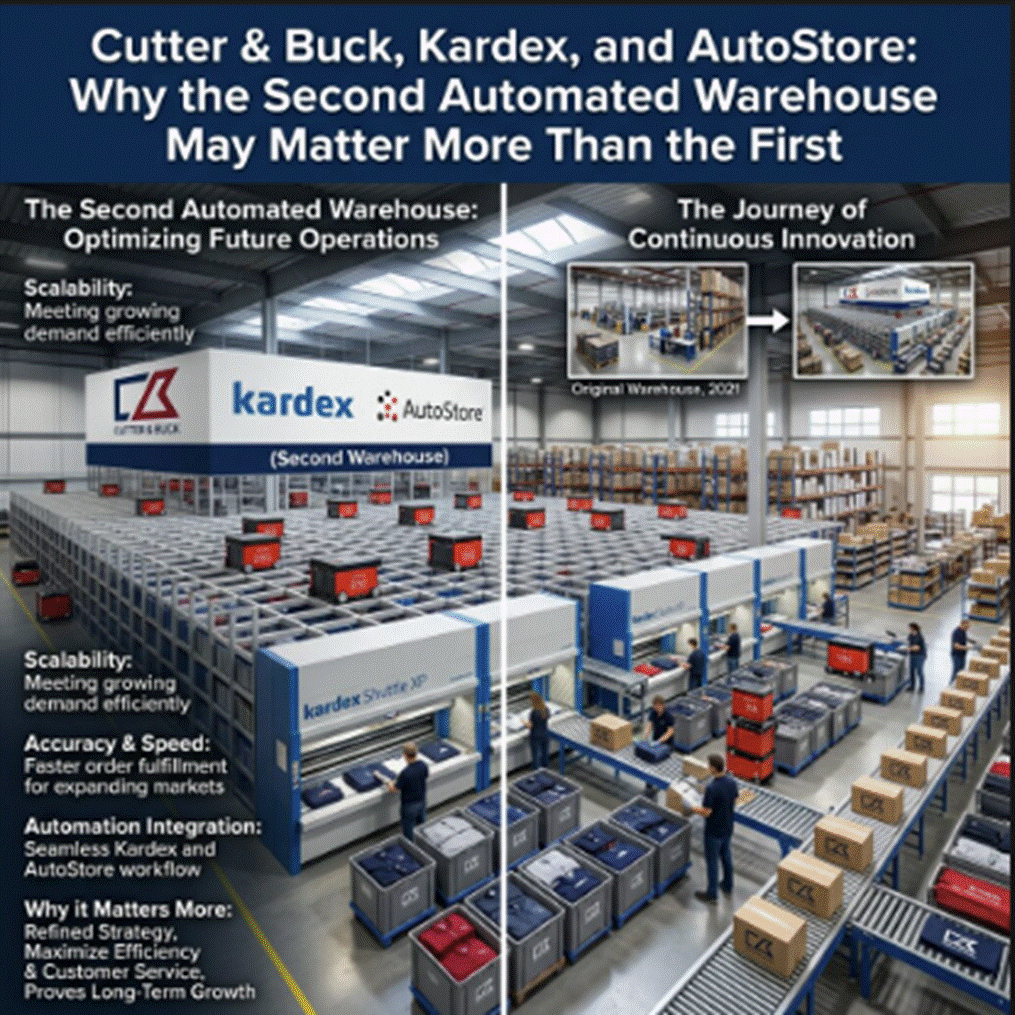
Warehouse automation announcements tend to celebrate the beginning. A new distribution center opens. Robots arrive. An automated storage and retrieval system goes live. Executives talk about throughput, labor savings, and future growth. But perhaps the more revealing warehouse automation story begins several years later, when a company decides whether to do it again. That is what makes the latest development involving Cutter & Buck, Kardex, and AutoStore particularly interesting.
Cutter & Buck, the apparel company, recently opened a new distribution center in Grand Prairie, Texas, featuring its second AutoStore goods-to-person system implemented by Kardex. The system includes 50,502 storage bins, 32 R5 Pro robots, and 13 ports, with Kardex FulfillX warehouse execution software coordinating the operation. It is designed for 1,256 bin presentations per hour, with simulation results averaging 1,284.
Those numbers are interesting. But the more important number may be two. This is not Cutter & Buck’s first attempt at warehouse automation. And that changes the story.
The First Warehouse Was the Experiment
Cutter & Buck began its earlier automation journey at its Renton, Washington, distribution center, where a Kardex-deployed AutoStore system went live in July 2023 with more than 34,000 bins and 54 robots. As the operation grew, the company later added another 9,962 storage bins along with additional ports and infrastructure. That evolution matters because the Texas facility was not designed simply by copying Renton.
According to Kardex, the companies used several years of operating experience, performance data, and lessons from the first deployment to shape the new distribution center around Cutter & Buck’s changing fulfillment requirements. This is where the story becomes much more useful for warehouse executives. There is an enormous difference between asking, “Should we automate?” and asking, “Knowing what we know after three years of automation, how should we automate the next building?” The second question may tell us far more about automation maturity.
What Happened After the Robots Arrived?
The publicly reported results from the original Renton deployment provide important context. In its case study, Kardex reports that Cutter & Buck reduced peak-season labor requirements by 60%, with 12 associates handling workloads that previously required 30. The company also reports that online orders can move from order to shipment in as little as 10 minutes.
Those are precisely the kinds of metrics automation buyers should be looking for. A warehouse can look highly automated without necessarily being highly productive. The business case ultimately depends on what happens to labor requirements, order cycle time, accuracy, capacity, service levels, and cost per order. That is especially important for Cutter & Buck because its fulfillment profile involves more than simply retrieving apparel from storage.
Nearly half of picking activity at the Renton operation supports embroidery workflows, according to the Kardex case study. That means products have to flow not just from storage to shipping, but through value-added customization processes as well. The Texas facility reflects that complexity. Its conveyor system connects AutoStore output with embroidery, order routing, Print & Apply, and shipping processes. In other words, the interesting technology story is no longer simply automated storage. It is automated flow.
The Second Warehouse Is the Real Vote of Confidence
Warehouse automation vendors understandably highlight initial customer wins. From an analyst perspective, however, repeat investment can be more revealing. A first implementation is based largely on expectations: projected throughput, anticipated labor savings, simulations, reference customers, and a calculated ROI. A second investment can be based on something much more valuable: the customer’s own operating data.
Cutter & Buck had several years to see how its first AutoStore deployment performed, expand that system as SKU requirements increased, identify where workflows could be improved, and then decide how to approach its next distribution center. It chose automation again. That does not mean every warehouse operator should reach the same conclusion. But it does suggest an important way customers should evaluate suppliers. Do not look only at how many new customers a technology provider wins. Look at how many existing customers expand, add robots or ports, increase storage capacity, or deploy the technology in another building. Those decisions occur after the sales presentation is over.
Modular Automation Changes the Economics
There is another important aspect of the Cutter & Buck example: scalability. At Grand Prairie, the number of robots and ports can be expanded independently as demand changes. That matters because one of the hardest parts of warehouse automation investment is forecasting the future.
Volumes change. SKU counts increase. Customer expectations shift. Peak seasons become more pronounced. A system designed perfectly for today’s demand may be poorly sized five years from now. Modular systems potentially give operators another way to think about ROI. Instead of asking whether they can perfectly forecast requirements over the entire investment horizon, they can ask whether the underlying automation architecture gives them enough room to respond when that forecast inevitably changes.
Cutter & Buck’s Renton facility illustrates that point particularly well. The original system was not frozen in its 2023 configuration. It subsequently expanded by nearly 10,000 additional bins as the business required more capacity. That ability to expand deserves more attention in automation business cases.
Stop Asking Only About Day-One Throughput
The warehouse automation market often focuses heavily on commissioning and initial throughput. Those metrics matter. But mature automation decisions should examine a longer timeline. What happened after year one?
Did the operation require more people than anticipated? What happened during peak? Could the system absorb additional SKUs? How expensive was maintenance? Could throughput be expanded without redesigning the facility? And most importantly, when the company needed another distribution center, did management choose the technology again? Research suggests these questions remain relevant. The 2026 Intralogistics Robotics Study surveyed 166 warehouse, distribution, and manufacturing professionals involved in robotic automation decisions. While 74% of organizations already deploying robots said they achieved their business goals, the study found a more complicated picture around cost and time to value.
That is an important distinction. Successful automation is not simply automation that works. It is automation capable of continuing to make economic sense as the operation changes.
Takeaway
The most interesting part of the Cutter & Buck, Kardex, and AutoStore story is not 32 robots or 50,502 bins. It is repeatability. Cutter & Buck implemented warehouse automation, operated it for several years, expanded it, learned from it, and then used those lessons to build another automated distribution operation. For companies evaluating AS/RS and goods-to-person technologies, that provides a useful lesson. Don’t just ask a supplier to show you its newest installation. Ask to see the customer that came back for the second one. That may be one of the clearest indicators that warehouse automation has moved from an impressive technology project to a sustainable operating strategy.
The post Cutter & Buck, Kardex, and AutoStore: Why the Second Automated Warehouse May Matter More Than the First appeared first on Logistics Viewpoints.
Non classé
Kinaxis Reports 22% SaaS Growth in Q3 2026, Raises Full-Year Outlook
Published
10 heures agoon
5 novembre 2026By
Kinaxis reported strong third-quarter 2026 financial results, with continued growth in cloud-based supply chain software, expanding customer adoption, and an increased full-year financial outlook. The results reflect sustained demand for supply chain planning and orchestration technology as manufacturers and distributors seek greater visibility, agility, and coordination across increasingly complex operations.
For the quarter ended September 30, Kinaxis generated $160.3 million in total revenue, an increase of 19% year-over-year. SaaS revenue rose 22% to $112.3 million, while annual recurring revenue (ARR) increased 19% to $483.9 million. Remaining performance obligations exceeded $1 billion, rising 21% from the prior year.
The company also reported $20.1 million in profit and adjusted EBITDA of $42 million, representing a 26% adjusted EBITDA margin.
Customer Growth Across Industries
Kinaxis continued to expand adoption of its Maestro supply chain orchestration platform across multiple industries and geographies.
New customer wins included Dr. Squatch, Sterlite Technologies, and WAI Global, along with organizations in luxury goods, biotechnology, and consumer health. The company also reported renewals and expansions involving Clariant and Sanofi.
More than 40 customer deployments went live during the quarter, including Asahi Beverages, with additional implementations across aviation, energy, healthcare, and manufacturing.
AI and Supply Chain Orchestration
Beyond its financial performance, Kinaxis is expanding its investment in AI-driven supply chain decision-making.
At Kinexions EMEA in October, the company introduced additional agentic AI capabilities, advanced inventory optimization, and enhancements to its Kinaxis Data Fabric. These developments are designed to help organizations move beyond traditional planning toward more connected and responsive operational execution.
The emphasis on AI-enabled workflows and improved inventory optimization reflects a broader industry transition toward systems that can identify changing conditions, evaluate alternatives, and support faster operational decisions.
Raised 2026 Outlook
Following its third consecutive quarter of outperformance, Kinaxis raised its full-year revenue guidance to $640 million–$650 million, increased its expected SaaS revenue growth to 20%–21%, and lifted its adjusted EBITDA margin outlook to 26.5%–27.5%.
The results highlight continued enterprise investment in supply chain planning technology, particularly platforms combining advanced optimization, real-time decision support, and emerging AI capabilities. For technology providers, the challenge increasingly extends beyond offering sophisticated planning tools to demonstrating how those capabilities translate into measurable operational improvements.
Read the full Kinaxis Q3 2026 financial results.
The post Kinaxis Reports 22% SaaS Growth in Q3 2026, Raises Full-Year Outlook appeared first on Logistics Viewpoints.

Cutter & Buck, Kardex, and AutoStore: Why the Second Automated Warehouse May Matter More Than the First
Cutter & Buck, Kardex, and AutoStore: Why the Second Automated Warehouse May Matter More Than the First
Kinaxis Reports 22% SaaS Growth in Q3 2026, Raises Full-Year Outlook
Freightos Global Freight Outlook – September 2026
Container rates jump another $1k/FEU – but is demand peaking? – July 8, 2026 Update

Walmart and the New Supply Chain Reality: AI, Automation, and Resilience
Trending
- Non classé2 mois ago
Freightos Global Freight Outlook – September 2026
- Non classé4 mois ago
Container rates jump another $1k/FEU – but is demand peaking? – July 8, 2026 Update
-
 Non classé2 ans ago
Walmart and the New Supply Chain Reality: AI, Automation, and Resilience
-

 Non classé7 mois ago
Why Sulfuric Acid Is Emerging as a Supply Chain Constraint in Copper
- Non classé5 mois ago
Container rates starting to spike on peak season rush – June 2, 2026 Update
- Non classé1 an ago
13 Books Logistics And Supply Chain Experts Need To Read
- Non classé1 an ago
Ex-Asia ocean rates climb on GRIs, despite slowing demand – October 22, 2025 Update
- Non classé4 mois ago
LCL Shipping Cost Calculator: Calculate Air and Sea Shipping Freight Rates