
Non classé
Labor Constraints are Accelerating Adoption of Dock Automation and Robotic Picking

Published
4 heures agoon
By
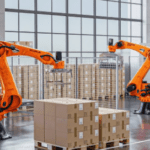
Manual trailer and ocean-container unloading remains one of the most ergonomically challenging activities in warehousing and distribution operations. The work is highly repetitive and, in many operations, is associated with higher injury risk and inconsistent staffing, making inbound receiving a persistent capacity constraint rather than a short-term labor disruption. In a recent briefing with Contoro Robotics, this dynamic was clear: when the limiting factor is the manual handling of floor-loaded cartons inside trailers and ocean containers, the value proposition for robotics—measured in throughput stability, safety performance, and labor availability—can become compelling.
For end users, the issue extends beyond unload rate. Safety risk, absenteeism, turnover, and process variability all increase when operations rely on workers to lift, twist, and reach within confined trailers for an entire shift. Conditions also matter: during summer months, temperatures inside containers can reach extreme levels, which can affect retention and staffing reliability. These pressures are driving interest in solutions that remove the highest-strain tasks from the workflow while keeping people focused on supervision, exception management, and value-added downstream activities.
Source: Boston Dynamics
Why Contoro Robotics is a relevant market signal
Contoro Robotics is noteworthy because it is targeting a well-defined, high-friction segment of the intralogistics value chain: autonomous (or semi-autonomous) unloading of floor-loaded trailers and ocean containers. By employing a human-in-the-loop operating model, the approach acknowledges real-world variability while still enabling meaningful labor displacement in the most demanding portion of inbound receiving. The positioning centers on improved ergonomics, reduced labor dependence, and scalable throughput—outcomes that directly support faster dock-to-stock performance and more predictable receiving operations.
More broadly, labor market conditions are reshaping automation investment criteria. Buyers are increasingly prioritizing solutions that reduce physical strain, stabilize throughput, and improve operational resilience—particularly in processes where staffing volatility directly impacts service levels. Unloading-focused robotic systems that can operate within trailers, accommodate variability in carton size and condition, and integrate with existing material handling equipment (MHE) and execution layers such as warehouse management systems / warehouse control systems (WMS/WCS) are easier to justify because they avoid wholesale facility redesign while still delivering a credible ROI and TCO improvement.
Robotic picking in intralogistics: definition and scope
Within intralogistics, robotic picking refers to the use of robots to identify, grasp, and place items or cartons as part of internal material flows. These solutions typically combine 3D vision/perception, AI-based recognition and grasp planning, industrial robot arms, and application-specific end effectors to execute tasks such as piece picking, depalletizing, singulation, or unloading of floor-loaded trailers and ocean containers.
The primary value proposition is improved productivity and process consistency under challenging labor conditions. When properly engineered and integrated, robotic picking can increase effective throughput, reduce labor exposure in high-strain tasks, and improve operational predictability across shifts and peak periods. In many facilities, these systems help reduce touchpoints between inbound receiving and downstream fulfillment by automating repetitive handling steps while reserving people for exceptions, quality checks, and flow supervision.
Key market drivers
Several factors are accelerating adoption of robotic picking. First, chronic labor scarcity, high turnover, and rising wage pressure make it difficult to staff the most physically demanding jobs with acceptable stability. Second, operators are seeking faster dock turns and more deterministic inbound flow; automation can reduce the variability inherent in manual unloading. Third, advances in perception, AI-based grasp planning, and end-effector design have expanded the range of real-world packages and mixed loads that robots can handle reliably.
At the same time, buying behavior is shifting toward deployment pragmatism. End users are less interested in technology demonstrations and more focused on solutions that can be implemented in brownfield environments, integrate with existing processes, and deliver measurable performance against agreed KPIs. Container and trailer unloading is an attractive entry point because the business case is often visible in multiple dimensions—labor reduction, improved ergonomics, higher inbound throughput, and a clearer path to ROI.
Representative use cases in intralogistics
Robotic picking is being applied across a range of material handling tasks. Inbound unloading of floor-loaded ocean containers is gaining priority because it is physically demanding and frequently constrains receiving capacity. Piece picking (from totes, bins, or shelves) is also a major segment, particularly in e-commerce and omnichannel fulfillment where SKU proliferation and service-level requirements pressure operations to increase pick rates and accuracy.
Source: KUKA Robotics
Common applications include:
Unloading of floor-loaded trailers and ocean containers (cartons/cases).
Piece picking from totes, bins, or storage locations for order fulfillment.
Depalletizing and transfer to conveyors, sortation, or put-wall processes.
Mixed-SKU handling in retail, e-commerce, and third-party logistics (3PL) operations.
Solutions that gain traction typically combine robust perception and grasp capabilities with operational workflows for exceptions, including human oversight where required. In many environments, this semi-autonomous approach delivers better real-world availability and faster time-to-value than designs that assume full autonomy under all load conditions—particularly when carton geometry, packaging materials, and load quality vary significantly.
ARC perspective
Robotic picking should be viewed less as a wholesale replacement for warehouse labor and more as a targeted strategy to remove the most physically taxing, variable, and difficult-to-staff tasks from core material flows. The Contoro Robotics briefing reinforces an important point: inbound floor-loaded unloading is both a significant source of labor pain and an increasingly addressable automation opportunity. As this segment matures, ARC expects evaluation criteria to center on deployability, integration with existing execution systems, and performance against KPIs such as inbound throughput, dock-to-stock time, safety metrics, and total cost of ownership.
The post Labor Constraints are Accelerating Adoption of Dock Automation and Robotic Picking appeared first on Logistics Viewpoints.
You may like
Non classé
From AI Experiments to Operational Impact: What It Really Takes for Enterprises to Realize Value
Published
8 heures agoon
9 avril 2026By

For the past several years, artificial intelligence has been everywhere in enterprise conversations and nowhere in actual results. Most organizations have experimented, many have piloted, but very few have operationalized AI in a way that meaningfully moves the needle. In fact, the numbers tell a sobering story: the vast majority of enterprise AI initiatives fail to deliver tangible business value, with estimates suggesting as many as 80 to 95% fall short of expectations.
For enterprise leaders, this gap between promise and performance isn’t just frustrating, it is costly. It also raises an important question: why has AI struggled to deliver despite the explosion of internal and external data, and the significant technology investments made to support enterprise processes and teams?
The answer lies less in the technology itself and more in how it’s being applied across real-world, interconnected operations. Most organizations are not failing because AI doesn’t work, but because of fragmented data, siloed processes, and the challenge of integrating AI into existing systems and workflows.
Why AI Struggles in Real-World Operations
If the first wave of AI was about prediction, the next wave is about action. Leading organizations are moving beyond static models toward systems that can sense, analyze, decide, and act in near real time, often described as agentic capabilities. These systems do not just generate insights; they participate directly in execution.
We are already seeing what this looks like in practice. In fast-moving consumer sectors, AI-driven approaches are compressing product development cycles from months to days by linking demand signals directly to design and supply decisions. In retail and food service, digital twin environments are enabling teams to simulate disruptions and resolve them in minutes instead of days, reducing manual effort while improving service levels and inventory efficiency.
The common thread is the integration of AI into the operational fabric of the business. Four characteristics stand out:
A shared, semantic understanding of the business – Enterprise intelligence is built on a unified representation of the business across structured and unstructured data, enabling AI to understand how information, decisions, and outcomes are connected.
Workflow-driven simulation and execution – AI must operate within real business processes, simulating outcomes across workflows and applying business logic to guide decisions from planning through execution.
Orchestrated decision-making across the enterprise – An orchestration layer connects people, data, and systems, enabling more collaborative, informed decisions and ensuring those decisions can be executed across existing systems of record.
Continuous learning and improvement – AI systems must continuously learn from outcomes, improving decision quality over time and adapting to changing conditions.
For all its sophistication, AI must also feel simple to the user. The underlying complexity does not disappear, but it must be abstracted. The real test is whether organizations can deliver accurate, real-time answers without exposing the complexity that makes them possible.
Increasingly, this also means making these capabilities accessible beyond technical teams, through self-service environments that allow business users to define, test, and adapt decision processes without relying entirely on specialized development resources.
Why Supply Chains Are the Proving Ground for Enterprise AI
Supply chains reflect the operational “physics” of the enterprise and are among its most consequential domains. Every decision, what to make, where to ship, how much to hold, has direct financial and customer impact. That complexity, when fragmented and managed in silos, is precisely why AI has struggled here. It is also why success in supply chains matters more than anywhere else.
But the implications go beyond supply chains alone. The highest-value opportunities are centered on solving these challenges because they are foundational to how enterprises operate. Supply chains are simply the most demanding proving ground for a broader shift toward real-time, connected decision-making across the business.
We are now at an inflection point. Advances in data architecture, cloud scalability, and AI techniques are converging to make enterprise-grade deployment practical. At the same time, market momentum is accelerating, with investment in enterprise AI outpacing traditional software categories and signaling a long-term shift in how organizations operate. For leaders, this creates both urgency and opportunity.
The lesson from the past few years is clear: isolated AI projects do not scale. Incremental experimentation alone will not get organizations where they need to go. What is required instead is a system-level approach that connects data, decisions, and execution across the end-to-end enterprise. This is where orchestration becomes critical.
Orchestration is not about replacing planning. It is about elevating it by connecting planning with execution, aligning decisions across functions, and ensuring that AI operates within the full context of the business. It enables organizations to move from reacting to disruptions to proactively managing them.
From a technology perspective, this means building environments where data, AI models, business rules, and human expertise coexist, and where decisions can be simulated, tested, and executed in a continuous loop.
From an organizational perspective, it requires rethinking how teams work. The most successful companies are investing in cross-functional capabilities, bringing together domain experts, data scientists, and operators to translate AI potential into operational reality. What’s emerging is not just a new set of tools, but a new operating layer that connects decisions across the enterprise.
From AI Experimentation to Enterprise Impact
AI in enterprise is no longer a question of “if.” It is a question of “how.” The hype cycle is giving way to a more pragmatic phase focused on measurable outcomes, operational integration, and sustained value creation.
Organizations that continue to treat AI as a series of experiments will fall behind, while those that embed it into the core of how they operate will gain a meaningful competitive edge.
McKinsey’s research reinforces this divide. High performers are nearly three times more likely than others to redesign workflows around AI, rather than simply layering it onto existing processes, and are significantly more likely to view AI as a driver of enterprise-wide transformation.
The path forward is not about chasing the next breakthrough model. It is about building the
foundation for continuous, connected decision-making and execution at scale. In complex operations, value does not come from knowing more. It comes from consuming data, contextualizing it, analyzing it, making decisions, and acting on them.
By Manik Sharma, Chief of Agentic Solutions, Kinaxis
Manik is a seasoned supply chain and digital transformation leader, bringing more than 30 years of experience driving operational and organizational change across industries and global markets. He is known for building and scaling go-to-market strategies, accelerating sales momentum, and delivering measurable customer value through strong cross-functional orchestration.
Currently Chief of Agentic Solutions at Kinaxis, he leads the development and execution of AI-driven strategies that help organizations transform decision-making and operational performance. His career spans leadership roles at Celonis, Palantir, Coupa, and previously Kinaxis, where he has consistently driven growth, innovation, and customer impact.
His expertise includes digital transformation, supply chain management, advanced analytics, and enterprise strategy, with a focus on helping organizations adapt and compete in increasingly complex environments.
The post From AI Experiments to Operational Impact: What It Really Takes for Enterprises to Realize Value appeared first on Logistics Viewpoints.

The space economy is no longer a distant innovation story. It is becoming part of the operating infrastructure behind communications, visibility, resilience, and national logistics capacity.
For years, the space economy was discussed as a specialized frontier market. That framing is becoming less useful. Space is still its own sector, but it is also becoming an enabling layer for terrestrial supply chains. Satellite communications, positioning, remote sensing, launch capacity, and space-based data services are moving closer to the center of how freight networks, industrial operations, and national logistics systems function.
That matters because the modern supply chain is now built on more than trucks, ships, ports, rail, warehouses, and enterprise software. It also depends on digital infrastructure that helps companies see, coordinate, and secure operations across distance. Increasingly, that infrastructure has a space component.
The scale of the shift is no longer marginal. CSIS notes that the global space economy was valued at $613 billion in 2024, with commercial activity accounting for $480 billion, or 78 percent of the total. The same analysis points to a launch tempo of roughly one orbital launch attempt every 34 hours in 2024, with the United States leading global launch activity.
Space is no longer upstream from logistics
The most useful way to think about the space economy is not as a separate vertical, but as a growing layer of capability that supports real-world operations. The European Space Agency defines the space economy broadly, covering not only rockets and satellites themselves, but also the downstream economic value created by the services those assets enable. That downstream value is where supply chain relevance becomes much clearer.
A manufacturer tracking remote assets, a carrier relying on resilient communications, a retailer using precise timing and geolocation, and a government monitoring infrastructure risk are all using capabilities that depend, directly or indirectly, on space-based systems. What used to be viewed as aerospace infrastructure is increasingly logistics infrastructure.
This is especially true in environments where terrestrial systems are incomplete, congested, or vulnerable. Maritime lanes, remote resource operations, defense logistics, cross-border corridors, and emergency response networks all benefit from persistent satellite-enabled connectivity and visibility.
The supply chain implications are becoming more concrete
The strategic relevance of low Earth orbit is growing because LEO systems are becoming part of the communications and data backbone for both commercial and national operations. CSIS argues that LEO capabilities now sit at the intersection of commercial competitiveness and national security, and that U.S. leadership is meaningful but not guaranteed. The report also notes a structural dependence on a narrow set of dominant providers, particularly SpaceX, which introduces concentration risk even in a market that appears strong.
That concentration issue is important for supply chain leaders. If a sector becomes foundational to logistics performance, but remains dependent on a small number of launch, satellite, or communications providers, then resilience becomes a board-level concern rather than a technical footnote.
The same logic applies to satellite proliferation. CSIS notes that as of 2025 there were around 10,000 active satellites in orbit, with more than 7,000 operated by a single U.S. company, and that tens of thousands more are likely over the next five years. That growth points to increasing capability, but also increasing congestion, dependence, and exposure.
This is also becoming an industrial supply chain story
Space is often discussed in terms of launch economics and defense posture, but it is equally an industrial production story. Satellites, launch vehicles, propulsion systems, semiconductors, sensors, advanced materials, communications payloads, and ground systems all sit inside complex manufacturing and supplier networks.
That brings the discussion back to more familiar supply chain questions. Where are the bottlenecks? How concentrated are the supplier tiers? Which components are capacity constrained? Where are the geopolitical risks? And how much of the sector’s apparent momentum depends on a handful of fragile nodes?
NASA’s own recent language reflects this reality. In March 2026, the agency said it would embed subject-matter experts across the supply chain at major vendors, subcontractors, and critical-path components in order to challenge assumptions, solve problems, and accelerate production. That is not the language of a sector treating supply continuity as a secondary issue. It is the language of an industry confronting industrial-scale execution risk.
For supply chain executives outside the space sector, that should sound familiar. When an industry begins placing experts directly into supplier and subcontractor environments, it usually means the delivery challenge is no longer about concept validation. It is about throughput, integration, and control.
Why this matters beyond aerospace
The broader implication is that space capacity is starting to shape terrestrial economic performance. McKinsey has identified space among the next big arenas of competition, tied to the broader buildout of AI, cloud, semiconductors, and physical-world digital systems. That framing is useful because it places space where it now belongs: not at the edge of the economy, but inside a cluster of enabling technologies that will reshape operations across industries.
For supply chains, this does not mean every company needs a “space strategy.” It does mean more firms should understand which parts of their operating model already depend on space-based infrastructure, and where hidden exposure exists.
That includes:
communications continuity in remote or disrupted environments
geolocation and timing dependencies
visibility and sensing for global transport networks
defense and critical infrastructure interdependencies
supplier concentration in launch, satellite, and component ecosystems
None of this suggests that space becomes the dominant issue for most logistics organizations. But it does suggest that space is moving from adjacent to embedded.
A more practical way to frame the opportunity
The strongest framing for executives is probably not that the space economy is “the next big thing.” That phrase is too loose and too promotional. A better framing is that space is becoming a strategic infrastructure layer for modern supply chains.
That is a more disciplined idea. It places the emphasis on utility, resilience, and dependency rather than novelty.
It also helps separate two questions that are often blurred together. One is whether the space sector itself will continue to grow. The evidence suggests yes, although growth will remain uneven and strategically contested. The second is whether space-derived capabilities will become more important to supply chain performance on Earth. That also appears to be yes, and probably more quickly than many industrial firms fully appreciate.
The bottom line
The space economy is no longer just a sector to watch. It is becoming part of the infrastructure stack that supports visibility, coordination, resilience, and national competitiveness.
For supply chain leaders, the issue is not whether they are “in space.” It is whether key parts of their operating model already rely on space-enabled systems, and whether those dependencies are understood well enough to manage risk.
That is where this topic becomes less speculative and more operational. Space is not replacing the supply chain. It is increasingly part of the system that makes the supply chain work.
The post Space Is Becoming Supply Chain Infrastructure appeared first on Logistics Viewpoints.
Non classé
Decision Latency: The Hidden Cost in Modern Supply Chains
Published
1 jour agoon
8 avril 2026By

In modern supply chains, disruption does not always begin with a weather event, a port closure, or a supplier failure. It often begins inside the decision cycle itself, where fragmented data, unclear ownership, and slow escalation turn manageable issues into measurable cost.
Supply chain leaders have spent the last several years responding to visible disruption. Port congestion, labor shortages, geopolitical instability, and shifting demand patterns have all exposed weaknesses across global networks. But many of the most persistent costs in supply chain operations do not begin with the disruption itself. They begin with the organization’s response.
This is the problem of decision latency.
Decision latency is the time between recognizing that conditions have changed and taking effective action. In modern supply chains, that delay can be more damaging than the original event. A late shipment becomes a stockout because no one reallocated inventory in time. A supplier issue becomes a margin problem because escalation occurred after the available options narrowed. A demand shift becomes a service failure because the replenishment response moved too slowly.
In many operations, the physical supply chain is moving faster than the management system wrapped around it.
That matters because modern supply chains operate with tighter service expectations, less slack, more dependencies, and more frequent exceptions. In that environment, visibility alone is not enough. Companies can have dashboards, alerts, and analytics in place and still underperform if decisions remain slow, fragmented, or politically constrained.
Decision latency is not a soft organizational issue. It is an operating cost.
Visibility is not the same as responsiveness
Most supply chain organizations have invested heavily in visibility. They have better planning systems, better transportation tracking, more data feeds, and more dashboards than they had even a few years ago. But more signal does not automatically produce faster response.
In some cases, it has the opposite effect. Teams receive more alerts, more metrics, and more exceptions, but still lack a clear path to action. A planner sees the problem, but not the authority to act. Procurement identifies a supplier risk, but has no mechanism to trigger a coordinated response. Transportation sees capacity tighten, but needs approvals that arrive after the best options are gone.
The result is a common pattern: companies improve awareness without improving execution.
This is why decision latency deserves closer attention than generic calls for more visibility. The issue is not always whether the organization can see the problem. The issue is whether it can decide in time to preserve the best option set.
Where the cost shows up
Decision latency rarely appears as a formal KPI, but its effects are visible across the operating model.
One impact is inventory distortion. When response speed is unreliable, organizations compensate with more stock. Safety stock becomes protection not just against demand variability or supply uncertainty, but against slow internal decision-making. Over time, this weakens inventory productivity and hides the real source of instability.
Another impact is service erosion. A manageable disruption becomes a missed customer commitment when the response window is allowed to shrink. The longer an organization waits to act, the fewer recovery options remain.
Cost inflation is another consequence. Premium freight, expediting, last-minute sourcing changes, schedule reshuffling, and reactive labor decisions are often treated as disruption costs. In many cases, they are delay costs. The disruption created the condition. The slow response increased the financial damage.
There is also an organizational cost. When decisions move too slowly, teams begin to work around the formal operating model. Informal escalation paths take over. Exceptions become routine. People rely less on process discipline and more on personal intervention. That may solve some short-term problems, but it weakens operating consistency over time.
Why modern supply chains are more exposed
Decision latency is not new, but several structural shifts have made it more expensive.
First, many supply chains now operate with less buffer. Inventories are leaner, transportation conditions are tighter, and customer tolerance for delay is lower. That narrows the recovery window.
Second, dependencies have multiplied. A single issue can affect sourcing, logistics, manufacturing, customer fulfillment, compliance, and finance at the same time. That raises the penalty for hesitation.
Third, organizations now process far more data than before, but governance structures often remain slower than the business environment they are trying to manage. Monthly planning cycles and weekly review cadences still matter, but they are often too slow to govern exception-driven operations on their own.
Finally, many companies modernize systems without redesigning decisions. They implement new tools but leave untouched the questions that matter most: Who decides? Under what thresholds? With what information? On what timeline?
If those questions are unresolved, the underlying bottleneck remains.
Decision latency is usually a design problem
It is easy to describe slow decisions as bureaucracy. But in most cases, the problem is more specific. It is a design failure inside the operating model.
There are four common forms of decision latency.
The first is informational latency. Relevant data exists, but it is delayed, fragmented, or presented in a way that does not support action.
The second is interpretive latency. Different functions see the same issue but frame it differently. The signal is visible, but the meaning is contested.
The third is procedural latency. The organization knows what should happen, but approvals, meetings, and escalation paths delay execution.
The fourth is ownership latency. A cross-functional problem emerges, but no one has clear authority to make the required tradeoff.
These forms of latency often overlap. A shipment delay may begin as a data issue, become an argument over implications, and end in an ownership gap. By the time action is taken, the cost of recovery has already risen.
Seen this way, decision latency is not simply slow management. It is accumulated structural drag.
Technology only helps if it shortens the path to action
Supply chain technology vendors rightly emphasize visibility, orchestration, and intelligence. Those capabilities matter. But the real test is not whether technology produces more insight. It is whether it shortens the path from signal to action.
A control tower that generates alerts without assigning decision ownership may improve awareness but not response. A predictive model that identifies disruption risk but is not embedded in operating workflows may improve analysis without changing outcomes. A planning system that produces better recommendations still depends on whether someone can act on those recommendations within the right window.
Technology reduces decision latency when it does three things well.
First, it improves signal quality by elevating the issues that matter most.
Second, it creates shared context so functions are not reacting to different versions of reality.
Third, it supports governed action through clear thresholds, workflows, and decision rights.
That is the more useful standard for judging digital maturity. The question is not just whether the system is intelligent. It is whether the operating model becomes more responsive because of it.
What supply chain leaders should do
The first step is to treat decision speed as an operational capability rather than a cultural aspiration. Leaders should ask where in the supply chain decisions routinely arrive too late to preserve the best available option. That is usually more valuable than asking where the organization needs more data.
The second step is to map decision flows, not just process flows. Most organizations understand how inventory, orders, and shipments move. Fewer understand how exceptions move, who owns them, what thresholds trigger action, and where delay accumulates.
The third step is to clarify decision rights. Not every issue should escalate. Many operational decisions can move faster if authority is defined more explicitly and tied to clear business rules.
The fourth step is to examine metrics and incentives. Functional KPIs often reinforce hesitation when enterprise tradeoffs are required. If teams are measured too narrowly, they may delay action that is rational for the network but uncomfortable for their own function.
Finally, leaders should measure response time directly. Forecast accuracy, inventory turns, and service levels remain important, but they do not fully capture how quickly the organization detects, escalates, decides, and acts.
Decision speed is now a competitive variable
For years, supply chain performance has been evaluated through cost, service, and asset efficiency. Those metrics still matter. But underneath them sits a capability that increasingly separates stronger operators from weaker ones: the ability to make sound decisions quickly under changing conditions.
That capability affects how much inventory a company truly needs, how much disruption turns into cost, and how often local issues spread across the network. It shapes the value of digital investments and the degree to which resilience is real rather than theoretical.
In that sense, decision speed is not a managerial convenience. It is part of the operating model.
Companies that continue treating latency as a minor internal issue will keep paying for it through expediting, excess inventory, service failures, and avoidable internal friction. Companies that design for faster, clearer, better-governed decisions will operate with more control and less waste.
In modern supply chains, delay is not only something that happens at the port, on the road, or on the factory floor.
It also happens in the time between knowing and acting.
The post Decision Latency: The Hidden Cost in Modern Supply Chains appeared first on Logistics Viewpoints.


Labor Constraints are Accelerating Adoption of Dock Automation and Robotic Picking

From AI Experiments to Operational Impact: What It Really Takes for Enterprises to Realize Value

Space Is Becoming Supply Chain Infrastructure

Walmart and the New Supply Chain Reality: AI, Automation, and Resilience
Ex-Asia ocean rates climb on GRIs, despite slowing demand – October 22, 2025 Update
13 Books Logistics And Supply Chain Experts Need To Read
Trending
-
 Non classé1 an ago
Walmart and the New Supply Chain Reality: AI, Automation, and Resilience
- Non classé6 mois ago
Ex-Asia ocean rates climb on GRIs, despite slowing demand – October 22, 2025 Update
- Non classé8 mois ago
13 Books Logistics And Supply Chain Experts Need To Read
- Non classé2 mois ago
Container Shipping Overcapacity & Rate Outlook 2026
- Non classé5 mois ago
Ocean rates climb – for now – on GRIs despite demand slump; Red Sea return coming soon? – November 11, 2025 Update
- Non classé2 mois ago
Ocean rates ease as LNY begins; US port call fees again? – February 17, 2026 Update
- Non classé1 an ago
Unlocking Digital Efficiency in Logistics – Data Standards and Integration
-

 Non classé6 mois ago
Navigating the Energy Demands of AI: How Data Center Growth Is Transforming Utility Planning and Power Infrastructure