
Non classé
AI in the Supply Chain – RAG, Grounding Supply Chain AI in Real-Time Data – Part 4:

Published
1 an agoon
By

Download the full white paper – AI in the Supply Chain
Retrieval-Augmented Generation (RAG): Smarter AI with Domain-Specific Memory
Even with A2A and MCP in place, AI systems still face a significant limitation: the boundaries of their internal training data. Most language models and forecasting tools only know what they’ve been trained on, and that knowledge may be outdated, incomplete, or too general for the nuanced, regulated, and fast-moving environment of supply chain operations.
Retrieval-Augmented Generation (RAG) addresses this challenge by giving AI systems access to external, real-time knowledge sources. In effect, RAG systems don’t just “guess” based on learned patterns, they “look up” information before answering.
1. What Is RAG?
RAG is an AI architecture that combines:
A retriever: A system that searches a database, document set, or knowledge base to find the most relevant information.
A generator: A language model (like GPT or PaLM) that uses the retrieved information to produce a more exact, context-aware output.
This enables AI to respond with domain-specific, up-to-date, and verifiable information, critical in supply chains where regulations, tariffs, vendor lists, and performance data change often.
2. Why RAG Matters in Supply Chains
Supply chains work in data-dense, highly regulated environments, where accuracy is non-negotiable. The risks of misinformation are high:
A missed regulatory clause in customs documentation can cause multi-day delays.
A misquoted incoterm could shift liability and result in financial penalties.
A failure to check a supplier’s current compliance status could expose the business to reputational or legal risk.
RAG-based systems can dynamically retrieve current policy documents, contract language, shipment histories, or supplier certifications to guide actions and responses with precision.
3. Use Cases for RAG in Logistics and Supply Chain
Customs Documentation:
AI retrieves the correct import/export documentation requirements from a government database and generates pre-filled, compliant forms.
Supplier Discovery and Risk Assessment:
When sourcing agents consider new vendors, a RAG model pulls recent financial data, sanction lists, ESG ratings, and delivery records to assess reliability.
Tariff & Trade Compliance:
AI retrieves current tariff rates, HS code classifications, and trade restrictions for any given origin-destination pair, automating what was once a legal review task.
Customer Service & Internal Knowledge Assistants:
Warehouse or customer support agents query an AI assistant that pulls SOPs, real-time shipment data, and exception logs to resolve issues quickly.
Technical Documentation Generation:
For complex products with component-level traceability needs (e.g., automotive or aerospace), AI pulls from multiple source systems to compile BOMs, certificates, and handling instructions.
4. Architecture Overview: How RAG Works
In a typical RAG system:
A user or system prompts a question or task (e.g., “What documentation is required for lithium battery export from China to Germany?”).
The retriever searches a vectorized knowledge base of documents, government websites, internal SOPs, and compliance manuals.
Top-matching documents are passed to the generator, which reads them and produces a tailored, human-readable answer.
This pipeline can be implemented using tools such as:
FAISS or Pinecone for document retrieval and vector search
LangChain or LlamaIndex for orchestration
OpenAI GPT-4, Anthropic Claude, or other LLMs for generation
5. Benefits of RAG in Supply Chains
Accuracy: AI responses are based on retrieved facts, not guesswork.
Auditability: Outputs can include citations or links to the source documents.
Domain Adaptation: Enterprises can inject industry-specific knowledge without retraining the base model.
Regulatory Compliance: Reduce risk of incorrect or non-compliant responses.
Cost Efficiency: No need to retrain AI every time a document or rule changes, just update the knowledge base.
6. Challenges in Implementing RAG
Knowledge Base Maintenance: The retrieval system is only as good as the data it can access. Enterprises must invest in building, tagging, and updating high-quality document sets.
Latency: Complex retrieval pipelines can increase response time unless optimized.
Security and Access Control: Sensitive documents used in retrieval must be segmented, encrypted, and governed by role-based access control.
Evaluation: Testing RAG system output requires both human judgment and validation against business rules.
7. Examples in Industry
Flexport: Uses RAG-style systems to provide instant customs advice and documentation review, accelerating cross-border shipments.
Project44 and FourKites: Integrate external signals and logistics event data into dynamic shipment tracking and disruption response tools.
SAP and Oracle: Are embedding retrieval-based assistants into their enterprise platforms to help planners and analysts find policies, exceptions, and best practices.
In summary, RAG equips AI with the ability to reference external truth, an essential capability in the high-risk, high-regulation world of global supply chains. It’s not just about speed or scale; it’s about getting things right the first time.
Still, most retrieval systems treat data as flat, lists of documents or bullet points. But supply chains are networks, not lists. That’s where the next evolution, Graph RAG, comes in.
[Download AI in the Supply Chain](https://logisticsviewpoints.com/download-the-ai-in-the-supply-chain-white-paper/)
The post AI in the Supply Chain – RAG, Grounding Supply Chain AI in Real-Time Data – Part 4: appeared first on Logistics Viewpoints.
You may like
Non classé
Can Real-Time Voice Translation Improve Warehouse Productivity and Employee Engagement?
Published
19 heures agoon
14 octobre 2026By
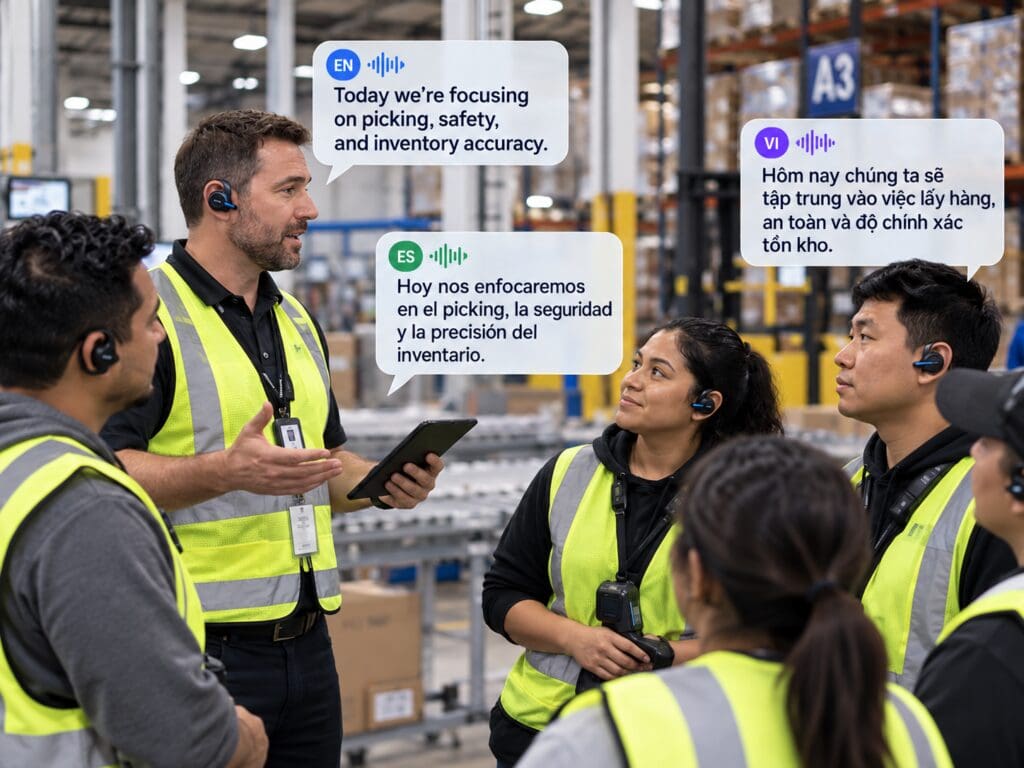
Labor shortages remain one of the most persistent challenges facing warehouse operators. Yet an often-overlooked issue sits beneath the labor discussion: communication. Modern distribution centers frequently employ associates who speak a variety of languages. While workforce diversity is a strength, language barriers can create delays, safety risks, training challenges, and unnecessary dependence on a small number of bilingual employees.
This challenge is becoming increasingly relevant across North America. Distribution centers routinely employ associates representing multiple linguistic backgrounds. As labor shortages persist, operators are focusing less on hiring workers who speak a common language and more on ensuring communication systems can accommodate workforce diversity. Technology that bridges language gaps can therefore expand the labor pool while improving workforce effectiveness.
Historically, many operations have relied on supervisors or bilingual associates to bridge communication gaps. The problem is that those employees are frequently pulled away from their primary responsibilities to interpret instructions, explain process changes, or translate safety information. In a high-velocity warehouse environment, those interruptions create hidden productivity losses.
Recent advances in real-time voice translation technology are changing this dynamic. Solutions such as Relay’s TeamTranslate allow workers to communicate in their preferred language while messages are translated and delivered to others in near real time.
Consider a common warehouse scenario. A distribution center employs workers who primarily speak English, Spanish, and Vietnamese. During a shift startup meeting, supervisors must communicate labor priorities, inventory issues, quality concerns, and safety reminders. Without automated translation tools, information often flows through a bilingual intermediary. Even when translation is accurate, the process consumes time and introduces opportunities for misunderstanding.
With real-time translation, every worker can hear instructions in a familiar language. Communication becomes direct rather than dependent on an interpreter. Managers spend less time repeating instructions, and bilingual associates remain focused on their assigned tasks instead of serving as unofficial translators.
Relay highlights examples from warehouse operations where managers reported stronger understanding between English- and Spanish-speaking associates after implementing translation capabilities. Improved understanding contributed to better alignment and higher production levels.
The ROI opportunity can be meaningful. Consider a 200-person distribution center operating two shifts. If five supervisors each spend fifteen minutes per day locating a bilingual employee to translate instructions, answer questions, or communicate process changes, the facility loses more than 625 supervisory hours annually. At a fully burdened labor cost of $40 per hour, that represents approximately $25,000 in indirect labor costs before accounting for throughput improvements, reduced errors, and fewer delays.
The impact extends beyond productivity. Safety is another significant consideration. Warehouses depend on clear communication for forklift traffic management, hazardous material handling, evacuation procedures, and incident reporting. When critical messages are misunderstood because of language barriers, the consequences can be serious.
Training and onboarding may benefit as well. New employees often face a steep learning curve. Translation-enabled communication allows new hires to learn in their preferred language, potentially reducing training time while increasing confidence.
An emerging category of frontline communication technology is focused on solving these challenges. Vendors such as Relay, Zebra Workforce Connect, Microsoft Teams Walkie Talkie, Theatro, Honeywell Voice, and WorkJam are expanding communication capabilities for deskless workers. Historically, many solutions focused on push-to-talk communication or task management. AI-powered language translation introduces a new capability by directly addressing communication friction between workers.
Perhaps the most interesting impact is cultural rather than operational. Many warehouses consist of diverse teams that work side by side every day but communicate primarily within their own language groups. Technology that allows people to communicate naturally can help create a more inclusive workplace. Employees become more comfortable asking questions, sharing ideas, and participating in team discussions.
This matters because engagement and retention are increasingly strategic priorities. Employees who feel heard and understood are more likely to contribute, collaborate, and remain with an organization.
Takeaway and Market Outlook
For years, warehouse automation investments have focused primarily on moving products more efficiently. Robots, ASRS systems, autonomous mobile robots, and warehouse software have targeted improvements in material flow. Yet communication remains one of the least automated processes within many facilities.
Real-time voice translation represents an interesting shift because it focuses on people rather than equipment. By reducing dependence on bilingual intermediaries, organizations can improve productivity, accelerate onboarding, strengthen safety compliance, and create a more inclusive work environment.
Looking ahead, AI-enabled communication tools are likely to become increasingly common across warehouse and manufacturing environments. Facilities have spent decades optimizing the movement of inventory. The next frontier may be optimizing the flow of information between workers. If technologies such as real-time voice translation continue to demonstrate measurable workforce and operational benefits, they could become a standard component of the digital warehouse technology stack.
The post Can Real-Time Voice Translation Improve Warehouse Productivity and Employee Engagement? appeared first on Logistics Viewpoints.
Non classé
Blue Yonder Is Redesigning Supply Chain Software Around Decisions, Not Screens
Published
19 heures agoon
14 octobre 2026By
Blue Yonder is rethinking how users interact with supply chain applications as artificial intelligence takes on a larger role in planning and execution.
During a recent analyst briefing, Blue Yonder Chief Design Officer Nunzio Esposito outlined the company’s effort to move away from traditional application navigation and toward a more decision-centric model. The company is bringing together AI agents, recommendations, workflows, mobile capabilities, and collaboration tools through what it calls Blue Yonder Orchestrator.
The objective is to reduce the amount of manual navigation and repetitive interaction required from users. Instead of moving through multiple screens to find information and determine what requires attention, Blue Yonder wants its applications to surface the relevant information, recommendations, and decisions more directly.
The broader idea is that users should spend less time operating the mechanics of enterprise software and more time making higher-value decisions.
From Navigation to Orchestration
At the center of the strategy is Blue Yonder Orchestrator, which the company describes as a harness for creating a more coherent experience across its cognitive applications.
Orchestrator can use context including the business process, the user’s role and policies, and the situation in which the application is being accessed. Blue Yonder says this allows the system to determine what information should be presented, who may need to be involved, and what decision may need to be made.
This also affects the role of the traditional dashboard. Esposito described Blue Yonder’s briefing capability as a more intelligent version of a dashboard, with the objective of bringing users into the process when a higher-value judgment is required while allowing lower-level tasks to be handled by agents.
Blue Yonder is also consolidating functions including search, lookup, favorites, navigation, and interaction with agents into a more centralized access point. The company says this can reduce duplication in the interface while giving users a more consistent way to access different capabilities.
The system can also use information such as frequency of use, previous activity, and user-journey patterns to determine what is presented to the operator. According to Blue Yonder, those interactions feed back into its context graph and help Orchestrator respond more dynamically.
Extending the Experience Beyond a Single Application
Blue Yonder’s vision also extends beyond the desktop application.
Esposito said the company wants its capabilities and intelligence to be accessible wherever the user is working, including desktop systems, phones, voice-enabled environments, industrial warehouse devices, and potentially wearables. The company’s goal is to maintain continuity as users move among those environments.
That approach is already visible in Microsoft Teams. Blue Yonder has made some of its domain-agent capabilities available through Teams, allowing users to perform lookups and engage with Blue Yonder intelligence without necessarily returning to the application itself.
In logistics, Esposito pointed specifically to the logistics operations agent being available in Microsoft Teams. He described a scenario in which a procurement manager could ask about current activity and outstanding issues while remaining in Teams rather than moving back into the underlying logistics application.
This supports one of the central themes of the briefing: Blue Yonder does not believe its intelligence should be limited to a single application surface.
Warehouse Applications Put the Strategy Into Practice
The warehouse is one area where Blue Yonder has already applied this design approach.
The company has developed two role-specific mobile applications, one for warehouse operators and another for warehouse supervisors. The applications were developed using Blue Yonder’s mobile studio and were designed with industrial devices in mind.
Esposito said the warehouse effort focused on reducing clicks, maintaining application performance, and helping workers complete tasks more efficiently. Blue Yonder has also been examining measures including decision time and speed to completion as it evaluates these experiences.
The company is also introducing what it calls a decision-based workflow, or workbook. The concept is intended to give users a view of the jobs and tasks that need to be completed, while also providing context around who may be involved and where the work stands. Blue Yonder says the approach is intended to reduce cognitive load and improve collaboration.
For warehouse technology users, the relevance is fairly direct. Small reductions in clicks, navigation, or decision time can become meaningful when those interactions are repeated throughout a shift.
That is an LV interpretation rather than a specific Blue Yonder claim, but it helps explain why application design can have an operational impact in a warehouse environment.
Generative Interfaces and Cognitive Coaching
Blue Yonder is also developing concepts that go beyond simplifying existing interfaces.
One of those is the generative user interface. Esposito described a future in which interfaces could be curated more dynamically based on the information and situation at hand rather than remaining completely fixed.
The company is also developing what it calls Cognitive Coach. Blue Yonder is using information about what a user needs to do, how that user makes decisions, and who the user collaborates with to explore more personalized in-context assistance.
Esposito connected this effort to the broader issue of AI adoption and role transformation. He argued that companies need to think not only about the technology itself, but also about how jobs change as more activities are handled by agents.
Blue Yonder’s objective is to make that transition less disruptive by reducing the amount of change management required as users move from current ways of working toward more AI-assisted processes.
Managing AI Models and Consumption
The briefing also addressed how Blue Yonder manages different AI models.
Esposito said the company selects different models for different activities and can orchestrate multiple models based on the task being performed. He also noted that cost is one of the factors considered in that orchestration.
Blue Yonder is introducing a capability called Mission Hub that provides visibility into areas including the roles in the system, policies and entitlements, GenAI consumption, and which models and agents are being activated. The company said the capability will also help users understand the infrastructure cost associated with that activity.
Through GenAI Studio, customers can also choose models and establish limits or boundaries around their use. Esposito said customers are not limited to Blue Yonder automatically orchestrating those decisions for them.
This introduces a practical layer to the agentic AI discussion. As AI usage expands inside enterprise applications, customers will need visibility into which models and agents are being used and what that consumption costs.
That conclusion is analytical, but it follows directly from the capabilities Blue Yonder described.
The Larger Shift
The most important theme in the briefing was not a single application or interface feature. It was the way Blue Yonder believes the relationship between the user and the application is changing.
The company is trying to reduce manual navigation, surface decisions more directly, and allow agents to handle more of the lower-level activity surrounding those decisions. At the same time, Blue Yonder is extending those interactions across devices and collaboration environments rather than assuming that all work will take place inside one application.
Some of these capabilities are already available, while others remain in development. The company’s December releases, continued work on Cognitive Coach, and generative-interface efforts will provide additional evidence of how far this model can move from concept into day-to-day supply chain operations.
The direction, however, is clear. Blue Yonder is designing its applications around a future in which the user spends less time navigating software and more time deciding what needs attention, what can be delegated, and what action should come next.
The post Blue Yonder Is Redesigning Supply Chain Software Around Decisions, Not Screens appeared first on Logistics Viewpoints.
Non classé
Supply Chain Risk Management Is Moving From Alert Generation to Operational Response
Published
20 heures agoon
14 octobre 2026By
Executive thesis. Supply-chain risk management is moving from signal accumulation to consequence management. More alerts are not an advantage if the enterprise cannot map them to actual products, suppliers, sites, lanes, inventory, customers, or revenue.
Risk teams do not need more undifferentiated alerts
Supply chain risk platforms have become capable of collecting external signals about weather, geopolitics, suppliers, cyber events, infrastructure, finance, and other disruption sources. The challenge is that awareness does not equal response. A long queue of alerts can overwhelm the organization unless the system can determine which events intersect with real operational exposure.
Exposure mapping creates relevance
A disruption becomes actionable when it can be mapped to suppliers, sites, products, materials, lanes, customers, inventory, revenue, or service commitments. That requires multi-tier relationship data and a clear understanding of dependencies. Without that context, the enterprise may know that an event occurred but still lack a defensible answer to the question: what does this mean for us?
Prioritization should be consequence-based
Risk scoring is most effective when it helps allocate scarce attention. As a result, considering probability, exposure, time horizon, substitution options, inventory, capacity, and customer impact rather than relying on event severity alone. The same storm, port closure, or supplier issue can be immaterial to one business flow and critical to another.
Mitigation needs workflow and ownership
Once material risk is identified, the platform should support the response: investigate, validate, assign an owner, evaluate alternatives, obtain approval, execute mitigation, and track closure. Otherwise the risk platform becomes a notification system whose output has to be managed in separate tools. The value lies in shortening the path from detection to controlled action.
Scenario capability turns awareness into preparedness
Risk management improves when the organization can model alternatives before a disruption occurs. Alternate suppliers, substitute materials, inventory buffers, routes, capacity, and manual fallback can be evaluated and exercised in advance. That turns risk technology from a monitoring layer into part of the operating model for resilience.
The Logistics Viewpoints Supply Chain Risk Management Software: Buyer’s Guide evaluates external intelligence, multi-tier mapping, dependency and exposure analysis, mitigation workflow, scenarios, integrations, and alert quality as parts of one response system.
Executive implication
Risk technology should be evaluated by its ability to establish exposure, prioritize consequence, assign ownership, and accelerate executable mitigation.
Go deeper: provides the durable buyer, architecture, and implementation reference for this topic. Risk, Resilience & Security connects this analysis to the broader Logistics Viewpoints research architecture.
Related Logistics Viewpoints research
Best Practices in Supplier Risk Management
Go Deeper
Read the full Supply Chain Risk Management Software: Buyer’s Guide.
Explore the broader Risk, Resilience & Security domain for related Logistics Viewpoints research and analysis.
The post Supply Chain Risk Management Is Moving From Alert Generation to Operational Response appeared first on Logistics Viewpoints.


Can Real-Time Voice Translation Improve Warehouse Productivity and Employee Engagement?
Blue Yonder Is Redesigning Supply Chain Software Around Decisions, Not Screens
Supply Chain Risk Management Is Moving From Alert Generation to Operational Response
Freightos Global Freight Outlook – September 2026
Container rates jump another $1k/FEU – but is demand peaking? – July 8, 2026 Update

Walmart and the New Supply Chain Reality: AI, Automation, and Resilience
Trending
- Non classé1 mois ago
Freightos Global Freight Outlook – September 2026
- Non classé3 mois ago
Container rates jump another $1k/FEU – but is demand peaking? – July 8, 2026 Update
-
 Non classé2 ans ago
Walmart and the New Supply Chain Reality: AI, Automation, and Resilience
-

 Non classé6 mois ago
Why Sulfuric Acid Is Emerging as a Supply Chain Constraint in Copper
- Non classé4 mois ago
Container rates starting to spike on peak season rush – June 2, 2026 Update
- Non classé1 an ago
13 Books Logistics And Supply Chain Experts Need To Read
- Non classé12 mois ago
Ex-Asia ocean rates climb on GRIs, despite slowing demand – October 22, 2025 Update
- Non classé3 mois ago
LCL Shipping Cost Calculator: Calculate Air and Sea Shipping Freight Rates