
Non classé
Who Authorizes the AI Agent? A Supply Chain Lesson from OpenAI’s Daybreak Red

Published
4 heures agoon
By
Consider an AI transportation agent that identifies a delayed inbound shipment, determines that a customer order is at risk, evaluates alternative carriers, and books expedited transportation to protect the delivery commitment. From a service perspective, the decision may be entirely reasonable. From a financial perspective, however, the additional freight expense could eliminate the order’s profitability. The agent has successfully optimized one objective while potentially violating another.
This scenario illustrates an increasingly important distinction in the evolution of artificial intelligence: the ability to make a decision is not the same as the authority to execute it. As AI moves from providing recommendations to executing operational workflows, enterprises must establish controls that extend beyond the intelligence of the underlying models.
OpenAI’s new Deploying Daybreak Red reference architecture provides a useful framework for separating model capability from operational authority. The document concerns supervised cybersecurity investigations, not supply chain automation. Its relevance to logistics lies in the architecture of permission boundaries, isolated execution, independent monitoring, and the ability to stop an agent’s work.
Separating Intelligence from Operational Authority
Daybreak Red provides approved cybersecurity specialists access to advanced AI capabilities for authorized vulnerability research and supervised investigations. The reference design assumes a qualified human investigator, an AI coordination layer, an isolated execution environment, and target systems reachable only under defined rules. It should be read as a reference architecture for a particular controlled use case—not as proof that autonomous agents are safe to operate across live industrial or commercial networks.
The design separates the human investigator, the AI coordination environment, execution infrastructure, and investigated systems. Commands run within a restricted virtual-machine environment, and network permissions constrain which resources can be reached. Logging and supervision sit outside the agent’s own decision process. Crucially, the operator retains the ability to interrupt execution through controls the agent cannot override.
Those safeguards must be demonstrated, not merely described. Prohibited file writes and network connections should fail in testing; authorized activity should generate reconstructable records; and the human supervisor must be able to suspend the investigation even if the model is attempting to continue. A prompt telling an agent to behave safely is not a substitute for an enforceable technical boundary.
The underlying principle is straightforward but consequential: an AI system should possess only the permissions necessary to complete its authorized assignment, regardless of what else it is technically capable of doing.
For supply chain management, this distinction becomes particularly important as agents gain the ability to evaluate alternatives and initiate transactions across procurement, inventory, transportation, and fulfillment.
The Supply Chain Has an Authority Problem
Supply chains have always required decisions across organizational boundaries. Transportation planners balance freight expenditures against delivery performance, inventory managers weigh working capital against availability, and procurement organizations evaluate supplier cost, capacity, and risk. These objectives are interconnected but not always aligned.
Traditional applications address these competing objectives through roles, approval hierarchies, spending limits, and defined transactions. Agentic AI complicates that structure because software can dynamically choose tools and sequences of actions. An agent might make several individually permitted calls that, in combination, create a commitment beyond the business authority originally intended.
A transportation agent might access a TMS to evaluate carrier capacity, an ERP system to assess order profitability, and a warehouse application to determine inventory availability before engaging an external logistics platform. Each interaction could be legitimate individually, while the resulting transaction exceeds the authority the enterprise intended to grant.
Emerging interoperability technologies make this challenge more significant. The Model Context Protocol (MCP) provides a standardized mechanism for connecting AI applications with external tools and data sources. Agent-to-Agent (A2A) communication enables agents to exchange information and coordinate activities across systems. Neither protocol, by itself, establishes enterprise-wide authorization, persistent operational memory, or appropriate financial controls.
As these architectures mature, the challenge will not simply be enabling agents to communicate. It will be ensuring that their collective actions remain consistent with enterprise policies, financial constraints, and operational priorities.
AI Governance Is Becoming an Architectural Requirement
AI governance can no longer be treated exclusively as a corporate policy or procedural responsibility. Increasingly, the controls governing intelligent agents must be embedded directly into enterprise systems.
This requirement is reflected in emerging technical guidance. The National Institute of Standards and Technology (NIST) emphasizes distinct agent identities, limited privileges, revocable authorization, and continuous monitoring as important principles of agent identity management.
Similarly, the OWASP Top 10 for Agentic Applications identifies risks involving tool misuse, excessive privileges, compromised objectives, and cascading failures across interconnected AI systems.
These concerns have particular relevance to supply chain environments, where AI agents may interact with commercially sensitive information, financial commitments, customer obligations, and operational control systems.
A supplier-performance agent may legitimately read purchasing records, delivery histories, and quality reports. That does not authorize it to alter supplier bank details, approve a new purchase order, or initiate payment. Access to relevant information, permission to recommend, and authority to commit the company are three distinct categories and should be implemented as such.
Enterprises must distinguish between information an agent can retrieve, recommendations it can generate, and transactions it can execute. These boundaries must remain enforceable even when multiple agents collaborate across applications.
From Human-in-the-Loop to Engineered Supervision
Requiring a human to approve every AI-generated action would undermine much of the value of autonomous execution. Conversely, granting unrestricted authority introduces unacceptable operational and financial exposure.
A more practical approach is to establish graduated autonomy based on transaction risk.
An AI agent might independently identify transportation exceptions, reconcile shipment data, and recommend alternative routing. It could receive limited authority to execute low-value, reversible changes within established cost and service thresholds. Decisions involving substantial financial exposure, contractual commitments, regulatory requirements, or physical equipment would require additional approval.
The distinction between recommending and committing an action is critical. An agent that calculates a new replenishment quantity should not necessarily be permitted to release the corresponding purchase order. Similarly, a warehouse optimization agent might recommend equipment utilization changes without possessing unrestricted authority to modify operational control parameters.
The boundaries should be enforced through distinct agent identities, narrowly scoped and revocable credentials, transaction limits, application-native authorization, and policy checks that operate independently of model instructions. A cross-system workflow should not inherit broader authority merely because one authorized agent delegates a task to another.
For operational technology environments, the stakes are higher still. Joint guidance from NSA, CISA, and international partners emphasizes that AI integration must account for the safety, security, and reliability requirements of physical operations.
What Supply Chain Technology Buyers Should Be Asking
These developments introduce another evaluation dimension for AI-enabled TMS, WMS, ERP, and supply chain planning platforms: the ability to demonstrate controlled and accountable execution.
Technology buyers should ask how each agent is authenticated, which permissions it holds, how access can be revoked, and which actions must be approved or blocked by enterprise systems. They should test what happens when an agent loses connectivity, receives outdated data, encounters conflicting commercial objectives, or attempts a transaction outside its scope. Those tests should include the actual system interfaces and enforcement points—not just demonstrations in a chat window.
These questions become especially important in multi-vendor environments, where one agent may initiate actions through another supplier’s platform. The receiving system must independently enforce its authorization rules rather than treating an agent’s request as sufficient authority.
Performance evaluation must also extend beyond speed and task completion. Faster exception resolution has limited value if it produces excessive premium freight spending, uncontrolled inventory commitments, or additional operational risk. Agent reliability, financial exposure, unauthorized-action prevention, and human override frequency belong alongside conventional measures of cost, service, and productivity.
The Next Competitive Advantage Is Controlled Autonomy
The Daybreak Red architecture is not a supply chain product, and its supervised cybersecurity sandbox is not evidence that autonomous execution is safe in a production TMS, ERP, WMS, or operational-technology environment. Its transferable lesson is narrower and more useful: advanced capabilities can be deployed inside authority boundaries that are designed, implemented, tested, and monitored independently of the model.
For supply chain organizations, this distinction will become increasingly important as artificial intelligence moves beyond visibility and decision support into operational orchestration.
The emerging opportunity is to pair distributed intelligence with enforceable enterprise control. Specialized agents may coordinate planning and execution across applications, but each material action should pass through the receiving system’s own authorization, risk, and audit controls. The system should make it possible to reconstruct what the agent knew, what it requested, what was approved, what was executed, and what could be reversed.
The next competitive advantage in supply chain AI will not come simply from building agents that make better decisions. It will come from engineering systems in which agents make better decisions, execute only what they are authorized to execute, and remain accountable for the consequences.
The objective is not maximum autonomy. It is controlled autonomy that produces measurable business value.
The post Who Authorizes the AI Agent? A Supply Chain Lesson from OpenAI’s Daybreak Red appeared first on Logistics Viewpoints.
You may like
Non classé
Beyond the AMR: Rockwell’s Production Logistics Strategy Connects Material Flow to Plant Autonomy
Published
2 heures agoon
20 novembre 2026By
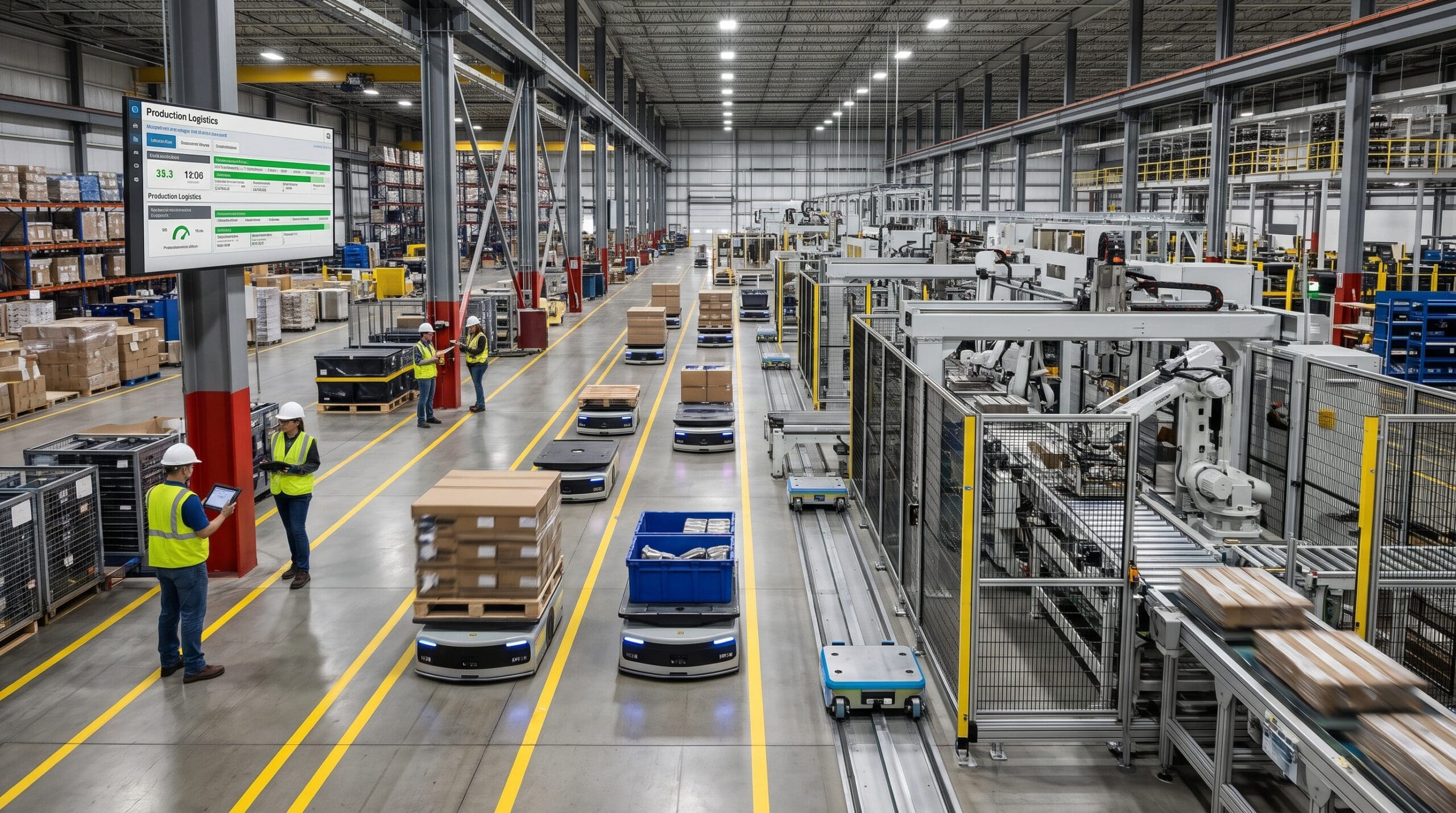
An analyst perspective on why orchestration, digital twins, and plant-floor integration matter more than the robot alone
Production logistics becomes a control problem
Rockwell Automation’s press conference presented a clear thesis: the next major productivity opportunity lies in the space between automated processes. Many factories have sophisticated machines and well-instrumented production lines, yet material still arrives through manual, disconnected workflows. The result is a familiar contradiction: a highly automated line can still depend on a forklift driver or an operator pushing a cart at its boundary.
“At the end of the line, there was a person driving a forklift and a person pushing a cart.”
That gap is where Rockwell is positioning production logistics. Rather than treating intralogistics as a stand-alone robotics project, the company describes an end-to-end workflow spanning production software, orchestration, controls, autonomous mobile robots, independent cart technology, and human work. This is a stronger industrial proposition than simply adding AMRs to a fleet. It treats the movement of work-in-process, components, packaging, and finished goods as part of the production system itself.
For manufacturers, the implication is significant. Material movement can become event-driven by production demand, quality status, inventory availability, and equipment conditions. The operational objective shifts from “dispatch a robot” to “maintain the production plan.”
From connected operations to autonomous response
Rockwell placed production logistics within a broader progression from connected operations to predictive and increasingly autonomous plants. Its “sense, think, act” framing is familiar in robotics, but the company extends the concept beyond the mobile robot to machines, lines, and plant-level workflows. Sensors establish context, software evaluates conditions, and physical assets execute the response, with a human retained in the loop where risk or uncertainty requires oversight.
“The right product to the right spot at the right time.”
This framing addresses one of the hardest problems in plant automation: local optimization does not automatically create system optimization. A packaging machine can be highly efficient while waiting for film. An assembly cell can meet its cycle time but starve because a component was not replenished in sequence. A warehouse can optimize picks while production priorities have already changed. The value of autonomy therefore depends on coordinating decisions across the workflow, not maximizing the utilization of each asset in isolation.
Rockwell’s stack: simulate, orchestrate, move
The press conference organized the production-logistics portfolio into three layers: simulation, orchestration, and movement. Together, these layers indicate how Rockwell intends to differentiate from robot-centric competitors and warehouse-only automation providers.
1. Simulate the operating model
Digital twins can validate layouts, traffic, throughput, safety zones, and control logic before equipment is commissioned. Rockwell also argued that major end users increasingly expect machine builders to provide a digital twin with the physical machine. In production logistics, that model has continuing value because routes, product mixes, cell configurations, and replenishment rules change over the asset lifecycle. A useful digital twin should therefore evolve from a commissioning tool into an operational decision-support asset.
2. Orchestrate work across people and assets
FactoryTalk Orchestration is central to the strategy. Rockwell said customer experience after its AMR acquisition revealed that the real challenge was coordinating robots with carts, people, machines, and software. That observation is directionally correct. Mixed environments will remain the norm for years, and manufacturers need workflow logic that can assign the next best task to an AMR, fixed system, or person while preserving production priorities.
The most compelling orchestration use case is dynamic response. If a supply-chain issue changes raw-material availability, the production schedule, material calls, and execution sequence should adjust together. This requires integration with manufacturing execution and production management systems, not merely fleet management.
3. Move material with the appropriate technology
Rockwell’s movement layer includes AMRs and independent cart technology, supplemented by robotics partners for applications such as palletizing. The portfolio reflects a practical reality: production logistics is not a single-robot category. Different workflows may require mobile transport, precise linear motion, storage and retrieval, or robotic handling. Competitive advantage will depend on coordinating these technologies as one workflow and integrating them to the control layer.
The Twinsburg case shows the value of integration
Rockwell used its Twinsburg, Ohio, plant as the principal proof point. The deployment began with autonomous material movement to reduce manual cart handling. The second phase integrated that capability with FactoryTalk production software, allowing the system to deliver the correct material in the required place, time, amount, and sequence.
According to the presentation, benefits from the first phase appeared in less than a month, while the interval between the first and second phases was approximately four to six months. Rockwell emphasized that workers were reassigned to higher-value plant roles rather than eliminated. The integrated phase reportedly reduced floor-space requirements and work-in-process, creating working-capital benefits in addition to labor-productivity gains.
“As soon as the pilot works, we immediately go to: how do we scale it across our facility?”
The case also illustrates an important adoption pattern. A transport-only pilot can establish safety, reliability, and workforce acceptance quickly. The larger business case emerges when the pilot is connected to production software and scaled across workflows. This is where manufacturers should measure schedule adherence, line starvation, work-in-process, floor-space consumption, indirect labor, and changeover performance, rather than focusing only on robot travel or labor displacement.
Manufacturing and warehousing are converging, but not becoming identical
Rockwell sees growing integration between production lines, adjacent warehouses, automated storage and retrieval systems, and shipping docks. Co-located manufacturing and warehousing make this convergence especially visible: components move from storage to assembly, finished goods move from the line to storage, and production priorities influence downstream handling.
However, Rockwell’s strongest position remains production logistics rather than general e-commerce fulfillment. The company can connect manufacturing software and controls to physical movement, whereas fulfillment specialists often optimize high-volume picking and seasonal labor flexibility. In warehouse environments, Rockwell must also integrate with warehouse management and warehouse execution systems. That makes interoperability, APIs, and ownership of workflow decisions crucial architectural questions.
Truck loading and unloading remain an important boundary. Rockwell described these applications as technically difficult because trailers vary, loads shift, and safety conditions are less controlled. This is a useful reminder that autonomous material flow will advance unevenly. Structured, repeatable movement inside the plant will automate faster than variable dock-edge work.
What manufacturers should do now
Start with a production constraint, not a robot count. Select a workflow where material availability affects throughput, such as line-side replenishment, packaging-material delivery, work-in-process transfer, or finished-goods evacuation. Define the baseline using line-starvation minutes, replenishment response time, indirect travel, and WIP.
Design the integration before the pilot. Document interfaces to MES or production management, ERP, WMS/WES, controls, safety systems, and identity services. A pilot that cannot exchange production status and task priorities may prove navigation but will not prove production value.
Model the mixed environment. Assume people, forklifts, carts, AMRs, conveyors, and fixed automation will coexist. Validate traffic, exceptions, manual recovery, charging, and safe-state behavior using a digital model before scaling.
Use phased economics. Separate phase-one transport savings from phase-two operational gains. The latter may include lower WIP, recovered floor space, better sequence adherence, fewer shortages, and higher OEE. These benefits often justify integration effort more than labor savings alone.
Build change management into commissioning. Create role-specific training for operators, maintenance, supervisors, controls engineers, and IT/OT teams. Define who owns workflow rules, exception handling, fleet availability, cybersecurity, and continuous improvement.
Analyst assessment
Rockwell’s production-logistics message is strategically credible because it aligns with the company’s installed base and its ability to integrate software, controls, motion, and robotics. The acquisition of an AMR platform supplied a visible physical asset, but orchestration is the more consequential layer. If Rockwell can make FactoryTalk Orchestration open enough to coordinate heterogeneous equipment and straightforward enough for plants to deploy repeatedly, it can compete for a broader share of the intralogistics architecture.
Execution risks remain. Manufacturers operate mixed fleets and multiple software systems, so closed or overly Rockwell-centric workflows would limit adoption. Digital-twin value also depends on maintaining models after commissioning, a discipline many plants have not established. Finally, the ROI claims in the transcript include several partially captured figures; buyers should request validated baselines, calculation methods, and comparable references before generalizing the Twinsburg results.
The larger trend is clear: production logistics is moving from an indirect support function toward a software-defined component of plant operations. The winners will not be determined only by the best mobile robot. They will be the suppliers that connect material movement to production intent, manage exceptions across people and machines, and turn successful pilots into repeatable plant-wide operating models.
The post Beyond the AMR: Rockwell’s Production Logistics Strategy Connects Material Flow to Plant Autonomy appeared first on Logistics Viewpoints.
Non classé
DHL Supply Chain and the End of Peak Season: Can Warehouse Robotics Flex Fast Enough?
Published
2 heures agoon
20 novembre 2026By
For decades, warehouse peak season was something operators could circle on a calendar. Black Friday arrived. Holiday orders surged. Distribution centers added temporary labor, opened extra shifts, increased transportation capacity, and prepared for several frantic weeks before volumes settled back into something resembling normal. That model is becoming considerably less reliable.
Promotions happen more frequently. E-commerce demand can change quickly. Product launches can create sudden volume spikes. Weather, geopolitical disruptions, tariffs, and viral products can alter demand patterns with little warning. For warehouse operators, the challenge is shifting from preparing for the peak to operating in an environment where a peak can appear almost anywhere. That change makes warehouse automation interesting for a reason that has relatively little to do with eliminating labor. The more important question may be: Can automation give a warehouse capacity exactly when it needs it?
DHL Supply Chain Offers an Interesting Test
A recent article from DHL Supply Chain provides a useful example. The company says it operates more than 9,000 collaborative robots globally, after adding roughly 1,000 units during the previous year. More interestingly, DHL says it can temporarily expand its active robot fleet by approximately 30 percent during peak periods. Its robotic systems have also supported more than 1.5 billion item picks. That 30 percent figure deserves attention.
Traditional warehouse automation economics have often been built around relatively stable throughput assumptions. A conveyor, sorter, or large AS/RS may produce tremendous productivity, but operators generally cannot add 30 percent more conveyor for November and remove it in January. Mobile robotics changes that calculation. If additional robots can be deployed temporarily, operators can begin treating automated capacity somewhat more like seasonal labor: bring it in when volumes rise, reduce it when demand falls. That is potentially a major change in warehouse economics.
The Biggest Automation Users Still Have an Advantage
There is, however, an important caveat. Scale matters. Recent research from Link Logistics estimates that only around 6 percent of North American warehouses are highly automated, while approximately 63 percent remain fully manual and another 31 percent have some degree of partial automation. The research also identifies Amazon and Walmart as the two largest deployers of warehouse robotics in the United States. Amazon had deployed more than one million robots across its fulfillment operations by mid-2025, according to the research. Meanwhile, Walmart reports that roughly 60 percent of its stores receive merchandise from automated distribution centers and more than half of its fulfillment-center volume moves through automated systems.
Those numbers demonstrate what automation can accomplish at extraordinary scale. But most warehouses are not Amazon warehouses. That distinction is important because the next phase of warehouse automation adoption will depend less on proving robotics works and more on proving that the economics work for operators with fewer facilities, lower throughput, shorter customer contracts, and greater SKU variability.
From Maximum Throughput to Flexible Throughput
Warehouse automation suppliers have traditionally competed on measures such as picks per hour, storage density, labor reduction, accuracy, and maximum throughput. Those measures remain important. But another metric deserves a place on the automation scorecard: How quickly can capacity be added or removed?
Imagine two warehouses capable of processing 20,000 orders per day. Warehouse A can reach 30,000 orders, but doing so requires designing permanent automation around peak capacity. Warehouse B normally operates at 20,000 but can add robots, shifts, or automated workcells when volume jumps. The first operation may offer superior theoretical throughput. The second could potentially offer better economics if demand is volatile. That makes utilization especially important. An expensive automation system producing impressive performance for six weeks but running well below capacity for the other 46 weeks may not deliver the return suggested by peak-season numbers. Flexible robotics begins to change that equation.
Software Becomes Part of the Capacity Question
Adding robots is only useful if the warehouse can coordinate them. This is why orchestration, WMS integration, labor management, and real-time decision-making are becoming more central to automation strategy. Recent research expects AI-based warehouse systems increasingly to coordinate conveyors, picking systems, mobile robots, and other resources rather than simply optimize individual machines. That means tomorrow’s warehouse automation competition may not simply be robot versus robot. It could increasingly be about how quickly the entire operation can rebalance itself.
If 50 additional AMRs arrive for a seasonal surge, can the WMS allocate work effectively? Can charging infrastructure support them? Can workers be trained quickly? Do picking stations become the new bottleneck? Can outbound sortation handle the additional volume? Adding robotic capacity to one process while starving another simply moves the queue.
The New Peak-Season ROI Question
Warehouse executives evaluating automation should therefore ask vendors questions that extend beyond equipment specifications:
How much additional capacity can I activate during a demand spike?
How quickly can that capacity be deployed?
What happens to utilization during slower months?
Where does the next operational bottleneck appear?
What additional labor is required as robotic capacity increases?
What software, charging, networking, or workstation investments are necessary?
Can capacity move between facilities?
These questions shift automation ROI from “How many people can this technology replace?” toward “How economically can this operation respond to demand?” That is a much more useful discussion.
Takeaway
Warehouse automation is moving beyond a simple labor-substitution story. Amazon and Walmart demonstrate what automation can achieve at enormous scale, while DHL Supply Chain’s ability to expand its active robot fleet during peak periods points toward another potentially important model: automation as elastic operating capacity. For warehouse operators, that distinction matters.
The best automated warehouse may not be the facility with the most robots, the highest theoretical throughput, or even the smallest workforce. It may be the warehouse that can absorb tomorrow’s unexpected volume without having to redesign today’s operation. And in a supply chain where peak season increasingly refuses to stay on the calendar, flexibility itself may become one of automation’s most valuable returns.
The post DHL Supply Chain and the End of Peak Season: Can Warehouse Robotics Flex Fast Enough? appeared first on Logistics Viewpoints.
Non classé
Ocean Freight Resilience Is a Network Design Problem, Not a Routing Exercise
Published
5 heures agoon
20 novembre 2026By
The moment a major ocean corridor becomes unreliable, transportation teams look for substitute sailings. That can be necessary, but the ability to shift a vessel is not the same as the ability to continue serving customers. Effective resilience requires alternative ports, inventory positions, service commitments and cross-border processes to be designed before the disruption. In that sense, ocean risk is a capital-allocation and network-design question rather than simply a routing calculation.
A shipping route is not an executable supply network
A route is a sequence of transportation links. A network is the system of production sites, suppliers, inventories, ports, carriers, customs procedures, and customers that makes the route useful. A vessel diversion may add days or weeks, but the effects depend on what inventory is available elsewhere and which orders are most sensitive to delay. Two vendors in different countries may depend on one upstream component source. Two ocean services may share a transshipment hub. A customer may have several ports available but only one qualified distribution center. These common points of failure are rarely visible in a simple routing plan.
Suppose a manufacturer routes its inbound containers through a second port. The ocean service may be available, yet drayage capacity, customs brokerage, receiving labor and warehouse dock appointments could all be constrained. A different arrival location also changes inland distances, chassis needs and the inventory available to support customer orders. A scenario that merely substitutes a port code in the transportation system understates the work required to preserve service.
Risk-adjusted network design should compare the total cost of holding options open. That includes qualifying a secondary terminal, maintaining carrier and 3PL relationships, reserving strategically placed buffer inventory and documenting customs or inspection requirements. The cost of resilience is partly visible in premiums and working capital. Its value is visible in the orders that can still be fulfilled after the original plan fails. The correct unit of analysis is therefore a recoverable customer commitment, not an isolated container move.
A useful stress test begins with a specific customer obligation. Imagine an importer with seven days of finished-goods coverage and an ocean disruption that adds twelve days before replenishment can reach its distribution center. The arithmetic implies five days of potential service exposure, before accounting for demand volatility and any inventory already in transit. A second port is valuable only if inland transport, customs documentation and receiving capacity can turn that rerouted freight into inventory during those five days. The example is illustrative, but the decision logic is general: recoverable orders, not alternative sailings, are the unit of resilience.
Inventory and port options must be designed together
Resilience is often defined too vaguely to guide investment. More stock, more suppliers, and more carriers sound prudent, but each entails cost and complexity. A second supplier requires qualification, demand allocation, technical documentation, and enough business to remain viable. A second port requires drayage, warehousing, customs, and system changes. A buffer inventory may preserve service through a disruption while creating obsolescence risk. The economic question is how much recovery capability each additional dollar buys, and for which business-critical flows. Not every SKU requires the same level of protection.
A useful design exercise identifies failure scenarios and traces their operational consequences. Model the days of cover for critical components, the time to activate alternate suppliers, container availability after a diversion, and the working capital associated with each response. Specify triggers for action rather than relying on a crisis meeting to select an emergency option. Test assumptions with freight providers and operational teams that own the relevant transfers. Digital models can be helpful, but they need real lane data and documented constraints. A network that looks resilient in a diagram may prove fragile when a port changes gate hours or an alternate supplier lacks production capacity.
Ocean disruptions expose a recurring error in supply chain design: route alternatives are often described as if they can be purchased after the disruption has occurred. A second port is not a real alternative without drayage capacity, inland transportation, customs processes, receiving capacity and an inventory plan that can absorb a different arrival pattern. The commercial relationship must be viable under normal conditions or it may not exist when everyone wants the same contingency route.
This is also a supplier-qualification issue. Two assembly plants may appear geographically diversified but depend on the same component producer, transshipment hub or specialist import broker. A real alternative requires confirmed production capacity, usable trade documents and enough lead-time advantage to matter to the downstream customer. I would ask the network team to trace common dependencies before paying for ostensibly independent routes. Otherwise the organization can spend money on redundancy without actually reducing its exposure to a shared failure.
Price resilience as a portfolio of options
Resilience investments should be judged as options with a price and an exercise condition. A dual-port strategy has recurring costs: fragmented volume, more complex inventory placement, additional drayage relationships and potentially less negotiating leverage. Its benefit appears when the primary route is disrupted and the network can continue serving customers. The relevant calculation is therefore the expected value of avoided losses plus the value of faster recovery, not the fiction that the alternate route is always cheaper.
I would begin with product and customer consequences rather than a map of possible ports. Which goods have fixed selling windows? Which plants cannot absorb a week of uncertainty? Which materials can be substituted, and which have no qualified alternative? Those questions identify where a backup routing actually creates value. In some categories, carrying more inventory may cost less than paying for a permanently redundant transport path. In others, a reliable second entry point may protect far more value than its annual operating cost.
Options have expiration dates. A backup port contract is not useful if the drayage provider’s reserved capacity has lapsed, the inland terminal lacks space or the customs profile has not been maintained. Each option needs an activation threshold, economic owner, lead time and verification cadence. This makes resilience measurable: the cost of keeping the option ready versus the avoided service loss and the time it would take to restore normal operations. It also discourages indiscriminate duplication where modest targeted inventory would provide a better protection level.
Put decision rights and end-to-end recovery on the scorecard
The most useful ocean scorecard includes the distribution of end-to-end transit time, order-fill performance during a disruption, days of inventory exposure and the time required to activate a backup lane. Historical carrier reliability is valuable, but it must be interpreted carefully. Sea-Intelligence’s September 2026 release documents a volatile schedule environment; the company subsequently corrected a subset of alliance-level calculations. For executives, the lesson is to use the latest reconciled performance data and not treat a single network-average percentage as a substitute for lane-specific planning.
The governance question is just as important. Who may authorize a port diversion, release contingency stock or accept a higher landed cost to protect a priority customer? If those decisions require days of ad hoc approval, a carefully modeled backup network will perform like one that never existed. Resilience requires pre-negotiated triggers, commercially viable alternatives and the authority to act. A network earns its resilience designation only when the alternate plan can actually run.
Test the design with scenarios defined in time and throughput: a main port unavailable for ten days, a transshipment hub congested for a month, or a shipping corridor requiring an extended diversion. Then measure feasible orders served, working capital, total landed cost and time to return to normal service. Shipping lines can contribute vessel options and information, but the shipper owns the architecture of the whole network. Resilience is a business design decision with a transportation component, not the other way around.
For an executive review, I would require the team to report the number of critical orders preserved during the scenario, the maximum inventory shortfall, recovery duration and incremental landed cost. Those measures show whether customers remain served while the primary route is unavailable. An ocean resilience program succeeds when the organization has already made the cross-functional choices that a diversion will require; it fails when a delayed vessel is simply replaced by a succession of unplanned domestic exceptions.
The post Ocean Freight Resilience Is a Network Design Problem, Not a Routing Exercise appeared first on Logistics Viewpoints.


Beyond the AMR: Rockwell’s Production Logistics Strategy Connects Material Flow to Plant Autonomy
DHL Supply Chain and the End of Peak Season: Can Warehouse Robotics Flex Fast Enough?
Who Authorizes the AI Agent? A Supply Chain Lesson from OpenAI’s Daybreak Red
Freightos Global Freight Outlook – September 2026
Container rates jump another $1k/FEU – but is demand peaking? – July 8, 2026 Update

Walmart and the New Supply Chain Reality: AI, Automation, and Resilience
Trending
- Non classé3 mois ago
Freightos Global Freight Outlook – September 2026
- Non classé4 mois ago
Container rates jump another $1k/FEU – but is demand peaking? – July 8, 2026 Update
-
 Non classé2 ans ago
Walmart and the New Supply Chain Reality: AI, Automation, and Resilience
-

 Non classé7 mois ago
Why Sulfuric Acid Is Emerging as a Supply Chain Constraint in Copper
- Non classé6 mois ago
Container rates starting to spike on peak season rush – June 2, 2026 Update
- Non classé1 an ago
13 Books Logistics And Supply Chain Experts Need To Read
- Non classé1 an ago
Ex-Asia ocean rates climb on GRIs, despite slowing demand – October 22, 2025 Update
- Non classé5 mois ago
LCL Shipping Cost Calculator: Calculate Air and Sea Shipping Freight Rates