
Non classé
The Next Logistics Capacity Investment May Not Be Another Building

Published
15 heures agoon
By
When a distribution center begins to run out of capacity, the conversation usually turns to physical expansion. The company may need another building, a larger yard, additional dock doors, more equipment, or a second site closer to customers. Those are familiar decisions, supported by familiar metrics: square footage, pallet positions, average volume, and the cost of carrying another lease.
There is a question that should come before the capital request. Is the network actually short of physical capacity, or is too much of the capacity it already owns being lost between activities? A dock door waiting for a late trailer is technically available but not productive. A switcher that cannot identify the next trailer to move is on the payroll but not adding throughput. A shipment that cannot be scheduled may tie up inventory even while the warehouse has labor ready to load it.
The answer matters because building capacity and recovering capacity are different investments. One expands the physical system; the other improves how the existing system is used. In the right circumstances, the second can deliver faster returns with less capital at risk. It will not eliminate every expansion, but it can prevent companies from mistaking operational friction for a structural shortage.
Red Gold illustrates the capacity hidden in scheduling
Food manufacturer Red Gold offers a concrete example. Its distribution operations once depended on large volumes of phone calls and email exchanges to coordinate dock appointments. In peak periods, some carriers could face a wait of two weeks to book a slot. That scheduling delay did not mean the operation had no physical space in an absolute sense; it meant access to available capacity was poorly coordinated.
In a case study published by Opendock and Loadsmart, Red Gold reported moving more than 60,000 annual appointments into online carrier self-scheduling. Appointment lead times fell 90%, from double-digit days to roughly one or two days, and case throughput increased 18%. The customer also introduced transportation management and brokerage changes, including ShipperGuide. It would therefore be too simplistic to credit every improvement to a single scheduling product.
The operational logic is nevertheless compelling. Advance notice allows a facility to stage orders, allocate docks and labor, and reduce the uncertainty created by a constant stream of last-minute phone calls. Employees who previously entered appointments can devote more attention to exceptions. Carriers gain a clearer path to an available slot instead of repeatedly contacting the shipper to discover one.
None of that creates new square footage. It improves the utilization of the square footage already present, which is exactly why scheduling belongs in a capital planning conversation rather than being classified as an administrative convenience.
Rated capacity is not realized capacity
Capacity planning often treats the warehouse as a set of tangible resources: doors, lift trucks, people, storage positions, conveyor rates, or pick locations. But the actual output of those resources depends on synchronization. A dock cannot be productive merely because it exists; freight, equipment, documentation, labor, and a usable appointment window must arrive together.
Consider a simplified facility with 30 dock doors operating across sixteen scheduled hours, with each transaction averaging two hours of door time. Its theoretical, uninterrupted maximum is 240 trailer transactions per day. At 70% productive occupancy, that falls to 168. Increasing productive occupancy to 80% yields 192 transactions—a gain of approximately 14% relative to realized throughput. These figures are an illustration, not a real facility result, and they assume receiving, storage, and shipping operations can absorb the extra volume.
That caveat is crucial. No facility should be operated at 100% utilization at all times. Maintenance, arrival variability, worker safety, late orders, and disruption recovery require buffer capacity. The objective is not to eliminate slack indiscriminately. It is to distinguish deliberate resilience from avoidable idle time, and then determine what the extra capacity would actually be worth.
The same argument applies across a multi-site network. One overloaded facility and one underutilized facility do not necessarily offset each other, because the freight may be in the wrong place, on the wrong timetable, or attached to the wrong customer commitments. The right unit of analysis is the flow of orders through the network, not simply aggregate square footage.
What dock coordination can recover
GoBolt offers an example closer to the receiving operation. In a 2025 Opendock customer case study, the fulfillment provider reported a 20% improvement in inbound receiving efficiency after replacing fragmented appointment coordination with a more consistent scheduling process. The company also reported recovering 10 to 15 hours of administrative work each week. Those are provider-published operational results, not an audited calculation of avoided building investment, but they show how better arrival predictability can help a receiving team extract more work from its existing doors and shifts.
The distinction between receiving efficiency and physical expansion is important. If more freight can be accepted and processed in the same labor window, management may have room to defer a capital project or meet a seasonal peak without adding a shift. That conclusion requires evidence: gate-to-door time, unload duration, dock-to-stock performance, staffing, and the utilization of downstream storage and putaway resources. A faster appointment system alone cannot prove that the entire facility has gained equivalent usable capacity.
Ralph Moyle, a food-and-beverage warehousing and transportation provider, presents a second dimension of the problem. Its operation coordinated as many as 500 weekly appointments across 37 dock doors. According to an Opendock case study published in November 2025, the organization reduced labor devoted to dock scheduling by more than 30% and gained clearer information on carrier punctuality and detention windows. This is a scheduling-labor result, not a published 30% improvement in warehouse throughput. It nonetheless illustrates a recurring investment choice: deploy scarce people against routine coordination, or free them to handle the exceptions and operating constraints that determine service.
Together, Red Gold, GoBolt, and Ralph Moyle suggest a capital-planning sequence rather than a universal savings percentage. First, measure whether appointment variability and inefficient handoffs are preventing existing assets from delivering their designed throughput. Next, test a bounded change to scheduling and execution, measuring both operational output and service reliability under actual peak conditions. Only then compare recovery investments against a larger building, additional doors, or other capacity additions. Supplier case studies establish plausible mechanisms; the company’s own operational and financial baseline must establish the return.
Treat avoided capital as an option, not a guaranteed saving
There is a temptation to translate every percentage point of productivity improvement into a claim that a new warehouse can be avoided. That overstates the evidence. A throughput gain at one dock or yard may merely move congestion downstream to picking, storage, staging, or outbound transportation. It may also be insufficient to cover peak demand, seasonal swings, or a required redundancy plan.
A rigorous alternative-to-expansion study should therefore define the specific capacity shortage and test the whole process. Start with actual hourly and daily flow data, not averages alone. Identify the constraining resource under peak conditions. Determine the amount of lost capacity attributable to preventable waiting or information errors, estimate the cost to recover it, and confirm that other resources can absorb the improvement. Compare that option with expansion through a common net-present-value analysis, including implementation risk, service impact, and flexibility.
For the CFO, the value of operational improvement is often optionality. A relatively modest investment in scheduling, yard coordination, or workflow redesign may postpone a lease commitment, provide better evidence about the true need for new space, or help size a future facility more accurately. Deferral is not the same as permanently avoiding an investment, and the distinction should appear in the financial model.
For operations leaders, this changes the questions asked of technology vendors. Instead of buying ‘visibility’ or ‘AI’ as abstract capabilities, they can ask what utilization constraint will be removed, what operating metric should change, who must act on the information, and how quickly a measurable result should appear.
The next warehouse may eventually be necessary. Demand growth, service commitments, and network resilience will continue to require physical expansion. But before pouring concrete, companies should understand how much of their current investment is stranded in queues, mismatched schedules, and preventable handoffs. More capacity sometimes starts with another building. Sometimes it starts with getting tomorrow’s truck into the right dock today.
The post The Next Logistics Capacity Investment May Not Be Another Building appeared first on Logistics Viewpoints.
You may like
Non classé
Walmart’s $6 Billion Automation Bet and DHL’s Orchestration Strategy: Two Playbooks, One Hard Question
Published
6 heures agoon
13 novembre 2026By
Two announcements in the past three weeks sum up where warehouse automation stands at the end of 2026. On October 29, Walmart and Symbotic expanded their commercial agreement to bring more automation to 25 U.S. regional distribution centers, with an initial commitment of roughly $6 billion spread over several years. Eleven days later, DHL Supply Chain described a very different path: it is scaling the robots it already runs, moving AI orchestration into live warehouses, and piloting what it calls adaptive robotics.
Both are spending heavily, but betting on different ideas about what makes automation pay. For most operators, who are neither Walmart nor DHL, the difference between those ideas matters more than the size of either announcement.
Playbook One: One Vendor, One System, Network Scale
Walmart’s approach is consolidation. Symbotic now supplies a full system rather than a single product: high-density case storage, BreakPack for picking individual items, and SymMicro for store-based e-commerce fulfillment, all run by Symbotic’s own software. Walmart says the expansion will support e-commerce inventory upstream, add storage capacity and make replenishment more reliable.
When one company owns the storage structure, the robots and the control software, there are fewer handoffs between systems from different vendors, and fewer places for goods to pile up when one system cannot see what another is doing. The track record also lends weight. Symbotic reported fiscal third-quarter revenue of $721 million, up 22% year over year, with 56 systems operating and 77 in deployment. Symbotic reported in August that deployment of BreakPack had begun at half of Walmart’s regional distribution centers.
Still, this is a commitment, not a result, and key pieces are still being proven. The first next-generation SymMicro unit was expected to take about six months to install at a Walmart store, and a possible order for 400 back-of-store systems depends on validating that second version. Symbotic itself has said its next revenue and margin inflection is expected in the second half of fiscal 2027.
Playbook Two: Many Robots, One Brain
DHL Supply Chain is betting on coordination rather than consolidation. The company says it has deployed more than 9,000 robots, completed more than 1.5 billion robotic picks and unloaded more than 10 million cases using Boston Dynamics’ Stretch robot. More than 95% of its global warehouses already use advanced digital tools.
The next step is orchestration. After a proof of concept, DHL is putting AI orchestration into live operations as a digital control layer that links data, workers and automated equipment. One workflow it is testing connects mobile robots, packaging automation and the warehouse management system so that resources shift with real-time order demand.
That approach suits a contract logistics provider. DHL serves many customers in many buildings, often on shorter contracts than a retailer would accept for a fixed system. Flexibility is the business model. DHL frames the goal as adding to its workforce, not replacing it. These investments support DHL Group’s broader Strategy 2030 ambition of increasing revenue by 50%.
The Reality Check Most Headlines Skip
Adoption across the market is still thin. Link Logistics, citing Kardex data, reports that about 63% of North American warehouse operations remain fully manual and only about 6% are highly automated, a share that has barely changed since 2024. Integration commonly takes 12 to 18 months and can run past two years for larger systems.
GXO offers another useful reality check. The company is expanding its partnership with Agility Robotics, with Digit humanoids scheduled for deployment at two additional U.S. facilities in 2027. Yet in August, CEO Patrick Kelleher acknowledged that humanoids had not achieved satisfactory returns on investment and that scaled production remained some years away. GXO expects approximately 20,000 robots across its network by year-end, illustrating the considerable distance between conventional robotics adoption and humanoid commercialization.
Scale is still the deciding factor. Walmart can justify a dedicated, end-to-end system because its volume is so large. DHL can justify an orchestration layer because it spreads that investment across more than 9,000 robots and a global network of warehouses.
What Operators Should Ask Before Choosing a Path
For mid-sized shippers, distributors and 3PLs, the lesson is not to copy either company but to be clear about the problem being solved. Four questions help:
Is volume stable enough to justify fixed automation? Dense, integrated systems reward predictable, high-volume flow. Volatile demand favors mobile robots that can be redeployed.
Who owns the control software? Mixing equipment from different suppliers without a single coordinating layer can create bottlenecks at every handoff. Decide who directs the work before buying the hardware.
What happens after go-live? Ask suppliers for evidence on uptime, maintenance cost, recovery from faults and throughput in month 18, not just at commissioning.
Where do people fit? Both Walmart and DHL describe automation as simplifying work for employees rather than removing them. Training, exception handling and clear decision rules for when a robot hands off to a person belong in the business case.
The Bottom Line
Walmart’s $6 billion commitment shows what a single, tightly integrated system can look like at network scale. DHL’s update shows how orchestration can turn a large, mixed robot fleet into one operation. For everyone else, the more useful question is which approach matches their own volume, contracts and tolerance for risk.
The post Walmart’s $6 Billion Automation Bet and DHL’s Orchestration Strategy: Two Playbooks, One Hard Question appeared first on Logistics Viewpoints.
Non classé
Walmart’s $6 Billion Automation Bet and DHL’s Orchestration Strategy: Two Playbooks, One Hard Question
Published
6 heures agoon
13 novembre 2026By
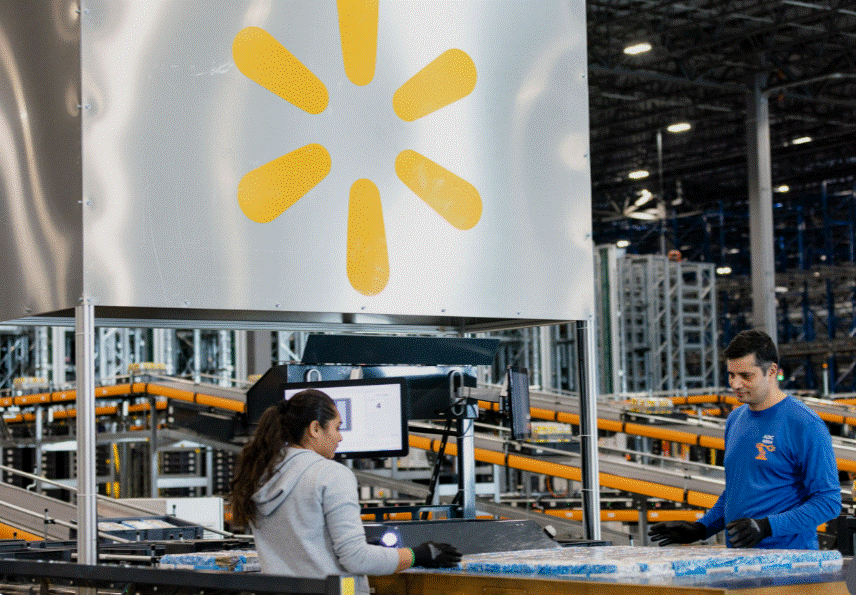
Two announcements in the past three weeks sum up where warehouse automation stands at the end of 2026. On October 29, Walmart and Symbotic expanded their commercial agreement to bring more automation to 25 U.S. regional distribution centers, with an initial commitment of roughly $6 billion spread over several years. Eleven days later, DHL Supply Chain described a very different path: it is scaling the robots it already runs, moving AI orchestration into live warehouses, and piloting what it calls adaptive robotics.
Both are spending heavily, but betting on different ideas about what makes automation pay. For most operators, who are neither Walmart nor DHL, the difference between those ideas matters more than the size of either announcement.
Playbook One: One Vendor, One System, Network Scale
Walmart’s approach is consolidation. Symbotic now supplies a full system rather than a single product: high-density case storage, BreakPack for picking individual items, and SymMicro for store-based e-commerce fulfillment, all run by Symbotic’s own software. Walmart says the expansion will support e-commerce inventory upstream, add storage capacity and make replenishment more reliable.
When one company owns the storage structure, the robots and the control software, there are fewer handoffs between systems from different vendors, and fewer places for goods to pile up when one system cannot see what another is doing. The track record also lends weight. Symbotic reported fiscal third-quarter revenue of $721 million, up 22% year over year, with 56 systems operating and 77 in deployment. Symbotic reported in August that deployment of BreakPack had begun at half of Walmart’s regional distribution centers.
Still, this is a commitment, not a result, and key pieces are still being proven. The first next-generation SymMicro unit was expected to take about six months to install at a Walmart store, and a possible order for 400 back-of-store systems depends on validating that second version. Symbotic itself has said its next revenue and margin inflection is expected in the second half of fiscal 2027.
Playbook Two: Many Robots, One Brain
DHL Supply Chain is betting on coordination rather than consolidation. The company says it has deployed more than 9,000 robots, completed more than 1.5 billion robotic picks and unloaded more than 10 million cases using Boston Dynamics’ Stretch robot. More than 95% of its global warehouses already use advanced digital tools.
The next step is orchestration. After a proof of concept, DHL is putting AI orchestration into live operations as a digital control layer that links data, workers and automated equipment. One workflow it is testing connects mobile robots, packaging automation and the warehouse management system so that resources shift with real-time order demand.
That approach suits a contract logistics provider. DHL serves many customers in many buildings, often on shorter contracts than a retailer would accept for a fixed system. Flexibility is the business model. DHL frames the goal as adding to its workforce, not replacing it. These investments support DHL Group’s broader Strategy 2030 ambition of increasing revenue by 50%.
The Reality Check Most Headlines Skip
Adoption across the market is still thin. Link Logistics, citing Kardex data, reports that about 63% of North American warehouse operations remain fully manual and only about 6% are highly automated, a share that has barely changed since 2024. Integration commonly takes 12 to 18 months and can run past two years for larger systems.
GXO offers another useful reality check. The company is expanding its partnership with Agility Robotics, with Digit humanoids scheduled for deployment at two additional U.S. facilities in 2027. Yet in August, CEO Patrick Kelleher acknowledged that humanoids had not achieved satisfactory returns on investment and that scaled production remained some years away. GXO expects approximately 20,000 robots across its network by year-end, illustrating the considerable distance between conventional robotics adoption and humanoid commercialization.
Scale is still the deciding factor. Walmart can justify a dedicated, end-to-end system because its volume is so large. DHL can justify an orchestration layer because it spreads that investment across more than 9,000 robots and a global network of warehouses.
What Operators Should Ask Before Choosing a Path
For mid-sized shippers, distributors and 3PLs, the lesson is not to copy either company but to be clear about the problem being solved. Four questions help:
Is volume stable enough to justify fixed automation? Dense, integrated systems reward predictable, high-volume flow. Volatile demand favors mobile robots that can be redeployed.
Who owns the control software? Mixing equipment from different suppliers without a single coordinating layer can create bottlenecks at every handoff. Decide who directs the work before buying the hardware.
What happens after go-live? Ask suppliers for evidence on uptime, maintenance cost, recovery from faults and throughput in month 18, not just at commissioning.
Where do people fit? Both Walmart and DHL describe automation as simplifying work for employees rather than removing them. Training, exception handling and clear decision rules for when a robot hands off to a person belong in the business case.
The Bottom Line
Walmart’s $6 billion commitment shows what a single, tightly integrated system can look like at network scale. DHL’s update shows how orchestration can turn a large, mixed robot fleet into one operation. For everyone else, the more useful question is which approach matches their own volume, contracts and tolerance for risk.
The post Walmart’s $6 Billion Automation Bet and DHL’s Orchestration Strategy: Two Playbooks, One Hard Question appeared first on Logistics Viewpoints.
Non classé
Why Warehouse Automation ROI Can Fail Before the Robot Starts Working
Published
1 jour agoon
12 novembre 2026By
An automated warehouse can look flawless in a vendor demonstration. Pallets move along a defined route, robots complete carefully sequenced tasks, and the control software displays a continuous flow of work. Then an actual shipment arrives with an uneven pallet, a damaged label, or a load profile that falls outside the assumptions used in the design. The robot may be working exactly as intended. The operation still slows down.
That is the uncomfortable truth in many automation business cases: a machine’s rated capacity is not the same thing as a distribution center’s realized capacity. The difference is created by everything the machine depends on—product presentation, packaging, pallet quality, data accuracy, software integration, human exception management, and the ability of the next process to accept what the machine produces. Those dependencies are neither exciting nor photogenic. They can, however, decide whether a multimillion-dollar investment earns its return.
Examples involving XPO Logistics, Staples, and Del Papa Distributing illustrate the issue from different directions. They are examples of organizations addressing the surrounding operating system, not evidence that their automation investments failed. Their experience deserves attention precisely because the mechanical equipment is only part of the story.
The first bottleneck may be the incoming pallet
At XPO Logistics’ fresh-goods operation in Nieuwegein, Netherlands, incoming products move into an automated crane warehouse. Before they enter the system, pallets undergo inspection. When the criteria for rejection do not match the actual requirements of the equipment, pallets can be diverted, placed on support pallets, or reloaded, consuming labor and slowing an operation designed to minimize manual handling.
A CHEP account of its work with XPO explains how the partners reviewed the inspection process and developed targeted employee training aligned to the warehouse’s pallet-quality needs. CHEP reports that rejected pallets and use of support, or ‘slave,’ pallets fell by approximately 50%, with better product flow and lower handling burden.
The specificity of this example matters. It was not a case of allowing unsafe pallets into automation to generate a better metric. It was a case of better distinguishing real mechanical and handling risks from characteristics that did not require rejection. Excessively broad screening can be just as damaging to throughput as insufficient inspection. An automated operation needs a standard that is demanding, measurable, and relevant to the equipment it serves.
A single rejected pallet is a small event; a steady stream of unnecessary rehandling can become an enduring cost structure. This is why upstream packaging and pallet requirements belong in the automation business case, not in a separate procurement discussion after the system is installed.
Software modernization is part of mechanical readiness
An equally important source of variability is the information controlling the work. Manhattan Associates reported in May 2025 that Staples had implemented Manhattan Active Warehouse Management across nine U.S. business-to-business fulfillment facilities within 18 months. The program was intended to improve picking accuracy, inventory management, process consistency, and integration with modern supply chain applications.
This is not a claim that Staples suffered a robotics ROI failure or that the WMS deployment alone produced a particular financial return. Its relevance is architectural. A modern automated system can move a pallet only when the surrounding organization knows what the pallet contains, where it should go, how the task relates to the order, and which exception rules apply when reality does not match the plan.
Warehouses routinely survive on informal workarounds: a supervisor recognizes an item by sight, a clerk corrects inventory after the shift, or an experienced operator knows that a certain product cannot be handled like the others. Those practices may keep a manual process functioning. They become costly weaknesses when an automated operation expects unambiguous identifiers, inventory locations, task priorities, and response rules.
Integration therefore has to be tested with the inconvenient transactions, not only with the normal ones. Short shipments, damaged units, substitutions, uncertain inventory, and orders arriving after cutoffs deserve as much attention as the average order. Otherwise a technically successful installation can leave the operating team to manage a growing collection of manual exceptions around the edges.
Del Papa closes the final gap in the workflow
Del Papa Distributing, a beverage wholesaler in Texas, provides a particularly useful example because the potential bottleneck came after robotic picking. Block One Automation’s Pallet Factory and Lantech’s wrapping equipment were integrated so that completed mixed-case orders could move from robotic pallet building through stretch wrapping and toward the dock without a person intervening at the wrapping stage.
A mixed beverage pallet is an unforgiving object. Shapes, weights, and heights vary; the load has to remain stable; and the stretch film must be controlled so it does not interfere with autonomous mobile robots or other equipment. Lantech’s September 2026 description emphasizes repeatable cycle times and reliable film-tail handling, details that can determine whether the warehouse execution system can dispatch the next job without allowing for a manual rescue.
This is the difference between automating a task and automating a process. If a robot can build 100 pallets an hour but downstream wrapping can prepare only 70 for shipment, the relevant operating capacity is not 100. A warehouse cannot bank the extra 30 pallets indefinitely without creating congestion, inventory, or additional handling. Throughput is governed by the constraint across the full chain of activities, not by the most impressive piece of equipment.
The Del Papa story is a documented integration accomplishment, not proof that every beverage facility can operate without labor or that a particular ROI was achieved. Its analytical value is showing the hidden design work required to make individually capable systems operate together.
An automation business case needs an exception budget
Financial evaluations usually capture capital expenditure, software fees, maintenance, staffing, and expected throughput. They are less consistent at estimating how often the operating environment will present a condition the equipment cannot process automatically, how long recovery will take, and what other work will be disrupted during that recovery.
A credible model should include the frequency of pallet rejections, unscannable labels, unstable loads, task failures, replenishment shortages, integration outages, and manual interventions. It should also distinguish a brief exception that can be cleared in parallel from one that stops a critical aisle or blocks the next workstation. These are different economic events, even if both are recorded as a single exception.
An illustrative system rated for 1,000 pallet movements a day might yield only 900 during real operation after allowing for unavailable material, planned downtime, process imbalance, and recovery work. The missing 100 movements are not necessarily ‘robot downtime.’ They are the gap between component specifications and operational output. Measuring that gap is the beginning of a realistic ROI calculation, not an admission that automation is a poor investment.
Procurement and engineering should also resist the temptation to solve every exception by adding more machine capacity. Sometimes the cheapest improvement is a better pallet standard, a changed inspection threshold, reliable product master data, or a more effective handoff between systems. Conversely, some physical constraints cannot be removed through software and genuinely require different equipment or facility design.
The real performance test starts before commissioning
Automation readiness is a cross-functional responsibility. Operations understands actual order variability; engineering knows machine tolerances; IT knows the data and integration risks; procurement influences handling-unit quality; and finance decides what constitutes a real, measurable improvement. The people who will clear exceptions should be represented before design decisions become expensive to reverse.
The most important question in a warehouse automation investment is not simply whether the robot will meet its specification. It is whether the entire system, including the least glamorous upstream and downstream activities, will meet the business’s required output. In the end, warehouses do not earn returns on robots. They earn returns on orders shipped accurately, safely, and at the promised cost.
The post Why Warehouse Automation ROI Can Fail Before the Robot Starts Working appeared first on Logistics Viewpoints.

Walmart’s $6 Billion Automation Bet and DHL’s Orchestration Strategy: Two Playbooks, One Hard Question
Walmart’s $6 Billion Automation Bet and DHL’s Orchestration Strategy: Two Playbooks, One Hard Question
The Next Logistics Capacity Investment May Not Be Another Building
Freightos Global Freight Outlook – September 2026
Container rates jump another $1k/FEU – but is demand peaking? – July 8, 2026 Update

Walmart and the New Supply Chain Reality: AI, Automation, and Resilience
Trending
- Non classé2 mois ago
Freightos Global Freight Outlook – September 2026
- Non classé4 mois ago
Container rates jump another $1k/FEU – but is demand peaking? – July 8, 2026 Update
-
 Non classé2 ans ago
Walmart and the New Supply Chain Reality: AI, Automation, and Resilience
-

 Non classé7 mois ago
Why Sulfuric Acid Is Emerging as a Supply Chain Constraint in Copper
- Non classé5 mois ago
Container rates starting to spike on peak season rush – June 2, 2026 Update
- Non classé1 an ago
13 Books Logistics And Supply Chain Experts Need To Read
- Non classé1 an ago
Ex-Asia ocean rates climb on GRIs, despite slowing demand – October 22, 2025 Update
- Non classé4 mois ago
LCL Shipping Cost Calculator: Calculate Air and Sea Shipping Freight Rates