
Non classé
Beyond WMS: Where Warehouse Execution Is Headed Next

Published
15 heures agoon
By
WMS is unlikely to disappear; its core responsibilities are more likely to expand into a more continuous, connected, intelligent, and selectively autonomous execution model. The category’s future is therefore less about replacement than about how warehouse execution is re-architected around real-time state and decisions.
WMS is moving from a transactional warehouse application toward a real-time execution and orchestration layer that coordinates inventory, labor, automation, and downstream transportation constraints That shift requires systems to understand not only what transaction was completed but what the current state means for the next decision. Events become inputs to a continuously refreshed operating model. The future of warehouse execution will therefore depend on the human-machine allocation described in Design the Human-Machine System: automation should expand where authority, observability, and recovery are engineered well enough to support it.
AI will be most useful where it can assemble context, interpret unstructured information, identify patterns, generate options, and support repetitive multi-step work. Optimization, rules, and traditional algorithms remain essential where constraints and feasible tradeoffs are mathematically explicit. The strongest architectures will combine these methods rather than treating one model as universal.
Routine decisions involving a late inbound trailer, a constrained dock, a wave that threatens a carrier cutoff, an automation cell that goes down, or an urgent order that must be reprioritized without destabilizing the rest of the facility can increasingly be prepared or executed automatically when policy, data confidence, financial exposure, and customer impact remain inside defined limits. Higher-consequence or ambiguous situations should continue to escalate to people. The design target is appropriate autonomy, not maximum autonomy.
As software gains more authority, decision rights have to be encoded in permissions, thresholds, workflow states, escalation paths, and audit trails. A platform should be able to reconstruct what it knew, what it recommended or changed, under whose authority, and with what result.
The provider landscape—enterprise warehouse specialists; broad supply-chain suite providers; cloud-native and midmarket WMS platforms; and execution/automation-centric platforms that increasingly overlap with WES and orchestration—will continue to overlap. Buyers should expect more partnerships, embedded intelligence, adjacent-category expansion, and competition around the control points between signal, decision, and action.
The near-term agenda is practical: define the decisions and outcomes that matter, clean up the operating state required to support them, test operational fit, configurability without excessive customization, automation integration, real-time work orchestration, data and API architecture, scalability, implementation model, upgradeability, and measurable warehouse outcomes, and measure inventory accuracy, order cycle time, throughput, labor productivity, dock-to-stock time, order accuracy, exception volume, automation utilization, and recovery time after disruption. Organizations that build those foundations can adopt new intelligence and automation incrementally without surrendering architectural control. The future will therefore be determined less by who adopts the newest label first and more by who builds the most coherent operating system around the technology.
The transition beyond WMS should be governed, not theatrical
The future warehouse will not become autonomous in one step. A more credible transition is selective: automate bounded decisions with clear inputs and consequences, improve observability around them, retain human authority where ambiguity or consequence is high, and expand autonomy only when performance evidence supports it. That approach makes governance an operating capability rather than a policy document.
Warehouse leaders should therefore build the next architecture around decision classes. Which work can be reprioritized automatically? When can labor or automation be reallocated without approval? What conditions require escalation? How are overrides recorded? How does the system learn from outcomes? The future of warehouse execution will be shaped as much by these authority boundaries as by the next generation of algorithms.
Related Logistics Viewpoints research
2026 Warehouse Management Systems Market Map
The New Architecture of Logistics
Systems Engineering in Logistics
Warehouse Execution Software for Regulated Environments – Where Compliance and Performance Meet
Previous in this series: Where WMS Fits in the New Architecture of Logistics
Request the 2026 Warehouse Management Systems Market Map Brochure
The 2026 Market Map is designed to help organizations understand the structure of the WMS market, evaluate provider differences, and identify the capabilities most relevant to their operating environment. If your organization is evaluating WMS platforms or preparing a shortlist, I would be glad to provide the Market Map brochure and discuss the evaluation questions and provider differences most relevant to your requirements.
Request the WMS Market Map Brochure
For technology providers
Providers may request the brochure, discuss the research framework, or contact me to confirm how their capabilities are represented in the market assessment.
The post Beyond WMS: Where Warehouse Execution Is Headed Next appeared first on Logistics Viewpoints.
You may like
Non classé
Auto Baggers Move Downstream: A New Approach to Packing Station Productivity
Published
16 heures agoon
27 octobre 2026By
For years, automated bagging systems have been viewed primarily as inventory preparation tools. Retailers, e-commerce companies, and third-party logistics providers (3PLs) commonly use systems from suppliers such as Pregis, PAC Machinery, Autobag, and Sharp Packaging to pre-bag products before storage or fulfillment. The value proposition has traditionally centered on reducing manual packaging labor and improving consistency. However, a growing number of warehouse operators are discovering that automated bagging technology can create even greater value when positioned directly at pack-out stations.
As distribution centers continue to battle labor shortages, rising order volumes, and pressure to improve throughput, the humble auto bagger is becoming an increasingly important tool for modern packing operations.
The Labor Challenge at the Pack Station
Packing remains one of the most labor-intensive processes within warehouse operations. Associates must select packaging, insert products, seal shipments, apply labels, and move completed orders downstream. Even in highly automated fulfillment centers, much of this work remains manual. Industry investments have focused heavily on goods-to-person robotics, autonomous mobile robots, and automated storage and retrieval systems (AS/RS). Yet many organizations still find packing stations becoming operational bottlenecks.
A typical packer may spend significant time handling bags, opening packaging materials, selecting the correct size, and manually sealing orders. While each activity may only take seconds, those seconds accumulate across thousands of daily shipments. The result is reduced throughput and increased labor costs during peak periods.
Rethinking the Role of Auto Baggers
Traditional deployment models place auto baggers upstream in the operation where inventory is packaged before being stored. While this approach provides efficiency gains, it does not fully address the labor requirements associated with order fulfillment. Instead, warehouses can deploy automated bagging systems directly at pack stations.
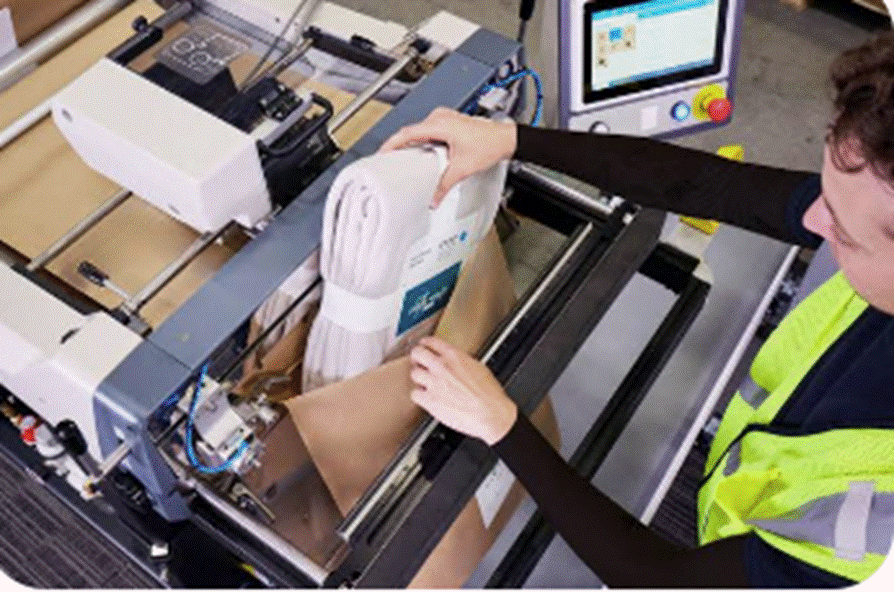
In this workflow, items arrive at the packing location via conveyor, AMR, or goods-to-person system. The auto bagger automatically presents an appropriately sized bag, the operator inserts the item, and the system prints labels and seals the package in a single process. By eliminating manual bag handling and sealing steps, workers can focus on exception management and order verification rather than repetitive packaging tasks. The result is a streamlined process capable of supporting substantially higher throughput per operator.
A Better Fit for E-Commerce
The model is particularly compelling for e-commerce operations shipping a high percentage of soft goods, apparel, cosmetics, health products, and small consumer packaged goods. Many of these items do not require corrugated cartons. Instead, flexible packaging can reduce material consumption while also lowering transportation costs due to reduced package dimensions and weight.
For operations shipping millions of small parcels annually, even modest reductions in packaging material and parcel shipping charges can produce significant savings. Auto baggers also support more consistent package quality. Uniform package dimensions can improve downstream sortation performance and reduce carrier-related issues associated with irregular packaging.
The ROI Story
For supply chain executives evaluating automation investments, the financial argument may be even more compelling than the operational one. Consider a 3PL or e-commerce distribution center processing 8,000 parcel orders per day. If automated bagging improves packer productivity by just 20 percent, a facility operating two shifts could effectively eliminate several full-time equivalent positions while handling the same volume. Assume six positions can be redeployed from packing activities at an annual loaded labor cost of $55,000 per employee. The labor savings alone would exceed $330,000 annually.
Additional savings often come from:
Reduced packaging material consumption
Lower parcel shipping costs through package size optimization
Improved throughput during peak seasons
Reduced training requirements for temporary labor
Better ergonomics and lower repetitive-motion risks
Under these assumptions, a facility could potentially achieve payback in less than two years depending on system configuration and throughput requirements.
A Natural Complement to Warehouse Automation
Auto baggers will not receive the same attention as robotic picking systems or AS/RS deployments. They are not as visually impressive, nor are they typically viewed as transformational technology. Yet many warehouse leaders are discovering that small process improvements often generate substantial returns. Companies such as Pregis, PAC Machinery, and other packaging automation providers have continued to expand their automation portfolios because packaging remains one of the last heavily manual activities within many fulfillment operations.
As organizations pursue end-to-end fulfillment efficiency, deploying automated bagging technology at pack stations represents an opportunity to remove labor from a critical bottleneck while improving consistency and reducing costs. In an era where warehouse operators are scrutinizing every labor hour and every package shipped, the next packaging innovation may not be found upstream in inventory preparation. Instead, it may be sitting directly at the pack station, quietly increasing throughput one bag at a time.
Bottom Line: Auto baggers are often viewed as fulfillment support tools, but their greatest value may lie at the pack station itself. By automating packaging presentation, sealing, and labeling, organizations can improve labor productivity, reduce packaging costs, and create measurable ROI without undertaking a major warehouse redesign. This makes automated bagging a practical and accessible automation investment for both e-commerce operators and 3PL providers.
The post Auto Baggers Move Downstream: A New Approach to Packing Station Productivity appeared first on Logistics Viewpoints.
Non classé
Auto Baggers Move Downstream: A New Approach to Packing Station Productivity
Published
16 heures agoon
27 octobre 2026By
For years, automated bagging systems have been viewed primarily as inventory preparation tools. Retailers, e-commerce companies, and third-party logistics providers (3PLs) commonly use systems from suppliers such as Pregis, PAC Machinery, Autobag, and Sharp Packaging to pre-bag products before storage or fulfillment. The value proposition has traditionally centered on reducing manual packaging labor and improving consistency. However, a growing number of warehouse operators are discovering that automated bagging technology can create even greater value when positioned directly at pack-out stations.
As distribution centers continue to battle labor shortages, rising order volumes, and pressure to improve throughput, the humble auto bagger is becoming an increasingly important tool for modern packing operations.
The Labor Challenge at the Pack Station
Packing remains one of the most labor-intensive processes within warehouse operations. Associates must select packaging, insert products, seal shipments, apply labels, and move completed orders downstream. Even in highly automated fulfillment centers, much of this work remains manual. Industry investments have focused heavily on goods-to-person robotics, autonomous mobile robots, and automated storage and retrieval systems (AS/RS). Yet many organizations still find packing stations becoming operational bottlenecks.
A typical packer may spend significant time handling bags, opening packaging materials, selecting the correct size, and manually sealing orders. While each activity may only take seconds, those seconds accumulate across thousands of daily shipments. The result is reduced throughput and increased labor costs during peak periods.
Rethinking the Role of Auto Baggers
Traditional deployment models place auto baggers upstream in the operation where inventory is packaged before being stored. While this approach provides efficiency gains, it does not fully address the labor requirements associated with order fulfillment. Instead, warehouses can deploy automated bagging systems directly at pack stations.
In this workflow, items arrive at the packing location via conveyor, AMR, or goods-to-person system. The auto bagger automatically presents an appropriately sized bag, the operator inserts the item, and the system prints labels and seals the package in a single process. By eliminating manual bag handling and sealing steps, workers can focus on exception management and order verification rather than repetitive packaging tasks. The result is a streamlined process capable of supporting substantially higher throughput per operator.
A Better Fit for E-Commerce
The model is particularly compelling for e-commerce operations shipping a high percentage of soft goods, apparel, cosmetics, health products, and small consumer packaged goods. Many of these items do not require corrugated cartons. Instead, flexible packaging can reduce material consumption while also lowering transportation costs due to reduced package dimensions and weight.
For operations shipping millions of small parcels annually, even modest reductions in packaging material and parcel shipping charges can produce significant savings. Auto baggers also support more consistent package quality. Uniform package dimensions can improve downstream sortation performance and reduce carrier-related issues associated with irregular packaging.
The ROI Story
For supply chain executives evaluating automation investments, the financial argument may be even more compelling than the operational one. Consider a 3PL or e-commerce distribution center processing 8,000 parcel orders per day. If automated bagging improves packer productivity by just 20 percent, a facility operating two shifts could effectively eliminate several full-time equivalent positions while handling the same volume. Assume six positions can be redeployed from packing activities at an annual loaded labor cost of $55,000 per employee. The labor savings alone would exceed $330,000 annually.
Additional savings often come from:
Reduced packaging material consumption
Lower parcel shipping costs through package size optimization
Improved throughput during peak seasons
Reduced training requirements for temporary labor
Better ergonomics and lower repetitive-motion risks
Under these assumptions, a facility could potentially achieve payback in less than two years depending on system configuration and throughput requirements.
A Natural Complement to Warehouse Automation
Auto baggers will not receive the same attention as robotic picking systems or AS/RS deployments. They are not as visually impressive, nor are they typically viewed as transformational technology. Yet many warehouse leaders are discovering that small process improvements often generate substantial returns. Companies such as Pregis, PAC Machinery, and other packaging automation providers have continued to expand their automation portfolios because packaging remains one of the last heavily manual activities within many fulfillment operations.
As organizations pursue end-to-end fulfillment efficiency, deploying automated bagging technology at pack stations represents an opportunity to remove labor from a critical bottleneck while improving consistency and reducing costs. In an era where warehouse operators are scrutinizing every labor hour and every package shipped, the next packaging innovation may not be found upstream in inventory preparation. Instead, it may be sitting directly at the pack station, quietly increasing throughput one bag at a time.
Bottom Line: Auto baggers are often viewed as fulfillment support tools, but their greatest value may lie at the pack station itself. By automating packaging presentation, sealing, and labeling, organizations can improve labor productivity, reduce packaging costs, and create measurable ROI without undertaking a major warehouse redesign. This makes automated bagging a practical and accessible automation investment for both e-commerce operators and 3PL providers.
The post Auto Baggers Move Downstream: A New Approach to Packing Station Productivity appeared first on Logistics Viewpoints.
Non classé
Use Digital Twins to Validate Logistics Designs Before Go-Live
Published
22 heures agoon
27 octobre 2026By
The strongest case for digital twins in logistics is not visualization. It is validation: using a sufficiently credible model to test operating assumptions, failure modes, capacity constraints, control logic, and alternative designs before those choices are exposed to a live network.
Many logistics decisions are still tested in the most expensive environment possible: the live operation. Change the network, policy, automation, or service model and then wait to see what the rest of the system does. Digital twins and simulation give us a better place to learn. A cyber-physical warehouse is exactly the kind of environment where simulation becomes valuable, because software, equipment, labor, inventory, and flow constraints interact before a design ever reaches production.
Digital twins and simulation offer a better option: test important choices before the physical system has to absorb them. The concept is especially useful when logistics is treated as an engineered system rather than a collection of independent projects.
A Twin Is Useful Only If It Changes a Decision
The term digital twin is used broadly, sometimes too broadly. At its most useful, a logistics digital twin is a dynamic representation of relevant parts of the operating system that allows the organization to understand current conditions, evaluate scenarios, and estimate how transportation, warehousing, and fulfillment may respond to change.
That does not mean every digital twin needs a perfect real-time copy of the enterprise. The level of fidelity should match the decision.
A logistics network-design question may need facilities, demand, flows, carrier capacity, cost, and service relationships. A warehouse simulation may need detailed process times, equipment behavior, labor, queues, and layout. A yard or transportation twin may need appointments, dwell, routes, capacity, departure schedules, traffic, and equipment state. More detail is not automatically better. The objective is useful fidelity.
More detail is not automatically better. The objective is useful fidelity.
Simulate Policies as Well as Assets
Simulation is often associated with physical assets: warehouses, cross-docks, yards, ports, terminals, and transportation networks. Its value is broader. Logistics policies can be tested as well.
What happens if order cutoffs move later? If wave size changes? If carrier allocation shifts? If dock appointments are tightened? If replenishment rules change? If a distribution center prioritizes certain order classes? If automated tendering or routing is allowed to operate within wider thresholds? These policies create logistics-system behavior.
These policies create system behavior.
A simulation can reveal second-order effects that are difficult to see in spreadsheets. A service improvement in one area may create congestion elsewhere. A transportation saving may increase inventory. A warehouse automation design may create a new bottleneck at packing or shipping.
The point is not to predict the future perfectly. It is to expose consequences before they become expensive.
Use the Twin to Make Tradeoffs Visible
Logistics decisions rarely have one objective. Leaders are balancing service, cost, inventory, resilience, capacity, labor, carbon, risk, and speed. These objectives interact.
Digital twins give the organization a structured environment for exploring logistics tradeoffs. Instead of debating whether an additional distribution point will improve service enough to justify cost, the team can model it. Instead of assuming resilience requires a large inventory buffer, the model can test alternate facilities, carriers, lanes, capacity arrangements, and operating policies.
The output does not make the decision. It improves the quality of the decision by making assumptions and consequences more visible.
Move From Project Simulation to Operational Simulation
The most interesting evolution is the movement from project-based simulation toward operational twins. A digital representation can be continuously refreshed with current data and used to evaluate near-term decisions.
If a port closes, what is the likely impact on inbound flow and customer commitments? If a major carrier loses capacity, which shipments become vulnerable? If demand shifts suddenly, where should inventory and transportation capacity be repositioned? If a distribution center or critical automation asset is unavailable, which alternate fulfillment plan creates the best feasible outcome?
This is where digital twins begin to intersect with control towers, decision intelligence, and AI.
The twin provides the environment. AI can detect the change and frame the problem. Optimization can evaluate alternatives. The decision layer can select or recommend an action.
That combination turns simulation from an occasional analysis tool into part of the operating system.
A Better Model Can Still Create False Confidence
A digital twin can create false confidence if its assumptions are poorly understood. Every model is a simplification.
Data may be incomplete. Lead times may be represented as averages. Human behavior may be difficult to model. Disruptions may not resemble historical patterns. Constraints may change.
The model therefore needs validation and governance.
What decisions is it approved to support? How accurate does it need to be? How frequently are assumptions updated? Who owns the model? How are differences between predicted and actual performance analyzed?
These questions matter more as the twin moves closer to automated decision-making. A model used for strategic exploration can tolerate uncertainty differently from a model controlling near-term operations.
The Real Product Is a Learning Loop
The strongest case for digital twins is not that they create a perfect virtual logistics. It is that they create a disciplined way to learn.
The organization can make assumptions explicit, test alternatives, observe real outcomes, compare those outcomes with the model, and improve the model over time. That feedback loop strengthens both design and operations.
Digital twins do not eliminate uncertainty. They give the organization a disciplined place to expose assumptions, test tradeoffs, and learn before the live network becomes the experiment. In 3.4, we bring the physical and digital worlds together in the design of automation and human work.
Related Logistics Viewpoints research
Systems Engineering in Logistics
The New Architecture of Logistics
2026 Supply Chain Decision Intelligence Market Map
From Warehouse to Delivery – How Digital Twins Drive Real-World Efficiency
Previous in this series: Engineer AI Into the Decision: Optimization, Intelligence, and Autonomy
Request the Systems Engineering in Logistics Client Edition
If your organization is evaluating a logistics transformation, technology strategy, automation program, or operating-model redesign, I would be glad to provide the complete client edition and discuss how the framework applies to your priorities, constraints, and operating environment.
The post Use Digital Twins to Validate Logistics Designs Before Go-Live appeared first on Logistics Viewpoints.

Beyond WMS: Where Warehouse Execution Is Headed Next
Auto Baggers Move Downstream: A New Approach to Packing Station Productivity
Auto Baggers Move Downstream: A New Approach to Packing Station Productivity
Freightos Global Freight Outlook – September 2026
Container rates jump another $1k/FEU – but is demand peaking? – July 8, 2026 Update

Walmart and the New Supply Chain Reality: AI, Automation, and Resilience
Trending
- Non classé2 mois ago
Freightos Global Freight Outlook – September 2026
- Non classé4 mois ago
Container rates jump another $1k/FEU – but is demand peaking? – July 8, 2026 Update
-
 Non classé2 ans ago
Walmart and the New Supply Chain Reality: AI, Automation, and Resilience
-

 Non classé7 mois ago
Why Sulfuric Acid Is Emerging as a Supply Chain Constraint in Copper
- Non classé5 mois ago
Container rates starting to spike on peak season rush – June 2, 2026 Update
- Non classé1 an ago
13 Books Logistics And Supply Chain Experts Need To Read
- Non classé1 an ago
Ex-Asia ocean rates climb on GRIs, despite slowing demand – October 22, 2025 Update
- Non classé4 mois ago
LCL Shipping Cost Calculator: Calculate Air and Sea Shipping Freight Rates