
Non classé
Modern Cost Engineering Evolution: Rewiring the Human Element for Supply Chain Resilience

Published
3 mois agoon
By
In my previous blog outlining the adoption of cost engineering, I explored the dynamics behind the market move away from sole reliance on traditional, backward-looking cost estimating to one that also incorporates modern “should-cost” methods. The reasons are many, of course, but it is clear that industrial organizations are keen to use AI-driven methods and other digital tools to build much stronger layers of resilience and competitive advantage necessary to compete in today’s hyperconnected economies.
Although digitally enabled results can sometimes be achieved in an operational vacuum, digital maturity cannot. The former can demonstrate benefits like efficiency, cost reduction, safety, etc., but it will rarely scale. The latter delivers market success via competitive excellence, providing a means for better organizing the business and orchestrating the ecosystem to anticipate and meet modern market signals.
Modernizing the supply chain is, at its core, a human-centered endeavor. The successful integration of cost engineering demands significant realignment and reskilling of people. As I began discussing almost a decade ago, the workforce transformation required to modernize is certainly the most difficult endeavor a business will face.
In this blog, I’ll dive into the human element of cost engineering. I’ll touch on how roles and attendant knowledge, skills, and abilities (KSAs) across the supply chain are evolving, discuss the cultural hurdles organizations must navigate, and outline how companies can transform traditional estimators into strategic consultants.
Tribal Knowledge: I Feel Like I’ve Been Here Before
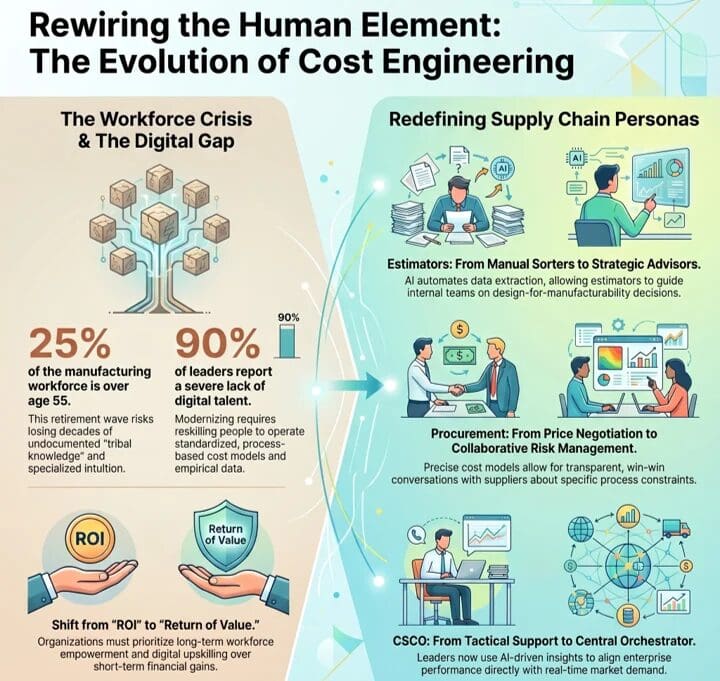
Leadership must address the workforce crisis currently confronting industrial manufacturing. Look at any credible information resource and the numbers are basically the same. Whole industries are facing rapid workforce retirements, with approximately 25 percent of the total manufacturing workforce already over the age of 55. Within small and medium-sized enterprises, which form the bedrock of the industrial manufacturing supply base, particularly in North America, between 30 and 40 percent of business owners and skilled operational workers are nearing retirement age. Ouch.
And yet we’ve known this has been underway for quite some time, but here we are. Historically, the reaction to tribal knowledge was wariness. I recall many conversations with leadership and frontline workers as technologies such as machine learning were initially deployed. Tribal knowledge, expertise, and the workforce that owned it were often treated as a nut to be cracked and the insides taken. Initially, the shell was perceived to be obstinately hard, with workers guarding their critical expertise, including core intellectual property (IP), as a means of fending off obsolescence. It didn’t lend itself to, shall we say, everyone pulling in the same direction.
Supply chain was no exception to this pattern. Cost estimating relied heavily on the undocumented tribal knowledge and personal experience of veteran employees. As these experts exit the workforce, they take decades of specialized intuition with them, leaving organizations highly vulnerable.
As a result, a new discipline has taken hold, as tribal knowledge is likely to be unretrievable in many instances or, in situations where leaders show a lack of humility, downsized too quickly. Modern cost engineering takes aim squarely at the reliance on human memory with standardized, process-based cost models and empirical data. Yet, an overwhelming 90 percent of supply chain leaders report a severe lack of the digital talent required to operate these new systems. Here we are, again, back to the ever-important human element at the center of a technology endeavor.
Redefining Supply Chain Personas
Rather than taking the same, lose-lose historical approach to cracking tribal knowledge, leading organizations are pivoting workers away from the manual, unsafe, and repetitive. What they are doing differently, though, is concertedly moving subject matter experts toward higher-level orchestration and critical oversight. It won’t pan out with every worker, certainly, but it will ensure that the expertise is retained and applied to creating more strategic value. On the surface, that presents much more opportunity for a win-win scenario. Here is how some specific roles are evolving:
Estimator
Historically, manufacturing estimators spent most of their time immersed in manual, backward-looking work. They pored over static 2D PDFs, visually interpreted complex 3D CAD models, and stitched together cost assumptions from disconnected spreadsheets. Much of their value came from patience and pattern recognition rather than insight, and the process was slow, reactive, and highly dependent on individual experience. For leading companies that are aggressively implementing cost engineering processes, that is radically changing.
In the world of cost engineering, this role is now that of a strategic advisor. Leveraging AI to automate much of the data extraction that once consumed their time, this role develops models to identify cost drivers based on real manufacturing constraints and material behavior. As a result, this role now focuses more on guiding internal teams on design-for-manufacturability decisions and outlining strategic trade-offs that can include a mix of potential metrics, such as cost, lead time, and, increasingly, carbon impact.
Procurement
Procurement has primarily been about transactional efficiency and negotiation. Success was generally determined by price, often with significant visibility limitations into how the price was constructed. Framed within cost engineering, procurement is driven by collaboration and risk management. Using precise cost models, sourcing conversations begin with a clear understanding of cost, informed by specifics on materials, labor, processes, and capacity constraints. If a supplier’s quote exceeds cost expectations, conversations can then be had specifically about how to target specific constraints, such as inefficiencies in process or materials. The objective is to provide transparency that allows for a win-win relationship in terms of performance, profitability, and reliability.
Frontline
Despite the best of intentions to change the reactive nature of the role, frontline work has been dominated by manual execution and post-problem decision-making. Operators were tasked with keeping machines running, responding to breakdowns as they occurred, and relying heavily on tribal knowledge passed down informally and gained over time. Cost engineering shifts the dynamic for frontline workers. Upstream processes and systems provide precision that is communicated to these workers in terms of production expectations. Operators are tasked with supervising processes, identifying deviations, and capturing machine-level issues as they occur. As these workers become more connected and augmented via technology, faults and anomalies are logged digitally, with automated routing to maintenance or engineering as needed. With effective cost engineering, the frontline workforce ensures production aligns with cost and performance expectations.
Chief Supply Chain Officer (CSCO)
In the past, supply chain leadership was back-office oriented, using historical information to attempt to optimize logistics execution, inventory control, and cost. Their influence was significant but fairly tactical. That orientation shifts significantly with cost engineering as the CSCO becomes the central orchestrator of enterprise performance, based on the organization’s ability to align with market demand. Supply chain data increasingly impacts revenue and margin stability, based on market responsiveness. As a result, the CSCO sits at the intersection of strategy, technology, and execution, with an increased mandate that expands beyond moving goods to shaping how the organization makes decisions. In an organization using cost engineering, CSCOs are redesigning roles, workflows, and governance models, based on AI-driven insights that orchestrate decision-making across the enterprise and ecosystem.
Aversion to Change: You Can’t Take the Human Out of, Well, the Human
So, implementing cost engineering seems like an obvious win. Despite the obvious operational benefits, integrating cost engineering introduces complex modernization challenges. Of course, these challenges are mostly rooted in aversion to change. It’s a pretty understandable problem, with generations of workers having been trained on historically based methods and having spent entire careers honing a requisite expertise. To them, AI and automated decision-making are met with deep suspicion, rightfully grounded in the fear that technology will replace jobs and render their expertise irrelevant. They are not wrong. This challenge has been exacerbated by leadership deploying complex new software without context. In reaction to these poorly orchestrated, technology-centric changes, operators bypass the systems and revert to familiar methods and tools, neutralizing investment and anticipated benefits. Pilot purgatory, anyone?
To counter this within the organization, leadership must employ empathy, transparency of intent, continuous learning, and AI explainability that enables humans to trust machines and the logic behind their decisions. From an external perspective, organizations also need to understand that they are only as strong as their weakest supplier. Leading companies gain their status by subsidizing the digital and cybersecurity capabilities of their ecosystem. It becomes a case of a rising tide lifting all boats.
Return of Value
Deploying cost engineering cannot be about eliminating the human workforce through automation. It relies on a human-on-the-loop model, but it defers to technology to manage massive data complexity. The role of expert workers is to apply contextual judgment and engage in continual collaboration. The transition to this approach requires transparency and significant digital upskilling that will likely feel uncomfortable initially. Due to the step change required in this shift, organizations need to define and align with a return of value rather than shorter-term return on investment. By empowering the workforce and supply chain ecosystem to employ data-driven precision, the organization transitions from a guesswork culture to one of definable competitive differentiation.
In blog three of this series, I’ll explore the process component of the equation. I’ll focus on departmental silos, cross-functional teams, and supply chain orchestration.
The post Modern Cost Engineering Evolution: Rewiring the Human Element for Supply Chain Resilience appeared first on Logistics Viewpoints.
You may like
Non classé
Supply Chain Technology Markets Are Converging Faster Than Vendor Categories
Published
9 heures agoon
1 octobre 2026By
The New Logistics Advantage — Part 6 of 9
Supply chain technology markets are usually described as categories. WMS, TMS, planning, visibility, control towers, order management, warehouse automation, decision intelligence, and other segments each have established buyers, competitors, and functional boundaries.
Those categories remain commercially useful. But strategically, the boundaries are moving faster than the labels. Providers are expanding into adjacent workflows, intelligence, orchestration, and automation, while buyers increasingly assemble architectures that cut across the traditional category map.
Convergence Is Happening From Multiple Directions
Execution vendors are adding intelligence. Planning vendors are moving closer to operational workflows. Visibility providers are extending toward exception resolution. Automation vendors are building software layers. Enterprise platforms are embedding AI. Specialized AI providers are attacking decision processes that historically lived inside application categories.
The four current MarketMaps make this movement visible. The 2026 Warehouse Management Systems Market Map examines a mature execution category expanding around automation and intelligence. The 2026 Transportation Management Systems Market Map shows a durable market becoming more connected to networks, visibility, and orchestration. The 2026 Autonomous Exception Management Market Map captures an emerging category between visibility and coordinated response. The 2026 Supply Chain Decision Intelligence Market Map addresses the broader shift toward systems organized around decisions.
The same pattern appears in buyer expectations. A warehouse platform is increasingly judged on automation connectivity and intelligence. A TMS is judged on network data, visibility, and response. A planning system is judged on whether recommendations can be operationalized. The category still defines the core job; differentiation increasingly comes from the adjacent layers.
The Competitive Battleground Is Shifting to Control Points
Products are expanding along several dimensions: workflow, data, intelligence, orchestration, automation, user experience, and ecosystem connectivity. Those dimensions matter because each can become a control point in the architecture.
A provider that owns the system of record controls authoritative transaction state. A provider with unique network data may control context. A decision-intelligence layer can shape which alternatives are considered. An orchestration platform can determine how work moves among systems. An automation platform can control the final physical action.
Two vendors can therefore compete even when analysts place them in different categories. A WMS provider and a warehouse-automation software platform may both seek to own task orchestration. A visibility provider and an exception-management platform may both seek to own disruption response. A planning provider and a decision-intelligence provider may both seek to own the cross-functional recommendation.
This is why convergence does not necessarily mean that one suite replaces everything. It means more vendors are competing for the same strategic control points from different starting positions.
The Buyer Problem Becomes Architectural
Traditional category evaluation begins with feature completeness. That remains necessary, especially for systems of record. But as markets converge, buyers need a second question: Which layer of the operating architecture is this provider attempting to control?
The market-research executive summaries provide category depth that remains essential: WMS, TMS, Supply Chain Planning, and OMS each explain the structure and capabilities of important markets. The strategic challenge is to interpret those markets as parts of a changing architecture rather than as permanent silos.
A buyer may select the strongest product in a category and still create a weak portfolio if the product traps data, duplicates decision logic, constrains adjacent workflows, or makes future substitution prohibitively difficult. Architectural fit therefore becomes part of product value.
This creates a useful distinction between functional depth and architectural leverage. Functional depth answers whether the product can perform its core job. Architectural leverage answers whether the product improves or constrains the larger system around it.
Convergence Changes Vendor Strategy Too
For providers, adjacency strategy needs discipline. Expanding into every neighboring function can increase surface area while weakening differentiation. The more important question is which adjacent capability reinforces an existing control point.
A TMS with strong transportation state may have a credible path into exception intelligence because it already sees important network events. A WMS with deep execution state may have a credible path into warehouse orchestration. A planning platform with broad enterprise context may have a credible path into decision support. The logic of expansion should follow the asset the provider already controls, not simply the size of the adjacent market.
That also raises the importance of interoperability. In a converging market, customers will resist architectures that require every adjacent capability to come from one supplier. Providers that can participate in a heterogeneous system may create more strategic value than providers that maximize suite breadth at the cost of flexibility.
The Executive Implication
Technology strategy should separate two questions that are often conflated: Which product is strongest inside a category? and Which architecture will remain adaptable as categories converge? The first is a product-selection problem. The second is a portfolio and operating-model problem. Organizations that solve only the first can end up with excellent applications that constrain future change. Organizations that solve both can preserve functional depth while creating room for new forms of intelligence, automation, and orchestration.
For buyers and providers alike, category labels still matter. But the more strategic question is increasingly about control: who owns the record, the context, the decision, the workflow, and the path to execution?
Explore the Related Logistics Viewpoints Research
2026 WMS Market Map
2026 TMS Market Map
2026 Autonomous Exception Management Market Map
2026 Supply Chain Decision Intelligence Market Map
WMS Executive Summary
TMS Executive Summary
Supply Chain Planning Executive Summary
The New Architecture of Logistics
The post Supply Chain Technology Markets Are Converging Faster Than Vendor Categories appeared first on Logistics Viewpoints.
Non classé
Kinaxis Extends Concurrent Planning Toward Continuous Response
Published
9 heures agoon
1 octobre 2026By
Kinaxis built its reputation around concurrent planning: the idea that demand, supply, inventory, capacity, and other planning decisions should be evaluated together rather than through a series of disconnected batch processes. That architecture is becoming more relevant as supply chains move toward continuous response.
The company’s Maestro platform emphasizes rapid scenario analysis, constraint-aware planning, and the ability for multiple users to understand the downstream effects of a change on a shared data model. This makes decision speed a central part of the product proposition. The objective is not simply to create a better plan, but to help planners evaluate alternatives quickly enough for the response to matter operationally.
Exception management is a natural extension of that model. A supply disruption or demand change creates value only if the organization can understand the consequence, compare choices, and coordinate action before the problem propagates through the network. Kinaxis’ emphasis on explainability and human-in-the-loop decision-making is also important as AI agents begin to monitor conditions and perform bounded tasks under defined oversight.
The important buyer question is how effectively planning intelligence connects to execution. Concurrent analysis can surface a better answer quickly, but organizations still need integration, decision rights, and workflows capable of translating that answer into action across functions and systems.
Kinaxis is included in the Logistics Viewpoints Supply Chain Decision Intelligence MarketMap and Autonomous Exception Management MarketMap. Together, the two MarketMaps frame the company both as a decision-intelligence provider and as a participant in the emerging exception-management layer.
The post Kinaxis Extends Concurrent Planning Toward Continuous Response appeared first on Logistics Viewpoints.
Non classé
Webinar: Five MarketMaps. One Emerging Supply Chain Technology Architecture
Published
12 heures agoon
1 octobre 2026By
Article 1 of 4 — Convergence
Supply chain technology buyers still purchase software in categories. The supply chain itself stopped operating that way.
For years, the boundaries were understandable. A Warehouse Management System ran the warehouse. A Transportation Management System planned and executed freight. Supply Chain Planning balanced demand, supply, inventory, capacity, and production. Visibility, analytics, and exception management sat around those core applications. When reality diverged from the plan, people reconciled what happened across the different systems.
This is the first in a four-part Logistics Viewpoints series leading to ARC Advisory Group’s October 29 webinar, “Beyond the Silos: Five MarketMaps Shaping the Next Supply Chain Technology Architecture.” Register for the October 29 webinar.
That architecture is changing because the systems themselves are moving. WMS platforms now coordinate complex execution environments that combine people, automation, robotics, labor, yard activity, and changing priorities. TMS platforms are extending beyond planning and tendering into continuous execution, visibility, exception response, and network control. Supply Chain Planning is operating on shorter feedback loops. Decision Intelligence is moving closer to operational action. Autonomous Exception Management is creating a new layer between recognizing a disruption and resolving it.
Individually, each of those developments is logical. Together, they create a different problem for technology buyers: several systems can now participate in the same decision.
From Applications to Decisions
Consider a critical inbound shipment that will arrive eight hours late. The TMS understands the shipment and the transportation consequence. The warehouse may need to change a dock appointment, labor plan, or receiving sequence. The planning environment may determine that the delay threatens inventory, production, or customer service. An exception-management capability can decide whether the event is material enough to require intervention. A Decision Intelligence layer may evaluate alternative responses.
Every one of those systems may be functioning exactly as designed. The harder question is not whether the applications are intelligent. It is who owns the decision.
One system may detect the event. Another may understand its broader business impact. Another may recommend the preferred response. Still another may execute it. That means software selection is no longer only a question of capabilities and features. It is also an architecture decision about authority, handoffs, and control.
Where should one system stop and another begin? Which application should be authoritative for a particular class of decision? What information must cross system boundaries? When should a human approve a recommendation, and when should software be allowed to act? Those questions become more important as AI and agentic capabilities spread across the supply chain stack.
One Architecture Does Not Mean One Platform
The answer is not necessarily to consolidate everything into a single application. Specialized systems exist for good reasons. Warehouse execution and transportation execution require different domain models. Planning operates across different horizons and constraints. Exception management has a different responsibility from execution, while Decision Intelligence may need to evaluate conditions that cut across several platforms.
The more realistic opportunity is coordinated specialization: systems remain strong within their domains, but events, context, recommendations, and actions move across the architecture with clearly defined ownership.
One useful way to frame the operating loop is: Plan → Sense → Identify the Exception → Decide → Execute → Learn.
Different systems may own different parts of that loop. The important point is that the ownership is deliberate rather than accidental.
Why Five MarketMaps Belong in One Conversation
ARC MarketMaps help technology buyers understand supplier capabilities, market direction, and relative positioning. Looking at these five markets separately still matters because each has different requirements, architectures, suppliers, and maturity curves. Putting them together, however, reveals something that separate evaluations can miss.
The boundaries between supply chain technologies are moving faster than many enterprise buying processes. Companies may still run separate WMS, TMS, planning, analytics, and exception-management evaluations while vendors move into adjacent operational territory. As a result, one technology decision can constrain another.
A WMS choice can influence automation orchestration and downstream transportation workflows. A TMS choice can shape visibility and exception-management architecture. A planning decision may determine where recommendations originate. A Decision Intelligence investment can affect which system ultimately has authority to recommend or initiate action.
That is why the October 29 webinar will not treat the five MarketMaps as five unrelated supplier landscapes. We will put them on the same architectural canvas and examine where planning, sensing, exception management, decision-making, and execution should reside.
The question is no longer simply which software category an application belongs to. The more important question is who owns the decision when the supply chain changes.
The post Webinar: Five MarketMaps. One Emerging Supply Chain Technology Architecture appeared first on Logistics Viewpoints.

Supply Chain Technology Markets Are Converging Faster Than Vendor Categories
Kinaxis Extends Concurrent Planning Toward Continuous Response
Webinar: Five MarketMaps. One Emerging Supply Chain Technology Architecture
Freightos Global Freight Outlook – September 2026
Container rates jump another $1k/FEU – but is demand peaking? – July 8, 2026 Update

Walmart and the New Supply Chain Reality: AI, Automation, and Resilience
Trending
- Non classé1 mois ago
Freightos Global Freight Outlook – September 2026
- Non classé3 mois ago
Container rates jump another $1k/FEU – but is demand peaking? – July 8, 2026 Update
-
 Non classé2 ans ago
Walmart and the New Supply Chain Reality: AI, Automation, and Resilience
-

 Non classé6 mois ago
Why Sulfuric Acid Is Emerging as a Supply Chain Constraint in Copper
- Non classé4 mois ago
Container rates starting to spike on peak season rush – June 2, 2026 Update
- Non classé1 an ago
13 Books Logistics And Supply Chain Experts Need To Read
- Non classé11 mois ago
Ex-Asia ocean rates climb on GRIs, despite slowing demand – October 22, 2025 Update
- Non classé3 mois ago
LCL Shipping Cost Calculator: Calculate Air and Sea Shipping Freight Rates