Non classé
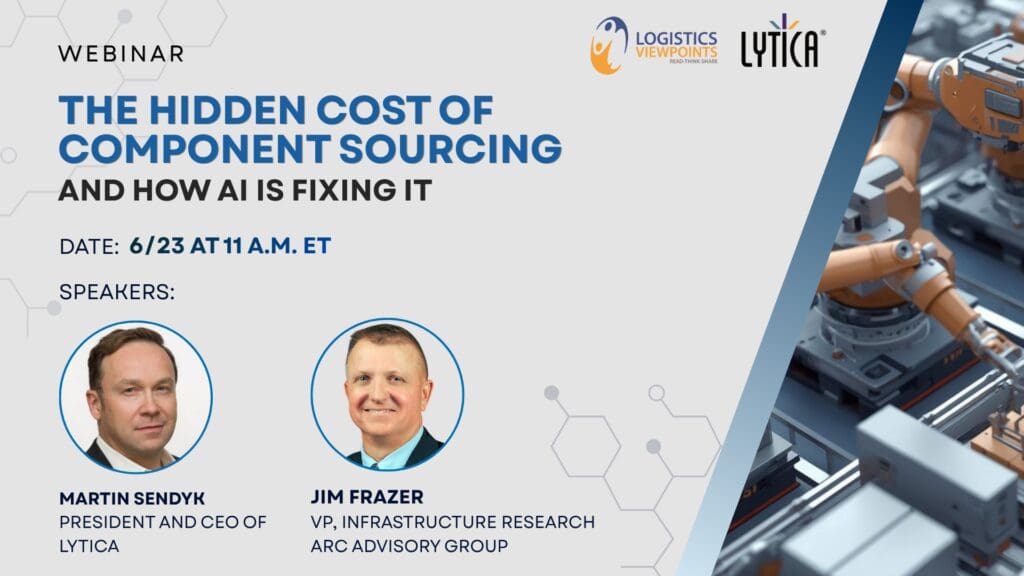
Upcoming Webinar – The Hidden Cost of Component Sourcing and How AI Is Fixing It
Published
5 heures agoon
By
Manufacturers are losing significant value in electronic component sourcing, not because procurement teams are failing, but because the market often gives them too little visibility into what a fair price actually looks like.
Electronic component pricing is opaque. Supply risk is rising. Geopolitical pressure is increasing. Demand continues to accelerate across automotive, industrial, aerospace, medical device, energy, and high-tech markets.
For many manufacturers, this creates a costly problem: they may be overpaying for direct materials without knowing where, why, or by how much.
On June 23, 2026, at 11:00 AM ET, ARC Advisory Group will host the webinar The Hidden Cost of Component Sourcing — and How AI Is Fixing It. Jim Frazer, Vice President at ARC Advisory Group, will sit down with Lytica CEO Martin Sendyk to discuss how real transactional data and agentic AI are changing component sourcing.
Register for the webinar to learn how leading OEMs and EMS companies are using sourcing intelligence to reduce overpayment, manage supply risk, and accelerate time to market.
Why Component Sourcing Is So Hard
Electronic components are sourced across thousands of part numbers, approved vendor lists, changing lead times, supplier constraints, and shifting demand signals. Even experienced procurement teams often lack a reliable external benchmark showing what comparable companies are actually paying for similar components.
That lack of transparency matters.
A few cents of overpayment on a single component may seem small. Across high-volume programs and large component portfolios, those differences can become millions of dollars in avoidable cost.
The challenge is no longer just negotiating harder. It is knowing where the opportunities are, which parts are mispriced, where risk is emerging, and which sourcing actions should be prioritized.
How AI Changes the Sourcing Model
Traditional benchmarking often depends on supplier quotes, historical pricing, internal spend data, and manual analysis. These methods can help, but they are usually too slow and too narrow for today’s electronics market.
Lytica is helping manufacturers move beyond manual benchmarking and opaque pricing by combining proprietary transactional data with AI-enabled sourcing intelligence.
The result is a shift from reactive sourcing to a more proactive operating model. Instead of waiting for periodic sourcing events or supplier renegotiations, manufacturers can continuously evaluate where they are overpaying, where supplier risk exists, and where sourcing teams should focus their attention.
Agentic AI adds another layer by helping sourcing teams move from analysis to action. It can surface pricing anomalies, identify opportunities, support prioritization, and help procurement teams act faster with better context.
What You Will Learn
In this webinar, attendees will learn:
Why electronic component pricing remains so opaque
How much manufacturers may be leaving on the table through overpayment
Why manual benchmarking is no longer enough
How real transactional data changes sourcing decisions
How agentic AI can support sourcing teams
How OEMs and EMS companies are using intelligence-driven sourcing to reduce cost and manage risk
Register for the Webinar
The Hidden Cost of Component Sourcing — and How AI Is Fixing It
Date: June 23, 2026
Time: 11:00 AM ET
Location: Online
Speakers: Jim Frazer, Vice President, ARC Advisory Group, and Martin Sendyk, CEO, Lytica
If your organization manages a significant electronic component spend, this webinar will help you understand how AI and transactional market data can expose hidden sourcing costs and turn procurement into a more proactive system of intelligence.
Register now to reserve your spot.
The post Upcoming Webinar – The Hidden Cost of Component Sourcing and How AI Is Fixing It appeared first on Logistics Viewpoints.

You may like
Non classé
How AI-Driven Decision Intelligence Is Transforming Hospital Supply Chains
Published
10 heures agoon
10 juin 2026By
Hospitals are under mounting pressure from rising supply costs, product shortages, and fragmented data. InterSystems and Ready Computing show how AI-driven decision intelligence can help healthcare supply chains move from reactive firefighting to initiative-taking orchestration, reducing procedure risk and improving operational confidence.
I had the opportunity to attend InterSystems READY 2026 global conference in Maryland. The event offered an environment rich in knowledge sharing, real-world customer stories, and a platform for sharing progress.
I participated in engaging sessions and learned how InterSystems supports its partners’ supply chain operations through data unification, automation, and artificial intelligence, enabling smarter decisions faster. I found myself in sessions discussing Agentic AI frameworks, developing agents from chatbots, and how to best leverage InterSystems Supply Chain Orchestrator.
How Ready Computing is leveraging decision intelligence and supply chain orchestration to avoid the cancellations of high-priority healthcare procedures.
One of the first sessions I attended was hosted by Chris Cunnane, Global Product Marketing Manager for Supply Chain at InterSystems, and Mike LaRocca, founder and CEO of Ready Computing. Chris Cunnane began by sharing a personal story reflecting on his job in college, where he was responsible for routing deliveries for a bedding retailer using:
A paper road atlas
A highlighter
An endless stream of traffic updates on the radio
No GPS, no real-time ETA updates, no emissions tracking, just manual planning, and best guesses. It worked “well enough” until the day a 13-foot box truck met a 10-foot bridge and had to turn around, barely making the final delivery on time. The point was clear: even a skilled human will hit limits without “the right data and tools.” That same gap exists today inside many hospital systems, and the stakes are far higher than late mattresses.
Recent market research shows three major pressures on hospital supply chains:
Rising supply costs & tight reimbursement
Product shortages & sourcing vulnerabilities
Data and technology gaps
This is classic logistics friction, except with life-and-death implications. Hospitals are effectively trying to run complex, high-risk logistics with equivalent “paper map”- level tools and data that aren’t connected between clinical and procurement systems. level tools and fragmented data. InterSystems helps its customers use decision intelligence to make supply chain and logistics decisions faster, reducing interruptions and cancellations of procedures in hospitals, boosting revenue, and getting people the care they need faster.
Decision Intelligence: Beyond Dashboards
Decision Intelligence (DI) goes a step beyond traditional analytics by transforming insights into actionable decisions. It combines data analysis, forecasting, scenario modeling, and human judgment to guide better business outcomes. With DI, organizations can move from simply understanding what is happening to actively deciding what to do next. For InterSystems customers, this means enabling more effective and timely decisions, such as placing orders, engaging with suppliers, managing inventory movement, and increasing operational visibility within a unified system.
Instead of firefighting shortages as surgeries near, AI models forecast demand, spot risks, and recommend adjustments before problems hit. In healthcare and logistics alike, the organizations that consistently make faster, smarter, data-informed decisions will outperform. At its core, decision intelligence connects (data + AI + people) into a continuous loop of better, more confident actions.
Decision intelligence understands the context behind the decisions that need to be made, including “who” is making the decision and “how often” it needs to be made. Next, data is pulled from multiple systems, such as operations, finance, and inventory, and analytics and AI are applied to formulate a recommendation. This recommendation is surfaced as a “one-click” decision or can be automated, depending on the customer’s preferences.
InterSystems is supporting its customers’ supply chain operations through two products:
InterSystems Supply Chain Orchestrator:
A decision intelligence platform with “out-of-the-box” data integration and interoperability that advances analytics and predictive models. Supply Chain Orchestrator has built-in generative AI capabilities that help supply chain professionals with tailored analytics for logistics and hospital operators.
InterSystems Data Studio with Supply Chain Model:
A Cloud-based, low-code data integration layer that harmonizes and normalizes data from disparate systems. Delivering clean, AI-ready data to the right users and applications that act as a “front-end data gateway” for supply chain solutions.
How Ready Computing is Leveraging Channels360 Supply Chain Edition and InterSystems Supply Chain Orchestrator
In the demo portion of the session, Ready Computing brought the hospital supply chain story to life by showing how their Channels360 platform operationalizes decision intelligence in a real-world surgical setting. Framed around the role of an Operating Room Materials Manager, the demo walked through an end-to-end workflow: creating a new patient case, scheduling a surgery, loading the surgeon’s detailed preference card, checking inventory, triggering AI-driven sourcing recommendations, routing items through sterilization, and finally assembling the surgical cart. What stood out was how Channels360 models this entire process as a configurable workflow (“channels” and tasks), combining human interaction where it matters with automated system tasks where it does not. Each step is logged as part of the case timeline, giving full traceability from scheduling to procedure.Channel360 is built on top of Supply Chain Orchestrator offering seamless integration. The Supply Chain edition introduces an orchestration-first model that connects upstream data with downstream execution. When the system identifies required supplies for a procedure, it calls out to Supply Chain Orchestrator, which consults inventory and supplier data, then returns ranked sourcing options that balance price, availability, delivery time, and historical reliability scores. The “control tower” view then layers on a 30-day forward-looking perspective across all upcoming procedures, highlighting items and cases at risk so teams can intervene early. The result is a compelling example of how InterSystems can deliver AI-assisted decision intelligence into a repeatable workflow that reduces last-minute scrambling, improves visibility, and helps hospitals execute surgical procedures with greater confidence and control.
InterSystems is a creative data technology provider that delivers a unified foundation for next-generation applications for healthcare, finance, manufacturing, and supply chain customers in more than 80 countries. Their flagship product, InterSystems IRIS data platform, is at the core of Supply Chain Orchestrator, which uses advanced data management, analytics, and integration features to offer tailored supply chain solutions. At the READY 2026 event, InterSystems demonstrated how its technology delivers decision intelligence to help hospitals minimize supply chain disruptions, improve reliability, and reduce mortality rates.
The post How AI-Driven Decision Intelligence Is Transforming Hospital Supply Chains appeared first on Logistics Viewpoints.
Non classé
Why Commercial Supply Chains Break Government Program Assumptions
Published
1 jour agoon
9 juin 2026By
Commercial supply chains can inform government purchasing decisions, but they often break down when federal programs require traceability, compliant sourcing, lifecycle support, documentation, and mission assurance.
Commercial supply chains can tell a government customer what something appears to cost, how quickly it appears to ship, and how available it appears to be.
They cannot always tell the customer whether that product can be procured, documented, supported, secured, or sustained inside a government program.
That distinction matters.
In large federal programs, some of the most damaging risks are created early. A customer conducts market research. A commercial price becomes a budget anchor. A retail delivery estimate becomes a schedule assumption. A consumer product page becomes the basis for an expectation.
The program then inherits a version of reality the supply chain may not be able to execute.
Background: Two Supply Chains, Two Operating Models
Commercial supply chains and government supply chains are built for different purposes.
Commercial supply chains are designed for speed, product availability, price competition, global sourcing, and convenience. They depend on broad distribution networks, mixed inventory, flexible sourcing paths, and rapid fulfillment.
Government supply chains operate under a different burden.
They must support compliance, traceability, country-of-origin requirements, approved sourcing channels, serialized asset tracking, cybersecurity review, lifecycle support, warranty mandates, controlled distribution, and auditability. In many cases, they must also satisfy requirements tied to the Trade Agreements Act, the National Defense Authorization Act, agency-level procurement policy, secure facility rules, or contract-specific restrictions.
Those requirements are not administrative details. They change the cost structure, lead time, sourcing path, and risk profile of the acquisition.
A laptop that appears to cost $1,200 through a consumer channel may cost substantially more once federal warranty terms, lifecycle support, configuration controls, asset tracking, and compliant sourcing are included. A security camera available for two-day delivery through a retail site may have a 90- or 120-day lead time when the government-compliant version is required. A network device that looks acceptable in a commercial catalog may become unusable once country-of-origin, cybersecurity, or facility restrictions are applied.
The commercial supply chain is not wrong. It is simply solving a different problem.
The Challenge: Commercial Research Becomes Government Commitment
The problem usually begins before the program office or supply chain team is fully involved.
A customer looks up laptops on Amazon. They configure systems on a commercial OEM website. They compare cameras, servers, networking equipment, or security products through ordinary retail channels. The information is easy to access, current, and specific. It feels authoritative.
The price looks defensible. The delivery date looks realistic. The product appears available.
So that information begins shaping the requirement.
It informs the customer’s budget. It influences the schedule. It frames expectations about what the program should deliver and how quickly it should deliver it. By the time procurement or supply chain specialists are engaged, the commercial assumption may already have become an informal commitment.
The customer is not necessarily trying to create risk. In many cases, the customer is trying to be informed, practical, and cost-conscious. The issue is that commercial data is being used to define expectations for a procurement environment that operates under different rules.
Once those expectations enter the program baseline, they are difficult to unwind. A later correction can look like delay, inefficiency, or overpricing, even when the program team is simply explaining the true cost and timeline of compliant execution.
This is how a supply chain mismatch becomes a program management problem.
The Risk: Sticker Shock, Schedule Drift, and Shadow Supply Chains
The first visible symptom is usually sticker shock.
A customer expected a commercial price. The compliant price is higher. A customer expected retail delivery speed. The compliant lead time is longer. A customer expected a specific product. The program determines that the product does not satisfy the contract, facility, cybersecurity, lifecycle, or sourcing requirement.
At that point, the program team is no longer just managing procurement. It is managing expectation risk.
Budgets built on commercial prices begin to collapse under compliant sourcing requirements. Schedules built on retail delivery estimates begin to unravel once documentation, traceability, approved distribution, and contract-specific controls are introduced.
Under enough pressure, programs may begin drifting toward shadow supply chains.
Shadow supply chains are informal, poorly documented, or nonstandard sourcing paths that emerge when execution teams are asked to meet commitments that were never aligned with acquisition reality. They may involve rushed substitutions, unclear provenance, weak documentation, excessive exception processing, or procurement workarounds that become normalized under schedule pressure.
These behaviors are not always created by bad intent. More often, they are created by structural pressure.
Program managers, capture teams, business development leaders, procurement teams, and customers all want delivery. But when the budget assumes a commercial supply chain and the contract requires a compliant one, the execution team inherits a conflict it cannot fully resolve.
In federal programs, supply chain integrity cannot be the thing that gives way.
Supply chain integrity is part of mission assurance. It protects the customer, the contractor, the end user, and the program. When commercial assumptions push teams toward nonstandard sourcing behavior, the risk is no longer limited to cost and schedule. It can become a compliance risk, cybersecurity risk, sustainment risk, and mission risk.
The Solution: Move Supply Chain Validation Earlier
The solution is not to discourage customers from conducting market research. That is neither realistic nor useful.
The solution is to validate commercial assumptions before they become government commitments.
Large programs need to bring supply chain expertise forward earlier in the process. Technical calls should not be treated as administrative checkpoints after the requirement is largely formed. They should be treated as strategic alignment sessions where program managers, procurement teams, supply chain specialists, and customers reconcile the desired outcome with sourcing reality.
These conversations should happen before the baseline is set.
Customers need to understand why a consumer technology channel is different from a federal channel. They need to understand why the same manufacturer may operate separate commercial and federal ecosystems, with different configurations, warranties, manufacturing paths, distribution models, documentation requirements, and lead times.
They also need to understand the difference between related but distinct compliance concepts. NDAA compliance and TAA eligibility are not the same thing. A product may satisfy one requirement and fail another. A device may be acceptable for one program environment and unusable in another. A product may appear compliant at the headline level but still fail facility, cybersecurity, warranty, lifecycle, documentation, or sourcing requirements.
These distinctions are often invisible during commercial research. They are decisive during government execution.
An effective technical call should make the tradeoffs explicit.
If the customer wants the lowest commercial price, there may be compliance limitations. If the customer wants a specific product, there may be lead-time consequences. If the customer wants foreign-made equipment, there may be exception processes. If the customer wants full compliance, the budget and schedule must reflect that reality from the beginning.
This is not bureaucracy. It is disciplined execution.
Guidance for Commercial Supply Chain Operators
For commercial supply chain operators, the lesson is clear: government demand is not simply another sales channel. It is a different supply chain requirement.
Manufacturers, distributors, OEMs, resellers, integrators, logistics providers, and service contractors should not assume that success in commercial markets automatically translates into success in federal, defense, public sector, critical infrastructure, or mission-service environments.
Serving those markets requires more than product availability and competitive pricing. It requires a supply chain model that can support documentation, traceability, approved sourcing, country-of-origin validation, lifecycle support, warranty compliance, cybersecurity expectations, controlled distribution, and auditability.
That creates both risk and opportunity.
The risk is that commercial channels may appear capable of serving government demand until a contract-specific requirement exposes a gap. A product may be available, but not through an approved channel. A device may meet the technical specification, but fail sourcing restrictions. Inventory may exist, but lack the documentation required for government acceptance. Lead times may look short, but only because they are based on commercial fulfillment rather than controlled distribution.
The opportunity is that supply chain operators that make compliance visible, repeatable, and predictable become more valuable to government-facing customers.
Commercial suppliers should treat government readiness as a supply chain capability, not a sales claim.
That means building clearer controls around where products are manufactured, how they are sourced, how substitutions are managed, how documentation is retained, how compliant inventory is separated from general commercial stock, and how exceptions are handled.
It also means being explicit about the distinction between commercial availability and government-compliant availability. Customers should not have to discover late in the process that the commercially available version of a product is not the same as the compliant version required for a federal program.
The most capable suppliers will provide government-facing customers with four things early:
A realistic compliant price, not just a commercial market price.
A realistic compliant lead time, not just a retail fulfillment estimate.
Clear documentation on sourcing, origin, warranty, lifecycle support, and distribution path.
A structured explanation of tradeoffs when a requested product, configuration, or sourcing path creates compliance risk.
This is especially important for suppliers serving mission-critical, defense, public safety, infrastructure, and secure facility environments. In those markets, compliance is not a paperwork exercise. It is part of the operating model.
Commercial supply chain operators that understand this shift can move from transactional vendors to strategic partners. They can help customers avoid budget distortion, schedule surprises, exception-heavy procurement, and shadow sourcing behavior.
The suppliers that win in this environment will not simply be the ones with the lowest price or fastest delivery estimate. They will be the ones that can prove what they are selling, where it came from, how it will be supported, and whether it can actually be used in the customer’s operating environment.
Government readiness must be designed into the supply chain before the customer asks for proof.
Guidance for Program Leaders
Federal program leaders should treat supply chain expectation management as a governance discipline, not a procurement afterthought.
Commercial market research should be used as an input, not as a baseline. It can help identify available technologies, market direction, rough order-of-magnitude pricing, and potential alternatives. But it should not define program commitments until those assumptions have been validated against compliant sourcing requirements.
Program leaders should ask five questions early:
Is the product being priced through a commercial channel or a government-compliant channel?
Does the product meet all applicable sourcing, country-of-origin, cybersecurity, facility, warranty, and lifecycle requirements?
Are the quoted lead times based on retail availability or controlled distribution?
Are documentation, traceability, asset tracking, and audit requirements included in the cost and timeline?
Has the customer been shown the tradeoff between commercial availability and compliant execution?
These questions move the program from assumption-based planning to execution-based planning.
The most effective programs will bring procurement and supply chain specialists into the requirement-shaping process earlier. They will use technical calls to reset expectations before they harden. They will make cost, compliance, and lead-time tradeoffs visible to the customer. They will treat sourcing realism as part of capture discipline, program governance, and customer success.
Final Takeaway
Commercial supply chains are not broken. They are built for a different operating model.
They are designed to satisfy market demand quickly and efficiently. Government supply chains are designed to satisfy contracts, regulations, security requirements, auditability, lifecycle needs, and mission outcomes.
Confusing those two models distorts budgets, weakens schedules, and creates execution risk.
For federal programs, the danger is allowing commercial assumptions to become government commitments.
For commercial supply chain operators, the opportunity is to build government readiness into sourcing, documentation, inventory management, distribution, lifecycle support, and customer engagement.
Commercial supply chains can inform the market conversation. They should not define the government program baseline unless they can support the government operating model behind it.
That is why commercial supply chains break government program assumptions.
They were never built to carry them unless they are deliberately redesigned for the job.
The post Why Commercial Supply Chains Break Government Program Assumptions appeared first on Logistics Viewpoints.
Non classé
AI PCs Could Become the Next Execution Layer for Supply Chain Workflows
Published
1 jour agoon
9 juin 2026By
NVIDIA and Microsoft’s RTX Spark announcement points to a larger shift: enterprise AI is moving from cloud-only copilots toward local agents that can support operational decisions across fragmented systems.
NVIDIA and Microsoft’s RTX Spark announcement is being positioned as a reinvention of the Windows PC for the age of personal AI. The headline is a new class of AI-enabled PCs with up to 1 petaflop of AI performance, 128GB of unified memory, Blackwell RTX graphics, a Grace CPU, and support for local AI agents.
But for enterprise technology leaders, the more important story is not the laptop. It is that the personal computer may become a secure, local execution environment for AI agents working across business applications, files, emails, spreadsheets, and operational workflows.
That matters for supply chain organizations because much of the work that determines service, cost, responsiveness, and risk does not happen inside one clean system. It happens across TMS, WMS, ERP, planning tools, visibility platforms, customer emails, carrier portals, rate files, contracts, PDFs, spreadsheets, and exception queues.
In other words, the daily work of supply chain execution is fragmented. Agentic AI is being aimed directly at that fragmentation.
From Cloud AI to Local AI
Enterprise AI has largely been framed as a cloud story. Large models run in hyperscale data centers. Enterprise copilots connect to cloud productivity suites. AI applications are deployed through SaaS platforms.
That architecture will remain important. But it is not the whole picture.
Supply chain work is distributed across corporate offices, warehouses, terminals, plants, ports, retail locations, supplier networks, field operations, and transportation control rooms. It also happens on individual users’ devices, where employees reconcile information from multiple systems before deciding what to do next.
A transportation planner may need to compare TMS data, carrier emails, shipment tracking updates, customer delivery requirements, rate files, and warehouse appointment schedules. A procurement analyst may need to evaluate supplier quotes, contract terms, tariff exposure, inventory levels, and risk alerts. A logistics manager may need to prepare a customer response based on what the system says, what the carrier says, and what the operation can actually execute.
Those are not single-screen problems. They are cross-application decision problems.
That is where local AI agents could become significant.
The Agent Becomes a User of the PC
Historically, the user operated the PC. The user opened applications, copied data, reviewed dashboards, interpreted information, and decided what action to take.
In an agentic model, the AI system becomes an active participant in that workflow. It can search local files, reason across applications, retrieve context, summarize information, draft responses, analyze data, and potentially execute defined tasks under user control.
For supply chain and logistics, the near-term opportunity is not replacing core systems. ERP, TMS, WMS, planning, procurement, and visibility platforms remain essential systems of record and execution.
The opportunity is creating an intelligent layer that helps people work across those systems.
A local agent could help summarize a carrier dispute, compare lane performance, identify missing shipment documents, draft a customer delay notification, reconcile accessorial charges, review an RFP response, prepare a morning risk briefing, or flag inconsistencies between a purchase order, shipment record, and customer commitment.
That is materially different from asking a chatbot a generic question. It is closer to giving the user an intelligent operating assistant that understands the local work environment and can help move a process forward.
Why Local Execution Matters
The case for local AI is not that every AI workload should run on the device. They should not.
Cloud AI will remain critical for large-scale training, enterprise applications, shared data environments, and complex workloads. But some AI use cases benefit from proximity, privacy, speed, and persistent access to local context.
Privacy is one reason. Many workflows involve sensitive information: customer records, contracts, pricing, supplier terms, forecasts, freight rates, claims, engineering files, and operational exceptions. Running more inference locally may reduce unnecessary exposure of sensitive information.
Latency is another. Operational work often happens under time pressure. A planner resolving a service failure, a warehouse manager addressing a dock constraint, or a procurement lead responding to supplier risk may need rapid support.
Context may be the biggest factor. The richest operating context is often not stored neatly in one database. It sits in emails, spreadsheets, PDFs, presentations, screenshots, shared folders, notes, prior drafts, and application states. Local agents may be well positioned to reason across this messy work layer.
Resilience also matters. Warehouses, plants, terminals, fleet depots, and field service locations may not always have perfect connectivity or bandwidth. Local AI capability could support continuity where full cloud dependency is undesirable.
The strategic question is not cloud versus local. The better question is: which decisions and workflows should be supported locally, which should be supported in enterprise applications, and which should be handled by cloud-based AI services?
Governance Is the Critical Issue
The RTX Spark announcement also highlights a key issue that will shape enterprise AI adoption: secure agent execution.
NVIDIA and Microsoft describe new Windows security primitives and NVIDIA OpenShell as part of the foundation for running agents securely on primary devices. The stated objective is to give users and developers more control over what agents can access, what they can do, how queries are routed, and how sensitive information is handled.
That matters because agents are different from traditional software interfaces.
An AI assistant that answers a question is useful. An AI agent that can act is powerful. An AI agent that can act without proper boundaries is a risk.
Supply chain organizations will need to define what agents are allowed to see, what they are allowed to change, which systems they can access, when human approval is required, how actions are logged, and how policies are enforced.
This is not a theoretical concern. Supply chain decisions have operational consequences. A poor recommendation can increase cost. A bad execution step can delay a shipment. An incorrect supplier decision can create compliance exposure. An unauthorized system action can create financial or legal risk.
The next phase of enterprise AI will therefore depend as much on governance as on model capability.
What This Means for Supply Chain Software
For years, the center of gravity in supply chain technology has been the enterprise application: ERP, TMS, WMS, demand planning, supply planning, procurement, visibility, and control tower platforms. These systems remain critical. But agentic AI may shift more value toward the decision and workflow layer that sits across them.
That layer could live partly in cloud platforms, partly inside enterprise applications, and partly on the user’s device.
This raises important questions for software vendors.
Will supply chain applications expose workflows in ways agents can safely use? Will TMS, WMS, ERP, and planning systems become more agent-addressable? Will vendors build native agents, partner with platform providers, or focus on APIs and governance frameworks? Will the user’s AI assistant become a new interface into enterprise software?
The likely answer is a combination of all of these.
But one thing is becoming clearer: enterprise AI will not be confined to one application screen. It will operate across workflows. That means the value of supply chain software may increasingly depend on how well it participates in agentic ecosystems.
The PC may therefore become strategically important again, not as a return to isolated desktop computing, but as a secure, high-performance, context-aware execution node in a distributed AI architecture.
For CIOs, supply chain technology leaders, and operations executives, this changes the device conversation. AI PCs should not be evaluated only as faster laptops. They should be evaluated as part of the enterprise AI architecture.
That includes endpoint security, identity management, model support, local inference capability, governance controls, application integration, data access, auditability, and IT manageability.
The most important question is not, “Does this device have an AI chip?”
The better question is, “What work can now be done locally, securely, and intelligently that previously required manual effort, fragmented workflows, or unnecessary cloud dependency?”
What to Watch
The market is still early. RTX Spark systems are expected from major PC manufacturers, and adoption will depend on price, performance, manageability, application support, security validation, and practical enterprise use cases.
But the direction is important.
AI is moving closer to the point of work. Agents are moving from demonstrations into operating environments. The boundaries between application, assistant, endpoint, and execution layer are beginning to blur.
For supply chain leaders, the practical takeaway is clear: do not think of AI only as a cloud service, chatbot, or embedded application feature. Begin thinking about where intelligence should run across the enterprise.
Some intelligence will run in the cloud. Some will run inside enterprise applications. Some will run at the operational edge. And some may run directly on the user’s PC.
That is why the reinvention of the PC matters.
It may become one of the places where enterprise AI stops being a demonstration and starts becoming part of daily supply chain execution.
The post AI PCs Could Become the Next Execution Layer for Supply Chain Workflows appeared first on Logistics Viewpoints.
Upcoming Webinar – The Hidden Cost of Component Sourcing and How AI Is Fixing It
How AI-Driven Decision Intelligence Is Transforming Hospital Supply Chains
Why Commercial Supply Chains Break Government Program Assumptions
Why Sulfuric Acid Is Emerging as a Supply Chain Constraint in Copper
Walmart and the New Supply Chain Reality: AI, Automation, and Resilience
Ex-Asia ocean rates climb on GRIs, despite slowing demand – October 22, 2025 Update
Trending
-
Non classé2 mois agoWhy Sulfuric Acid Is Emerging as a Supply Chain Constraint in Copper
-
Non classé1 an agoWalmart and the New Supply Chain Reality: AI, Automation, and Resilience
- Non classé8 mois ago

Ex-Asia ocean rates climb on GRIs, despite slowing demand – October 22, 2025 Update
- Non classé10 mois ago
13 Books Logistics And Supply Chain Experts Need To Read
- Non classé4 mois ago
Container Shipping Overcapacity & Rate Outlook 2026
-
Non classé1 an agoAmazon and the Shift to AI-Driven Supply Chain Planning
- Non classé4 mois ago
Ocean rates ease as LNY begins; US port call fees again? – February 17, 2026 Update
- Non classé7 mois ago
Ocean rates climb – for now – on GRIs despite demand slump; Red Sea return coming soon? – November 11, 2025 Update