
Non classé
From the Bank of NVIDIA to AI in Your Pocket: Who Will Control Supply Chain Intelligence?

Published
11 heures agoon
By
NVIDIA is helping mobilize hundreds of billions of dollars to construct AI factories. Governments are investing in sovereign computing infrastructure to reduce their dependence on foreign technology providers. Meanwhile, increasingly capable artificial intelligence is moving onto the smartphone in your pocket.
We are building the world’s largest centralized computing infrastructure at precisely the moment that intelligence itself is becoming increasingly distributed. The departure of Jensen Huang from NVIDIA brings this apparent contradiction into sharper focus.
On November 12, 2026, NVIDIA announced the resignation of its founding CEO and the appointment of longtime Chief Financial Officer Colette Kress as interim chief executive. Three days later, U.S. Treasury Secretary Scott Bessent publicly advocated that NVIDIA recruit its next CEO from outside the company, declaring that it needed a “dramatic shakeup.”
Questioning whether NVIDIA had circumvented semiconductor export restrictions to increase revenues and earnings, Bessent added, “I think we need answers in the next 10 days from the board and from the outside counsel.”
These developments raise a question that extends considerably beyond NVIDIA’s leadership: Who will control artificial intelligence, and what degree of independence will enterprises and individuals retain as intelligence becomes embedded throughout the global economy?
For supply chain executives, the answer may ultimately determine the architecture of their operations, the resilience of their organizations, and their ability to compete.
The Bank of NVIDIA
Under Huang’s leadership, NVIDIA evolved from a semiconductor manufacturer into an architect of the AI economy itself. Its processors, networking technologies, CUDA software ecosystem, and increasingly its financial relationships have become foundational elements of an industry dependent on accelerated computing.
In February 2026, OpenAI announced a funding round that included $30 billion from NVIDIA. In September 2025, CoreWeave disclosed a $6.3 billion computing capacity arrangement under which NVIDIA agreed, subject to contractual conditions, to purchase residual capacity that CoreWeave could not otherwise sell.
In August 2026, NVIDIA announced partnerships with Apollo, BlackRock, Blackstone, Brookfield, Goldman Sachs, and KKR intended to mobilize more than $500 billion in third-party capital for AI infrastructure. NVIDIA also disclosed conditional guarantees capped at $105 billion supporting approximately 4.25 gigawatts of computing capacity at SB Energy’s PORTS Technology Campus in Pike County, Ohio, on behalf of an OpenAI affiliate.
These figures represent different financial instruments, not cash already invested or amounts that should be combined into a single measure of exposure. Nevertheless, the emerging structure is remarkable: NVIDIA is helping finance the infrastructure that will consume NVIDIA products.
The metaphorical Bank of NVIDIA describes an ecosystem in which semiconductor sales, customer financing, infrastructure investment, and anticipated computing demand reinforce one another. Supply chain professionals will recognize the concentration risk inherent in these relationships. Apparently independent organizations may share substantial exposure to the same underlying assumptions about future demand.
But what happens if a growing proportion of AI inference moves away from centralized infrastructure? Improvements in computational efficiency may expand overall AI demand rather than reduce it. However, the relationship between AI adoption and centralized computing investment becomes considerably more complex.
Huang’s Entrepreneurial Paradox
One of the most interesting aspects of Huang’s strategy is that he was building both sides of this emerging architecture. While NVIDIA was financing enormous AI factories, it was also developing technologies that could place increasingly sophisticated intelligence in the hands of individuals and independently managed enterprises.
In March 2026, NVIDIA launched its Nemotron Coalition, bringing together developers including Mistral AI, Perplexity, LangChain, and Thinking Machines Lab to advance open frontier models. The initiative envisioned models developed using centralized computing resources that enterprises could subsequently adapt to their own industries and applications.
Earlier that year, at CES, Huang demonstrated a personal AI agent running locally on NVIDIA’s DGX Spark desktop computer. The company building some of the world’s most powerful centralized computing infrastructure was simultaneously demonstrating how intelligent systems could operate outside that infrastructure.
There is considerable commercial logic behind this strategy. A company confident in its ability to innovate can expand its market by enabling others to innovate. Open models, personal AI systems, industrial edge computing, and independently developed applications can increase demand for accelerated computing without requiring NVIDIA to control every application.
Huang’s departure raises an important question about the continuity of that entrepreneurial vision. Will NVIDIA’s next leadership team maintain the same emphasis on open innovation while managing substantial infrastructure commitments? There is no established evidence that its strategy will change, and NVIDIA has indicated that its product roadmap and customer commitments will continue. Nevertheless, the balance between entrepreneurial innovation, institutional governance, and capital allocation deserves attention.
Sovereign AI: Independence for Whom?
Governments increasingly regard artificial intelligence as a strategic resource comparable to energy, telecommunications, and semiconductor manufacturing. The European Union’s July 2026 initiative to establish up to seven AI Gigafactories, intended to mobilize more than €30 billion in investment, illustrates the growing importance of domestic computing capabilities.
National security and economic competitiveness provide legitimate reasons for governments to pursue technological independence. However, national sovereignty over artificial intelligence does not necessarily translate into individual or enterprise sovereignty over artificial intelligence.
A government can reduce its dependence on foreign technology companies while simultaneously increasing the dependence of domestic enterprises and citizens on nationally controlled infrastructure. The result could be a world in which AI becomes decentralized internationally while remaining highly centralized within individual jurisdictions.
Bessent’s remarks following Huang’s departure illustrate another dimension of this issue. Discussing semiconductor export controls, the Treasury secretary stated, “I don’t think we need the legislation. We have all the rules we need. We just need them enforced.”
The underlying investigations remain ongoing, and allegations of export-control violations should not be treated as established findings. Nevertheless, the fact that a Treasury secretary is publicly advocating changes to the leadership of one of the world’s most consequential technology companies demonstrates how closely AI infrastructure has become intertwined with national industrial policy.
For supply chain executives, this introduces another dimension of concentration risk. When access to intelligence depends upon relatively few semiconductor manufacturers, cloud providers, and model developers, government decisions affecting those organizations can propagate throughout the global industrial ecosystem.
Centralized infrastructure creates identifiable points through which access to intelligence can be regulated. Distributed intelligence offers a complementary architecture, potentially reducing dependence on individual providers and jurisdictions without eliminating legitimate regulatory obligations.
The Intelligence in Your Pocket
While governments and corporations construct enormous AI factories, another transformation is occurring. Apple’s Foundation Models framework enables applications to perform AI workloads on compatible devices without requiring internet connectivity. Advances in model quantization, specialized processors, and software optimization continue to expand the capabilities of smartphones, personal computers, and industrial edge devices.
The distinction is between where intelligence is developed and where it is applied. Training frontier models may require extraordinary centralized computing resources, but applying intelligence to many operational problems does not require continuous access to those resources.
We have seen this architectural evolution before. Mainframes concentrated computing capability within large institutions. Personal computers distributed that capability, and the internet subsequently connected independently managed computing environments. Distributed AI offers a similar opportunity to expand access to intelligence, improve privacy, and strengthen operational independence.
Local AI does not eliminate dependence on semiconductor manufacturers, operating systems, or software providers. It does, however, change the relationship between the individual and the infrastructure provider. For logistics, an industry characterized by mobile assets, geographically dispersed operations, and independently managed enterprises, this distinction has immediate practical significance.
Supply Chains Are Systems of Systems
A global supply chain consists of suppliers, manufacturers, warehouses, transportation providers, retailers, and customers, each possessing information, expertise, operational constraints, and decision-making authority that other participants do not. Its intelligence architecture should reflect that reality.
Consider an independent truck driver arriving at a distribution center with damaged freight. A locally deployed AI application could examine photographs, interpret shipping documents, retrieve cached handling procedures, and prepare an exception report. When connectivity becomes available, it could communicate relevant information to the carrier’s transportation management system and the consignee’s warehouse management system.
An inventory agent could evaluate downstream product availability, a transportation agent could assess recovery options, and an enterprise planning system could determine the broader financial and customer-service implications. Each participant contributes intelligence within its own domain of responsibility without necessarily surrendering all its proprietary information to a centralized platform.
Multiply this architecture across thousands of suppliers, manufacturing facilities, distribution centers, and transportation providers. The result is not one enormous AI application, but a network of interoperable intelligent systems. A small manufacturer or independent owner-operator could gain access to analytical capabilities historically associated with substantial enterprise software investments.
Manufacturing has understood this architectural principle for decades. Distributed control systems allow local controllers to manage individual industrial processes while supervisory systems coordinate broader operating objectives. A manufacturing facility does not transmit every sensor measurement to corporate headquarters and await instructions before adjusting a motor.
Supply chain AI should follow a similar systems engineering philosophy, while recognizing that probabilistic AI recommendations are not substitutes for validated industrial control and safety systems.
Centralized Governance, Distributed Execution
In my ARC Advisory Group white paper, AI in the Supply Chain: Architecting the Future of Logistics with A2A, MCP, and Graph-Enhanced Reasoning, I explored several technologies that can support this architecture.
Agent-to-Agent communication enables coordination among independently developed agents. The Model Context Protocol provides standardized access to information and operational tools, while Graph RAG supports reasoning grounded in relationships among suppliers, products, facilities, and transportation networks. Collectively, these technologies help separate operational intelligence from individual models, applications, and computing platforms.
They do not eliminate the need for data governance, mathematical optimization, secure identities, authorization, or human accountability. Enterprise planning systems must still resolve competing network-wide objectives, while local agents operate within defined financial, safety, and operational constraints.
Supply chain executives should evaluate their AI investments accordingly. Can critical operations continue when an external AI service becomes unavailable? Can models be replaced without rebuilding enterprise workflows? Can agents collaborate across organizations without surrendering proprietary information? Which decisions require centralized optimization, and which should be made closer to the point of execution?
These questions should become part of enterprise architecture, technology procurement, and business continuity planning. An enterprise that outsources its intelligence without preserving control over its data, interfaces, business rules, and decision-making authority may discover that it has outsourced a significant portion of its operational independence.
Who Will Control Intelligence?
The Bank of NVIDIA, sovereign AI, and the intelligence in your pocket represent different but potentially complementary visions of the future. Centralized infrastructure will remain essential, governments will continue pursuing technological independence, and increasingly capable intelligence will move closer to the people and machines that create economic value.
Huang’s legacy is particularly relevant because he helped advance both centralized computing and the technologies that make distributed intelligence possible. His departure, and the subsequent involvement of government officials in the debate over NVIDIA’s future, bring into focus the relationship between technological architecture and the distribution of economic power.
The strategic challenge for supply chain leaders is to capture the capabilities of centralized AI without creating unnecessary dependencies that compromise operational sovereignty.
Supply chain management has long demonstrated that coordination does not require common ownership and that effective governance does not require centralized execution. Artificial intelligence should extend those principles into the intelligent economy rather than undermine them.
The future of supply chain intelligence may belong not to those who concentrate the most computing power, but to those who most effectively connect intelligence distributed throughout the network.
The post From the Bank of NVIDIA to AI in Your Pocket: Who Will Control Supply Chain Intelligence? appeared first on Logistics Viewpoints.
You may like
Non classé
Loftware Acquires Seagull Software from Peak Rock Capital
Published
3 heures agoon
16 novembre 2026By
Loftware, a provider of product identification and labeling solutions, has acquired Seagull Software from an affiliate of Peak Rock Capital. The transaction brings together two companies focused on enterprise labeling, product identification, and supply chain traceability.
Seagull Software, headquartered in Redmond, Washington, provides labeling and item-level tracking solutions through its flagship BarTender platform. The software enables organizations to design, manage, print, and automate labels, barcodes, RFID tags, and other product identifiers used throughout manufacturing, distribution, and logistics operations.
Seagull serves thousands of customers across 160 countries through a global network of channel partners. Its technology supports the production of billions of labels and identifiers used for inventory management, regulatory compliance, product tracking, and supply chain execution.
Growth Under Peak Rock Ownership
Peak Rock acquired Seagull from its founders in 2022 and subsequently supported an expansion of the company’s product portfolio, sales organization, and recurring revenue business model.
During Peak Rock’s four-year ownership period, Seagull tripled its annual recurring revenue. The company also expanded its capabilities in supply chain traceability and invested in research and development, customer success, and international sales operations.
Product investments included AI-enabled label design and inventory analytics capabilities, extending Seagull’s offerings beyond traditional label creation and printing.
Jared Mason, Managing Director of Peak Rock, said the company had successfully transitioned toward a recurring revenue model while expanding its global sales organization and introducing additional AI capabilities.
Expanding Product Identification and Traceability
The acquisition places Seagull within Loftware’s product identification portfolio. Loftware is backed by private equity firms Accel-KKR and RS2 Healthcare Partners, formerly Riverside Partners.
Seagull’s BarTender platform supports organizations seeking to standardize labeling processes, automate identification workflows, and improve product traceability across distributed operations.
Jeff Hart, Chief Executive Officer of Seagull, credited Peak Rock with providing the resources to accelerate growth and expand the company’s ability to serve customers.
The transaction represents Peak Rock’s fourth recent sale from its software investment portfolio. According to the firm, it has now exited all software investments made before opening its fourth fund in 2025.
Financial terms of the transaction were not disclosed.
Raymond James and William Blair & Company served as financial advisors, while Kirkland & Ellis LLP provided legal counsel to Seagull.
The post Loftware Acquires Seagull Software from Peak Rock Capital appeared first on Logistics Viewpoints.
Heading into 2027, shifting carrier alliances, capacity returning to the Red Sea, and frequent rate and surcharge fluctuations make structured rate management essential to protecting your margins.
Join Judah Levine (Head of Research) for an exclusive breakdown of where ocean markets are heading next, followed by a live look at how forwarders use Rate & Quote Ocean to view non-digitized carrier contracts clearly, compare multiple carriers side-by-side, and eliminate costly invoice discrepancies.
What we’ll cover:
2027 Ocean Market Outlook: Key rate drivers, capacity shifts, and spot volatility trends with Judah Levine.
Digitized Contract Clarity: View non-digitized carrier agreements, 10-tab spreadsheets, and unmarked PDFs in a single, searchable digital format without folder-digging.
Multi-Carrier & Spot Comparisons: Compare contracted rates across multiple carriers side-by-side alongside live terminal and dynamic spot data on one screen.
Exclusive Live Attendee Offer: Unlock the chance to grab a quick 15 minutes with our team to see how your own carrier spreadsheets and tariffs look digitized inside the platform.
Can’t attend live? Register anyway and we’ll send the recording straight to your inbox.
The post 2027 Ocean Market Outlook appeared first on Freightos.
Non classé
From Material Flow to Machine Judgment: How Physical AI Connects Production Logistics to Autonomous Operations
Published
11 heures agoon
16 novembre 2026By
From Material Flow to Machine Judgment: How Physical AI Connects Production Logistics to Autonomous Operations
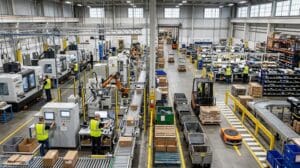
Walk any modern plant floor and you’ll see two different worlds. On one side are the production assets: CNC cells, assembly lines, test stations and packaging lines. Each one is heavily instrumented and tuned to the second. On the other side is everything that moves material between them: tuggers, forklifts, AMRs, conveyors, kitting stations and line-side supermarkets.
For decades these two worlds have been planned separately and run separately. They’ve been joined by a fragile layer of schedules, kanban cards, radio calls and heroic shift supervisors. The result is familiar. A line starves because a kit arrived 12 minutes late. A buffer overflows because upstream ran ahead of plan. A changeover stalls because the right fixtures are still on the far side of the building.
Here is the central argument of this column: manufacturers won’t reach true autonomous operations by automating the machines alone. They’ll get there when production logistics becomes as intelligent, perceptive and adaptive as the production process it feeds. Physical AI is the technology that finally makes that possible.
What We Mean by “Physical AI”
Most of the AI conversation over the past few years has been about language: copilots, chatbots and document summarization. Physical AI is different. It’s AI that perceives, reasons about and acts in the physical world. It combines four layers:
Perception: vision, LiDAR, force-torque and other sensors that let machines understand a changing, unstructured environment.
World models and simulation: physics-based digital twins where robots and material flows are trained and tested virtually before they touch the real floor.
Embodied decision-making: models that turn perception into motion, such as a path, a grasp or a hand-off, in milliseconds and at the edge.
Fleet-level orchestration: coordination across many heterogeneous agents (mobile robots, arms, conveyors and humans) toward one production goal.
Traditional automation does exactly what it was programmed to do. Physical AI handles what it wasn’t programmed for: the misplaced pallet, the deformed tote, the operator stepping into an aisle, the rush order that rewrites the afternoon.
The Missing Link: Why Logistics Is the Bottleneck to Autonomy
Manufacturers have spent heavily on making individual production assets smarter through predictive maintenance, closed-loop quality and adaptive process control. But a smart machine waiting for material is still an idle machine. Three failure patterns keep intralogistics from supporting autonomous operations.
1. The Schedule-Reality Gap
MES and ERP systems plan material movement against an idealized schedule, and the floor never matches that schedule. Fixed-route AGVs and milk runs can’t re-plan when a line speeds up, slows down or switches products. Each deviation travels downstream as either starvation or congestion.
2. The Perception Blind Spot
Most material handling still “sees” the plant through barcodes and RFID checkpoints. Between scans, the system doesn’t know where inventory really is or what condition it’s in. Autonomy can’t exist on top of partial situational awareness.
3. The Islands of Automation Problem
A plant may run AMRs from one vendor, AGVs from another, robotic palletizers from a third and a homegrown conveyor control system. Each is optimized locally, and none negotiates with the others. Local efficiency becomes system-level friction.
Until these gaps close, “lights-out” or “autonomous” manufacturing stays a slide in a strategy deck and never becomes an operating reality.
How Physical AI Closes the Loop
Physical AI connects production logistics to autonomous operations through four capabilities that build on each other.
1. Perception-Driven Material Awareness
Vision-equipped mobile robots, overhead cameras and smart sensors continuously map where material is, not where the system thinks it is. Inventory turns into a live spatial data stream instead of a series of transaction records. A shortage at line-side is detected when it starts to form, not when the line stops.
2. Simulation-Trained, Edge-Executed Intelligence
Robots and flow logic are trained in physics-accurate digital twins of the facility, covering layouts, traffic patterns, product mix and the edge cases that would be dangerous or expensive to test live. The resulting models are deployed to the edge, where they make path, grasp and hand-off decisions locally without waiting on a distant cloud. As Week 12 argued, that latency matters: a robot that has to ask permission for every move isn’t autonomous.
3. Demand-Sensing Material Flow
This is where logistics and production merge. When the production system signals a change, such as a faster takt, a quality hold or an unplanned changeover, the material flow responds on its own. Kits are re-sequenced, AMRs are re-tasked and buffers are rebalanced. Replenishment stops being a scheduled event and becomes a continuous, demand-sensing reflex.
4. Multi-Agent Orchestration Across the Value Stream
The end state isn’t one smart robot. It’s a coordinated fleet in which mobile robots, manipulators, conveyors, automated storage and people work as one system. Open interoperability standards such as VDA 5050 for mobile robot fleets, along with vendor-neutral orchestration layers, let mixed fleets negotiate priorities, resolve traffic conflicts and share tasks. Production logistics becomes an active participant in running the plant, not a support function.
A Day in the Autonomous Plant
Picture a discrete manufacturer running a mixed-model assembly line:
06:40. An inline vision system flags a supplier defect on a component batch, and the quality agent places the batch on hold.
06:41. The orchestration layer re-sequences production to models that don’t use the affected component. Within seconds, the material flow agents re-plan kitting: AMRs pull alternate kits from storage, and a robotic cell re-picks sub-assemblies for the new sequence.
06:45. A changeover begins on Line 2. Fixtures and tooling are already staged, because the logistics fleet saw the sequence change and pre-positioned them.
06:52. A supervisor gets one consolidated notification with the root cause, the actions taken and a recommended supplier escalation, and approves the escalation.
No line stopped. Nobody ran across the building with a clipboard. The decisions that needed human judgment (the supplier escalation) went to a human. The decisions that needed speed (re-routing, re-kitting, re-staging) were made by machines.
That’s autonomous operations: not the absence of people, but the absence of avoidable friction between production and the material that feeds it.
Autonomy With Guardrails: Safety Comes Before Speed
Autonomy isn’t the same as abdication. Physical AI puts moving mass, tooling and people in the same space, and the safety stakes are far higher than for a chatbot answering a question. Manufacturers getting this right follow a few clear principles.
Bounded autonomy. AI agents work inside hard-coded safety envelopes. Learning systems optimize within constraints and never override deterministic safety functions such as safety-rated controllers, light curtains and certified speed and separation monitoring.
Hierarchical control. Adaptive, learning layers stay architecturally separate from safety-critical control. The AI proposes, and certified systems enforce.
Human-in-the-loop by design. High-consequence decisions, such as quality dispositions, supplier actions and process parameter changes outside validated windows, go to people with clear context and fast override paths.
Validated before deployed. Simulation is a test bench as well as a training ground. Every model update is checked against the digital twin before it reaches the floor, and changes are documented as rigorously as any other engineering change.
Workforce readiness. Operators, technicians and contractors need real literacy in how these systems behave, where they fail and how to step in. Regulators increasingly expect it.
The organizations that scale Physical AI fastest won’t be the ones that grant the most autonomy. They’ll be the ones whose operators trust the autonomy, because it’s predictable, observable and bounded.
The Strategic Takeaway: Treat Logistics as a Production System
If you’re a plant leader, operations executive or digital transformation owner building a multi-year roadmap, three shifts matter most.
Stop funding logistics automation and production automation as separate programs. Put both under one operating model, one data architecture and one orchestration strategy. The value is in the connections between them.
Invest in the perception and simulation foundation first. Live spatial awareness and a trustworthy digital twin are the prerequisites for every autonomous capability above them. Without them, Physical AI is guessing.
Demand openness from your vendors. Require interoperability standards, edge-capable execution and open APIs. Any robot or system that can’t negotiate with the rest of your fleet will become tomorrow’s island of automation.
The factory of the future won’t be defined by its fastest machine. It will be defined by how well every asset, whether it makes things or moves them, perceives, decides and acts as one system.
The timing is fitting. Rockwell Automation’s Automation Fair is happening November 16-19, in Boston, and production logistics is a featured track there. On Wednesday, November 18, from 11:30am to 3:30pm ET, the event hosts its Production Logistics Summit. The summit opens with a keynote on “Production Logistics: The Next Era of Manufacturing Performance” and includes a customer fireside chat, breakout sessions on bridging disconnected systems and moving from pilot to enterprise-wide autonomy, and a closing panel on the journey to end-to-end autonomous operations.
Join the Conversation
Where does your plant lose the most time today: inside the production process, or in the handoffs that feed it? Is your material flow reacting to production, or still running on yesterday’s schedule? Let’s talk about it in a briefing.
Engage with ARC Advisory Group
Schedule a Briefing. Are you a technology provider bringing Physical AI, mobile robotics or orchestration solutions to manufacturing? Share your roadmap and case studies with our analyst team to be featured in future market maps and columns. Request an executive briefing from Lucas Martin.
The post From Material Flow to Machine Judgment: How Physical AI Connects Production Logistics to Autonomous Operations appeared first on Logistics Viewpoints.

Loftware Acquires Seagull Software from Peak Rock Capital
2027 Ocean Market Outlook

From Material Flow to Machine Judgment: How Physical AI Connects Production Logistics to Autonomous Operations
Freightos Global Freight Outlook – September 2026
Container rates jump another $1k/FEU – but is demand peaking? – July 8, 2026 Update

Walmart and the New Supply Chain Reality: AI, Automation, and Resilience
Trending
- Non classé3 mois ago
Freightos Global Freight Outlook – September 2026
- Non classé4 mois ago
Container rates jump another $1k/FEU – but is demand peaking? – July 8, 2026 Update
-
 Non classé2 ans ago
Walmart and the New Supply Chain Reality: AI, Automation, and Resilience
-

 Non classé7 mois ago
Why Sulfuric Acid Is Emerging as a Supply Chain Constraint in Copper
- Non classé6 mois ago
Container rates starting to spike on peak season rush – June 2, 2026 Update
- Non classé1 an ago
13 Books Logistics And Supply Chain Experts Need To Read
- Non classé1 an ago
Ex-Asia ocean rates climb on GRIs, despite slowing demand – October 22, 2025 Update
- Non classé4 mois ago
LCL Shipping Cost Calculator: Calculate Air and Sea Shipping Freight Rates