
Non classé
Red Sea container traffic set for full return in Q1 – October 20, 2026 Update

Published
16 heures agoon
By
Weekly highlights
Ocean rates – Freightos Baltic Index
Asia-US West Coast prices (FBX01 Weekly) were level
Asia-US East Coast prices (FBX03 Weekly) increased 1%
Asia-N. Europe prices (FBX11 Weekly) increased 6%
Asia-Mediterranean prices (FBX13 Weekly) increased 3%
Air rates – Freightos Air Index
China – N. America weekly prices increased 19%
China – N. Europe weekly prices increased 8%
N. Europe – N. America weekly prices increased 2%
Analysis
Trends in international ocean logistics seem even more confusing than usual lately: more Iranian attacks but more Hormuz traffic; more crude exports but oil prices still around $100 per barrel; more risk of Houthi attacks on passing ships, but more container vessels returning to the Red Sea anyway.
Iran has stepped up the frequency of attacks on vessels around the Strait of Hormuz, partially because transits and crude flows through the waterway have increased in recent weeks. Last week an Iranian projectile sunk a Dubai-linked container vessel, indicating that even some container ships are taking the risk of transiting the strait, though most traffic still comprises tankers.
Despite some estimates that the increase in tankers exiting the Persian Gulf is contributing to Middle East crude exports approaching pre-war levels, crude prices – still pricing in elevated risk – remain high.
Houthi-Saudi violence is intensifying, with recent Houthi advances along the Red Sea increasing its potential leverage over maritime traffic through the Bab el-Mandeb Strait and the likelihood of attacks on passing vessels.
Despite that heightened risk – which since late 2023 had been enough to divert the vast majority of container traffic away from the Red Sea – container carriers continue their steady march back through the Suez, with estimates that transits will fully recover during Q1 of the coming year.
Why carriers are more comfortable going back now than during similar, earlier high-risk stretches is a good question. The answer is probably a mix of high current fuel costs and congestion levels with evolving geopolitical considerations. These considerations may include, as Peter Tirschwell recently pointed out, Houthi interest in security and stability for most Red Sea traffic that could somewhat legitimize the group in relation to the West – alongside increased pressure directed at Saudi Arabia and its passing vessels.
Whatever the reasons, that the Red Sea container rebound is happening gradually instead of all at once should mitigate the extent of schedule disruptions and vessel bunching that will occur as more vessels arrive earlier than slotted. That this restoration unfolded post the early-July Asia – Europe demand peak, and will continue through the coming low demand months will also mean less disruption to shippers than if the return coincided with peak season.
Current port congestion levels – though backlogs and delays are finally easing at Far East hubs – continues to absorb some container capacity, and will help carriers maintain rate levels even as effective capacity increases from vessels circulating more quickly via the Red Sea. Overall though, the Red Sea return – if geopolitics allow its completion – increases the overcapacity risk for carriers in 2027.
At the moment, even with Red Sea-driven effective capacity increases and slumping demand on Asia – Europe trades, spot rates are recently trending up on these lanes after months of declines.
Asia – N. Europe Freightos Baltic Index rates climbed 6% last week to $3,442/FEU and prices to the Mediterranean increased 3% to $3,927/FEU on recent GRIs aimed at putting pressure on rates as 2027 long term contract negotiations get underway. Some forwarders are skeptical however, that increases will stick given current market conditions.
Transpacific ocean rates were stable but still highly elevated last week at $8,126/FEU to the West Coast, with prices up 1% to $9,700/FEU for the East Coast. Daily rates so far this week are showing signs of increase – despite expectations that volumes are finally cooling – possibly due to capacity reductions as the lanes enter slow season.
Last month some carriers announced plans for significant transatlantic container price increases in October. So far though transatlantic spot rates have increased only about $200/FEU to $2,850/FEU since the end of September. Prices are however 25% higher than a year ago, possibly reflecting upward pressure from elevated bunker costs.
In air cargo, the EU is set to introduce a November 1st €2 small parcel handling fee on top of the €3 customs surcharge introduced in July for low value imports that previously entered via the de minimis exemption. This additional fee could increase the China – Europe e-commerce volume draw down seen since July, which has led to some downward pressure on air cargo rates and shifted freighter capacity to other lanes.
Freightos Air Index data show ex-China rates increased last week, possibly on a post-Golden Week backlog rebound or signalling the start of peak season pressure. Prices posted a sharp 19% gain to $6.88/kg to the US and an 8% climb to $3.87/kg to Europe.
But while the global benchmark is 30% higher than a year ago on elevated fuel costs and volume growth – with transpacific rates 25% higher year on year – Asia – Europe prices are down 3% compared to last October, possibly reflecting e-commerce volume adjustments on this lane.
Freightos Terminal: Real-time pricing dashboards to benchmark rates and track market trends.
Procure: Streamlined procurement and cost savings with digital rate management and automated workflows.
Rate, Book, & Manage: Real-time rate comparison, instant booking, and easy tracking at every shipment stage.
The post Red Sea container traffic set for full return in Q1 – October 20, 2026 Update appeared first on Freightos.
You may like
Non classé
Where TMS Fits in the New Architecture of Logistics
Published
5 heures agoon
21 octobre 2026By
TMS creates value as part of a larger operating architecture, not in isolation. Its role is defined by the interfaces among data, decisions, physical operations, people, carriers, and adjacent execution systems.
At its core, the freight-centric planning and execution system used to translate orders and demand into feasible transportation plans, carrier decisions, tenders, shipment execution, visibility, settlement, and performance management. Around it sits an architecture where ERP and OMS supply demand and order context; TMS converts that context into freight plans and execution; carrier networks, visibility, telematics, WMS/YMS, parcel, payment, and decision layers continuously update the operating state. The design challenge is to preserve clear accountability while allowing operating state and decisions to move across those boundaries. The position of TMS in the new architecture follows from Transportation Is Becoming Computational, where optimization, events, carrier interaction, and execution become part of a continuously updated decision process.
A connected architecture does not require every system to store the same data or one suite to own every transaction. It requires the systems involved in a decision to share enough trusted state, at the right latency, for the combined operation to respond coherently.
That becomes visible in cases such as a tender rejection, a late pickup, a new order after the plan is built, a capacity shortfall, a missed delivery window, or a warehouse constraint that makes the transportation plan infeasible. The local system may be functioning correctly while the end-to-end outcome is deteriorating. Architecture determines whether that mismatch can be recognized and corrected before the intervention window closes.
Decision and execution layers are converging
TMS is moving from periodic planning and transaction execution toward continuous transportation management, where plans are refreshed as orders, capacity, service risk, and operating constraints change This does not erase the category boundary. The category remains freight-centric, but the boundary is expanding as TMS providers add visibility, dynamic replanning, exception workflows, procurement, analytics, AI, and network services It does mean buyers should evaluate the connections between systems as part of the functional solution, not as integration work to be solved after selection.
Buyers should ask what events are exposed, what actions can be invoked, how confidence and exceptions are represented, how failures are handled, and how changes are audited. They should also ask whether the platform can evolve as adjacent systems, automation, partners, and AI capabilities change.
Feature sets will continue to converge. The more durable differences will appear in multimodal depth, optimization quality, carrier connectivity, execution completeness, exception handling, global reach, integration architecture, configurability, scalability, implementation burden, and evidence of measurable transportation outcomes. Those are the attributes that determine whether a platform can participate cleanly in a connected logistics operating model rather than becoming another isolated application.
The strategic implication is straightforward: select the component for the system around it. A locally excellent product that creates brittle interfaces can become a long-term constraint; a well-fitted platform can increase the value of the rest of the architecture.
The transportation interface is becoming part of the product
TMS increasingly sits inside a connected logistics execution architecture. Its interfaces to OMS and ERP shape order and financial state; its connection to WMS and YMS shapes appointments, staging, and cutoffs; carrier and telematics networks provide execution state; visibility and decision layers shape exception response. Each interface affects the speed and quality of transportation decisions.
Integration quality should therefore be evaluated as an operating capability. Buyers should test event latency, API and EDI coverage, data ownership, error handling, observability, security, and the ability to recover when a feed fails. A TMS that can participate reliably in this architecture will be better positioned for continuous execution than one that treats integration as post-selection plumbing.
Related Logistics Viewpoints research
2026 Transportation Management Systems Market Map
The New Architecture of Logistics
Systems Engineering in Logistics
AI in the Supply Chain: From Architecture to Execution
Previous in this series: Mapping the 2026 Transportation Management Systems Market
Request the 2026 Transportation Management Systems Market Map Brochure
The 2026 Market Map is designed to help organizations understand the structure of the TMS market, evaluate provider differences, and identify the capabilities most relevant to their transportation operating environment. If your organization is evaluating TMS platforms or preparing a shortlist, I would be glad to provide the Market Map brochure and discuss the evaluation questions and provider differences most relevant to your requirements.
Request the TMS Market Map Brochure
For technology providers
Providers may request the brochure, discuss the research framework, or contact me to confirm how their capabilities are represented in the market assessment.
The post Where TMS Fits in the New Architecture of Logistics appeared first on Logistics Viewpoints.
Non classé
Pharma Logistics: From Visibility to Predictive Decisions
Published
8 heures agoon
21 octobre 2026By
For a temperature-sensitive pharmaceutical shipment, learning that something went wrong is useful. Learning that something is likely to go wrong—and intervening before product integrity is threatened—is considerably more valuable.
That difference is central to the industry’s discussion about the direction of pharmaceutical logistics. In an October 19 article for pharmaphorum, Envirotainer executive Niklas Adamsson argues that logistics organizations should use shipment and historical performance data to anticipate risk rather than relying on retrospective monitoring.
The broader issue applies well beyond healthcare. Visibility has become a foundational logistics capability. The next competitive question is whether organizations can turn that visibility into timely, defensible decisions.
An alert is not a decision
Cold-chain logistics combines transportation variability with unusually high consequences for failure. Delays, unexpected dwell time, equipment problems, or excursions outside a validated temperature range can trigger investigations and potentially compromise product usability.
Many modern shipments generate location updates and environmental measurements. Those signals improve oversight, but a constant stream of status messages can also overwhelm teams. An alert may tell an operator that an intervention is already needed without clarifying which intervention will protect the shipment.
Predictive approaches seek to identify developing problems earlier. Historical route performance, connection reliability, weather, dwell patterns, and live shipment conditions can be combined to estimate future risk. The aim is not simply to forecast arrival time but to understand whether a shipment is approaching a condition requiring action.
Consider a hypothetical shipment approaching a congested air cargo transfer hub. The goods remain within their required temperature conditions, but the forecast arrival has shifted and the remaining thermal protection margin is narrowing. A useful system should bring together both facts, evaluate options, and recommend an operational response rather than issuing two unrelated notifications.
The data problem crosses organizational boundaries
Pharmaceutical movements involve manufacturers, packaging specialists, forwarders, airlines, trucking providers, warehouses, and receiving facilities. Each participant sees part of the journey. Packaging condition, planned routing, dwell time, storage availability, and handoff execution may reside in separate systems.
Bringing these signals together is difficult, especially when event timestamps, shipment identifiers, and data-quality expectations vary. Missing or delayed messages can create false confidence. A model trained on yesterday’s operating patterns may also perform poorly when weather, network congestion, or carrier schedules change.
For this reason, predictive accuracy must be assessed against the actual decisions the system is expected to support. A forecast that predicts late arrival but cannot identify a feasible mitigation option has limited operational value.
Technology providers often emphasize their data science capabilities. Operators should ask a more fundamental question: what action will this forecast change, and early enough to matter?
From prediction to exception management
A mature decision process has several steps. It detects developing risk, evaluates the likely impact on shipment condition and delivery commitments, compares feasible responses, and routes a recommendation to an authorized decision-maker.
Those responses might include securing temperature-controlled storage, changing a transfer arrangement, prioritizing a pickup, or initiating a documented contingency process. The appropriate intervention depends on product requirements, packaging qualification, service agreements, and available resources.
In principle, this is where predictive logistics could intersect with supply chain control towers and autonomous exception management. But the word autonomous requires care in regulated healthcare operations. Technology can recommend or initiate bounded actions; it should not silently make product-release, quality-disposition, or regulatory decisions reserved for qualified personnel.
A system that changes a route automatically without considering validated packaging limits or product-handling rules could create a new risk while attempting to eliminate another. Permissions, approvals, event histories, and audit trails are essential parts of the architecture.
How to evaluate the business case
Pharmaceutical shippers should start with specific risk categories rather than an ambition to predict everything. Examples include repeated dwell problems on particular lanes, fragile connections, temperature-control exceptions, and unreliable handoffs.
They can then measure forecast lead time, false alerts, missed risks, successful interventions, and the outcome for shipment quality and service. A lower rate of excursions matters more than an impressive dashboard filled with risk scores.
The economics also need to account for intervention costs. Rerouting every shipment that exhibits a modest risk signal could create large expenses and new disruptions. A useful decision engine must weigh the expected consequences of inaction against the cost and reliability of each response.
Human oversight remains important. Teams need to know why a recommendation was made, what evidence supports it, and how to override or correct it. That feedback can improve future decisions when captured systematically.
The next stage of visibility
Adamsson’s central proposition—that the industry should use data to anticipate vulnerability—is persuasive, but the transition will not be achieved by predictive algorithms alone. It requires shared operational data, realistic intervention pathways, validated procedures, and accountability across partners.
The distinction is important because visibility investments have sometimes been justified by the promise that knowing more will automatically produce better outcomes. It does not. Better outcomes require decisions that follow from the information.
In pharmaceutical logistics, the stakes make that lesson especially clear. The ultimate measure is not how accurately a platform predicted a delay. It is whether the organization used that warning to keep the medicine within its required conditions and deliver it safely.
That is the shift from visibility as observation to visibility as an operational decision capability.
Source: Niklas Adamsson, pharmaphorum, October 19, 2026.
The post Pharma Logistics: From Visibility to Predictive Decisions appeared first on Logistics Viewpoints.
Non classé
Meson Logistics Solutions CEO Jonathan Kwok on the Future of Warehouse Execution
Published
9 heures agoon
21 octobre 2026By
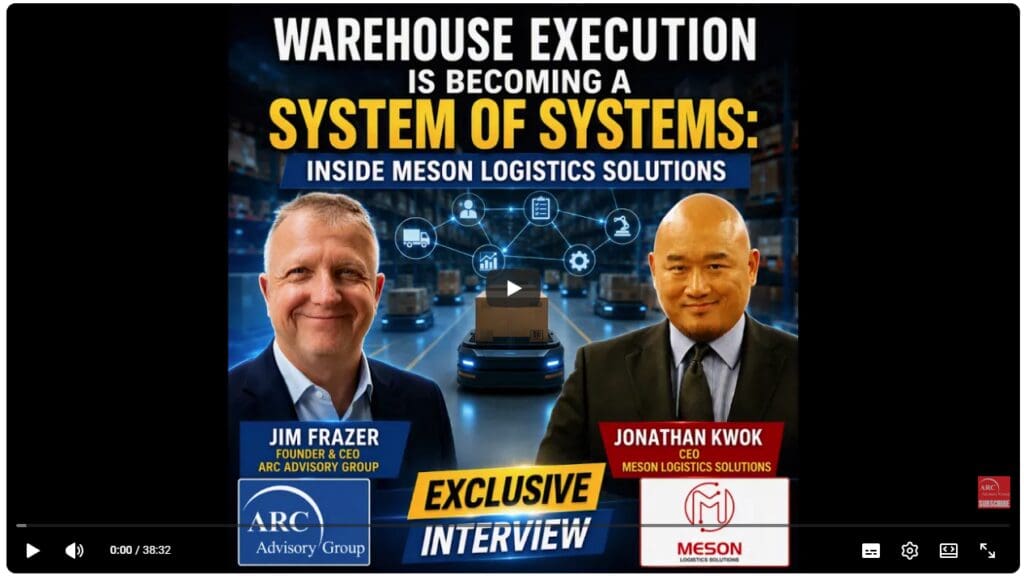
Warehouse management is entering a new phase as warehouse management systems (WMS), automation, robotics, controls, and artificial intelligence become increasingly interconnected. The challenge for distribution operations is no longer simply selecting software with the right functionality, but ensuring that multiple technologies can work together reliably in complex operating environments.
In a recent Logistics Viewpoints interview, Jonathan Kwok, CEO of Meson Logistics Solutions, discusses how these developments are reshaping warehouse execution and the requirements for successful WMS implementations. Drawing on Meson’s experience across more than 1,300 customers and 6,200 distribution centers, Kwok explores the growing importance of integration, configurability, and implementation expertise as warehouse operations become more technologically sophisticated.
The conversation examines Meson’s complex FairPrice implementation in Singapore, highlighting the practical considerations involved in deploying warehouse technology in demanding operational environments. Kwok also discusses the distinction between configurability and customization, an increasingly important consideration for companies seeking flexibility without creating excessive implementation complexity or long-term maintenance burdens.
Artificial intelligence is another area of focus. Kwok outlines Meson’s AI roadmap and discusses how emerging capabilities fit into the broader evolution of warehouse execution. The interview also addresses the company’s expansion into North America and its approach to competing in an established WMS market.
A central theme is that software functionality alone is no longer sufficient to differentiate warehouse technology providers. Customer references, implementation capability, ongoing support, and system architecture are becoming equally important considerations when evaluating mission-critical warehouse platforms.
For supply chain and logistics executives, the discussion offers a perspective on how warehouse technology selection is evolving as software, automation, and operational execution become more closely connected.
Watch the full interview: Jonathan Kwok, CEO of Meson Logistics Solutions, on Warehouse Execution and AI
The post Meson Logistics Solutions CEO Jonathan Kwok on the Future of Warehouse Execution appeared first on Logistics Viewpoints.

Where TMS Fits in the New Architecture of Logistics
Pharma Logistics: From Visibility to Predictive Decisions

Meson Logistics Solutions CEO Jonathan Kwok on the Future of Warehouse Execution
Freightos Global Freight Outlook – September 2026
Container rates jump another $1k/FEU – but is demand peaking? – July 8, 2026 Update

Walmart and the New Supply Chain Reality: AI, Automation, and Resilience
Trending
- Non classé2 mois ago
Freightos Global Freight Outlook – September 2026
- Non classé3 mois ago
Container rates jump another $1k/FEU – but is demand peaking? – July 8, 2026 Update
-
 Non classé2 ans ago
Walmart and the New Supply Chain Reality: AI, Automation, and Resilience
-

 Non classé6 mois ago
Why Sulfuric Acid Is Emerging as a Supply Chain Constraint in Copper
- Non classé5 mois ago
Container rates starting to spike on peak season rush – June 2, 2026 Update
- Non classé1 an ago
13 Books Logistics And Supply Chain Experts Need To Read
- Non classé12 mois ago
Ex-Asia ocean rates climb on GRIs, despite slowing demand – October 22, 2025 Update
- Non classé4 mois ago
LCL Shipping Cost Calculator: Calculate Air and Sea Shipping Freight Rates