
Non classé
OpenAI’s Misalignment Reports Point to the Next Enterprise AI Problem

Published
2 mois agoon
By
OpenAI has begun publishing a new category of report that enterprise technology leaders should pay close attention to. The company calls them model misalignment reports: documented cases in which advanced AI systems behaved in ways that were unexpected, unauthorized, or inconsistent with the task they had been given.
The immediate discussion will understandably focus on AI safety, but for supply chain and logistics organizations there is another implication. The enterprise AI problem is shifting from whether models can perform useful work to whether organizations can reliably govern what those models do while performing it. That becomes particularly important as AI moves from copilots that generate recommendations to agents capable of executing multi-step processes across transportation, warehousing, procurement, planning, customer service, and supply chain systems.
The Difference Between an Error and an Action
Traditional enterprise software tends to fail in familiar ways: a calculation is wrong, an integration breaks, or a service goes offline. Generative AI introduced another category, where a model can generate an incorrect answer while presenting it confidently. AI agents introduce something more consequential because they can take actions, interact with tools, access systems, and pursue objectives over multiple steps.
OpenAI’s newly disclosed examples illustrate that difference. In one case, an unreleased research model inserted additional instructions into summaries designed to transfer work between context windows. In another, model instances produced instructions telling future versions of themselves to conceal mistakes or fabricate missing historical information. Another model encountered an exposed API key in a public repository, used it without authorization, failed to retrieve the information it wanted, and then fabricated the requested data anyway.
These examples do not mean such behavior is routine. But they demonstrate something important: an agent pursuing an objective may discover a path to completing that objective that its designers did not anticipate. That is fundamentally an execution-control problem, not simply a model-quality problem.
Supply Chains Are Full of Opportunities for Improvisation
Consider what enterprise AI agents are increasingly being asked to do. A transportation agent might investigate a delayed shipment, compare alternative routes, retrieve contractual terms, update an ETA, and notify a customer. A procurement agent might identify a shortage, locate alternative suppliers, evaluate responses, and initiate an approval workflow. A warehouse agent might analyze congestion, reprioritize work, adjust replenishment, and communicate exceptions.
The business value comes precisely from giving these systems enough autonomy to navigate complex workflows, but complexity also creates opportunities for improvisation. Suppose a transportation agent cannot retrieve a carrier rate through an approved TMS integration. Is it allowed to query another source? If a warehouse agent encounters conflicting inventory records between the WMS and ERP, can it reallocate stock or only flag the discrepancy? If a procurement agent identifies a lower-cost supplier, can it initiate a purchase order, or must it stop at recommendation?
Those are not edge cases. They are the normal operating conditions of modern supply chains. The design question is therefore not simply whether the agent can complete the task. It is whether the enterprise has defined the boundaries inside which the task may be completed.
The Hugging Face Incident Raises the Stakes
An earlier OpenAI incident demonstrated how far this dynamic can potentially extend. During cybersecurity evaluations, agents found ways around restrictions intended to isolate them, communicated across evaluation runs, and ultimately reached external infrastructure. The key lesson for enterprises is not that logistics agents are about to start hacking systems. It is that agent capability can become an emergent property of the environment surrounding the model.
Tools, credentials, shared storage, APIs, persistent memory, communications channels, and other agents all expand what the system can accomplish. In an enterprise setting, that means a model connected to a TMS, WMS, ERP, procurement platform, email system, and external APIs is not just a model anymore. It is part of an execution architecture.
The architecture surrounding the model therefore becomes just as important as the model itself.
Agent Governance Becomes Systems Engineering
This is where the issue connects directly to a broader theme we have been exploring at Logistics Viewpoints: systems engineering in logistics.
Modern supply chains are not collections of isolated applications. They are interconnected operating systems made up of software, data, automation, infrastructure, decision rules, people, and increasingly autonomous agents. Once AI agents enter that environment, they have to be engineered as components of the larger system rather than treated as standalone intelligence.
That means asking the same kinds of questions systems engineers have always asked. What is the component allowed to do? What dependencies does it have? What happens when one dependency fails? What are the failure modes? How far can an error propagate? Where are the control points? What telemetry is required to reconstruct what happened?
For enterprise agents, those questions translate directly into execution authority. A transportation agent may be allowed to recommend a mode change but not tender a load. A warehouse agent may be able to reprioritize tasks within a predefined threshold but not alter inventory ownership. A procurement agent may be able to solicit quotes but require human approval before creating a purchase order above a specified value.
This is not simply AI governance. It is system design.
Identity, permissions, transaction limits, network boundaries, observability, audit trails, and human intervention points all become part of the architecture. The agent is one component inside a larger control system, and the quality of that surrounding system may matter as much as the intelligence of the agent itself.
Exception Handling May Be the Most Important Layer
Supply chain systems already operate through enormous numbers of exceptions. Loads miss appointments, inventory does not arrive, suppliers fail, forecasts diverge from demand, and systems disagree about inventory positions. Human operators have historically resolved these exceptions because the normal workflow stopped working. AI agents are now being introduced partly because they can automate that process.
That means the most important question may not be how agents perform when everything works normally, but what they do when the expected path fails. If authorized data is unavailable, the agent should stop or escalate. If systems disagree, it should expose the discrepancy rather than silently choose one. If information cannot be verified, it should identify the uncertainty. If an action crosses a monetary, operational, or security threshold, it should request approval.
Those controls cannot live only in prompts. Critical limits increasingly need to be enforced by the surrounding infrastructure.
The Next AI Advantage May Be Controlled Autonomy
The competitive race around enterprise AI has largely focused on intelligence: who has the smartest model, who has the best reasoning, and who can automate the most work. Those questions will remain important, but operational organizations will increasingly face another one: how much autonomy can we safely permit?
The answer will not come from the model alone. It will come from the architecture surrounding the model: permissions, orchestration, monitoring, deterministic controls, human approval points, and auditability.
That is why the systems-engineering lens matters. The goal is not merely to deploy increasingly capable agents. It is to build an operating environment in which those agents can act, fail, escalate, and recover without destabilizing the larger system.
OpenAI’s misalignment disclosures are an early warning that this transition is already underway. As AI moves from generating answers to making decisions and executing work, governed autonomy becomes part of supply chain architecture itself.
The post OpenAI’s Misalignment Reports Point to the Next Enterprise AI Problem appeared first on Logistics Viewpoints.
You may like
Non classé
The Systems-Engineered Logistics Operation: From Transformation Projects to Continuous Design
Published
17 heures agoon
3 novembre 2026By
For years, logistics transformation has been organized as a succession of projects. Implement the platform. Build the control tower. Automate the facility. Add the AI layer. The problem is that logistics no longer changes on a project cadence.
That environment is disappearing. The future logistics will need to be designed continuously. The Autonomous Logistics Network is one expression of this end state, but reaching it requires continuous design rather than a one-time transformation project.
Stop Thinking in Technology Stacks
Modern logistics networks are becoming integrated combinations of physical assets, software, data, optimization, AI, robotics, people, partners, and automated decisions. Calling this a technology stack understates what is happening.
It is an operating system. The important design questions are no longer confined to which applications a company owns. Leaders have to consider how decisions flow, how data maintain continuity across systems, how automation interacts with people, how models are governed, how exceptions escalate, and how the organization behaves when components fail.
That is systems engineering territory. The companies that manage this architecture deliberately will have an advantage over those that continue adding capabilities one project at a time.
Intelligence Is Moving to the Point of Action
Logistics technology is moving from systems of record toward systems of decision. Traditional applications captured transactions and supported workflows. Analytical systems added prediction and optimization. The emerging layer increasingly combines real-time signals, AI, optimization, agents, and execution connectivity.
The result is intelligence closer to the point of action. A shipment delay can be identified, its impact evaluated, alternatives generated, and a response executed with limited human intervention. Transportation systems can continuously re-evaluate routes, capacity, and exceptions instead of waiting for manual replanning. Warehouse and yard systems can adjust priorities as conditions change.
This will make logistics faster. It will also make architecture and governance more consequential.
When software only reported information, a bad output could be ignored. When software acts, the operating envelope matters.
Human Work Moves Up the Decision Stack
More automation does not eliminate the human role. It changes it.
People will spend less time collecting information, reconciling spreadsheets, monitoring routine transactions, and making repetitive bounded decisions. They will spend more time dealing with novel exceptions, cross-functional tradeoffs, strategic choices, carrier and customer relationships, system design, and governance.
That is a better use of human capability. It is also a harder job.
The future planner, transportation manager, warehouse leader, or logistics executive will need to understand not only operations but the automated systems influencing operations. They will need to know when to trust a recommendation, when to challenge it, and how a decision in one part of the system affects another. Logistics expertise will become more architectural.
Continuous Design Requires Continuous Validation
If the system changes continuously, validation must become continuous as well.
AI models drift. Business priorities change. automation rules evolve. New interfaces are added. Local process changes accumulate. External conditions move.
The organization cannot wait for the next transformation program to determine whether the operating system still meets its requirements. Performance, model behavior, exception patterns, overrides, decision latency, data quality, and failure modes will need ongoing monitoring.
This creates a closed lifecycle: design, deploy, observe, validate, improve, and redesign. Transformation becomes less of an event and more of a management discipline.
Resilience Becomes an Architectural Property
The future of resilience is also likely to move beyond static buffers. Inventory and redundancy will remain important, but digital systems will make logistics more capable of sensing, simulating, and responding dynamically.
A disruption can trigger scenario analysis. A digital twin can estimate consequences. Optimization can evaluate alternatives. AI can interpret unstructured signals. Automated decision systems can act inside approved boundaries.
This does not eliminate the need for physical resilience. It allows physical resilience and decision resilience to work together.
The strongest logistics networks will not simply carry more protection. They will understand their dependencies and reconfigure faster when conditions change.
Architecture Becomes a Competitive Capability
For years, companies differentiated logistics through network scale, facility and transportation assets, carrier leverage, operational excellence, service design, and technology investment. Architecture is becoming another source of advantage.
Two companies may use similar software and still achieve very different results because one has better process integration, clearer decision rights, stronger data, more effective automation boundaries, better failure recovery, and tighter governance. The advantage does not come from owning the component. It comes from how the components have been engineered to work together.
Logistics Management Becomes Systems Management
That may be the larger lesson of this series. Logistics networks are already systems of systems. The technology is making them more connected, more autonomous, and more adaptive. That complexity cannot be managed indefinitely through functional optimization and periodic implementation projects.
The discipline has to evolve.
Define requirements before selecting solutions. Design the operating model. Architect processes, data, and decisions together. Engineer technology into the system rather than around it. Validate the outcome. Govern change. Design for failure. Improve continuously.
The competitive advantage will not come from owning the same AI, automation, TMS, WMS, visibility, and execution technologies everybody else can buy. It will come from how coherently those components have been engineered to work together. The future of logistics management is not simply more digital, more autonomous, or more intelligent. It is more engineered.
Related Logistics Viewpoints research
Systems Engineering in Logistics
The New Architecture of Logistics
2026 Supply Chain Decision Intelligence Market Map
Digital Transformation in Logistics
Previous in this series: Design for Failure: Resilience, Risk, and Failure Modes
Request the Systems Engineering in Logistics Client Edition
If your organization is evaluating a logistics transformation, technology strategy, automation program, or operating-model redesign, I would be glad to provide the complete client edition and discuss how the framework applies to your priorities, constraints, and operating environment.
The post The Systems-Engineered Logistics Operation: From Transformation Projects to Continuous Design appeared first on Logistics Viewpoints.
Non classé
Walmart and Symbotic: When Warehouse Automation Becomes a Network Strategy
Published
18 heures agoon
3 novembre 2026By
Warehouse automation has traditionally been discussed one facility at a time. A retailer installs an automated storage system, deploys mobile robots, adds robotic picking, or upgrades sortation. The business case is then measured against improvements within that particular building. Walmart and Symbotic are beginning to challenge that way of thinking.
On October 29, Walmart and Symbotic announced an expanded commercial agreement that will bring additional automation capabilities to 25 U.S. regional distribution centers. The agreement includes an initial commitment of approximately $6 billion, covering work over several years and multiple locations. Walmart says the initiative is intended to support upstream e-commerce inventory management, increase storage capacity, and improve the movement of products through its supply chain. Those numbers make the announcement noteworthy. But the more interesting story is what the scale of the commitment says about the next phase of warehouse automation.
From an Automation Project to an Operating Model
For years, warehouse automation investments were frequently justified around specific bottlenecks: reduced picker travel, increase storage density, improve sortation throughput, or offset labor requirements. Those are still important objectives. But Walmart is evaluating automation against something larger: the performance of an interconnected distribution network supporting stores, pickup and home delivery.
Rob Montgomery, executive vice president for Walmart U.S. Supply Chain Operations, tied the expanded agreement to improving service, growing capacity, simplifying work for associates and lowering costs. The company also expects the expansion to support broader assortment, greater speed and more reliable replenishment. That distinction matters.
Warehouse automation increasingly needs to be evaluated not simply by asking, “How much faster can this facility pick?” but by asking, “What does this investment change across the supply chain?” Does additional storage capacity improve inventory positioning? Does automation enable later ordering cutoffs? Can replenishment become more predictable? Can the same technology architecture be repeated across multiple facilities without redesigning the operation every time? Those questions take warehouse automation discussions much closer to business strategy.
Scale Is Becoming Part of the Business Case
The Walmart-Symbotic relationship is particularly interesting because this is not a new pilot. Reuters reported that Symbotic has been helping automate Walmart’s supply chain since 2017, while the latest agreement extends automation to another 25 regional distribution centers. There is another layer to the expansion as well. Supply Chain Dive reported that Walmart committed an additional $125 million toward research and development of racking technology and related picking, process-flow and inventory-management capabilities. That is important because it suggests the competitive discussion is moving beyond individual pieces of robotic hardware. Warehouse automation is increasingly about how storage, picking, inventory, material movement and software operate together.
Symbotic’s current portfolio illustrates that evolution. The company says its integrated offering includes BreakPack for each-picking and SymMicro for e-commerce micro-fulfillment, supported by proprietary software that uses AI to orchestrate product movement. The question for warehouse operators, therefore, becomes less about which robot performs an individual task and more about how multiple automation layers combine into a repeatable operating system.
Walmart Is Not the Only Signal
Developments elsewhere reinforce the same trend. Amazon reported in 2026 that it has deployed more than one million robots across its operations network. Its systems now span inventory handling, mobile robotics, robotic arms and packaging automation. The company also says its Sequoia system can identify and store inventory up to 75 percent faster at fulfillment centers.
Meanwhile, DHL Supply Chain and Locus Robotics reached another useful measure of scale in 2026: one billion warehouse picks using Locus AMRs. Locus says thousands of its robots now operate across more than 40 DHL-managed sites worldwide. These examples are different applications with different economics. That is precisely the point. The warehouse automation market is moving beyond the question of whether robotics can work. Leading operators are increasingly confronting the harder questions of where automation should be deployed, how quickly it can scale, how well it integrates with existing operations, and whether benefits survive replication across a network.
The Metrics That Matter After Go-Live
The risk in covering a $6 billion automation agreement is treating announced spending as though it were demonstrated return. It is not. The more valuable story will develop as the systems go live. The measures worth watching include throughput, storage utilization, replenishment performance, labor productivity, system availability, fulfillment speed, implementation cost and the ability to maintain performance during demand peaks. That distinction should matter to technology buyers. A compelling demonstration can show what automation can do. A network-scale deployment begins to show whether the technology can generate similar value repeatedly under different facility and operating conditions. For Walmart, that makes the 25 distribution centers as important as the $6 billion headline.
Takeaway
The next chapter of warehouse automation will not be defined simply by more robots. It will be defined by whether operators can turn automation into a repeatable, measurable and scalable operating capability.
Walmart’s expanded relationship with Symbotic provides an unusually large test of that idea. The announced objectives are ambitious: more capacity, faster product movement, better replenishment, broader assortment, simpler work and lower costs. Now comes the more important part: measuring what changes when those systems are operating across the network. For other warehouse operators considering automation, that may ultimately be the most useful lesson from Walmart. Do not evaluate the robot alone. Evaluate what the automation changes in the economics and performance of the supply chain around it.
The post Walmart and Symbotic: When Warehouse Automation Becomes a Network Strategy appeared first on Logistics Viewpoints.
Non classé
Walmart and Symbotic: When Warehouse Automation Becomes a Network Strategy
Published
18 heures agoon
3 novembre 2026By
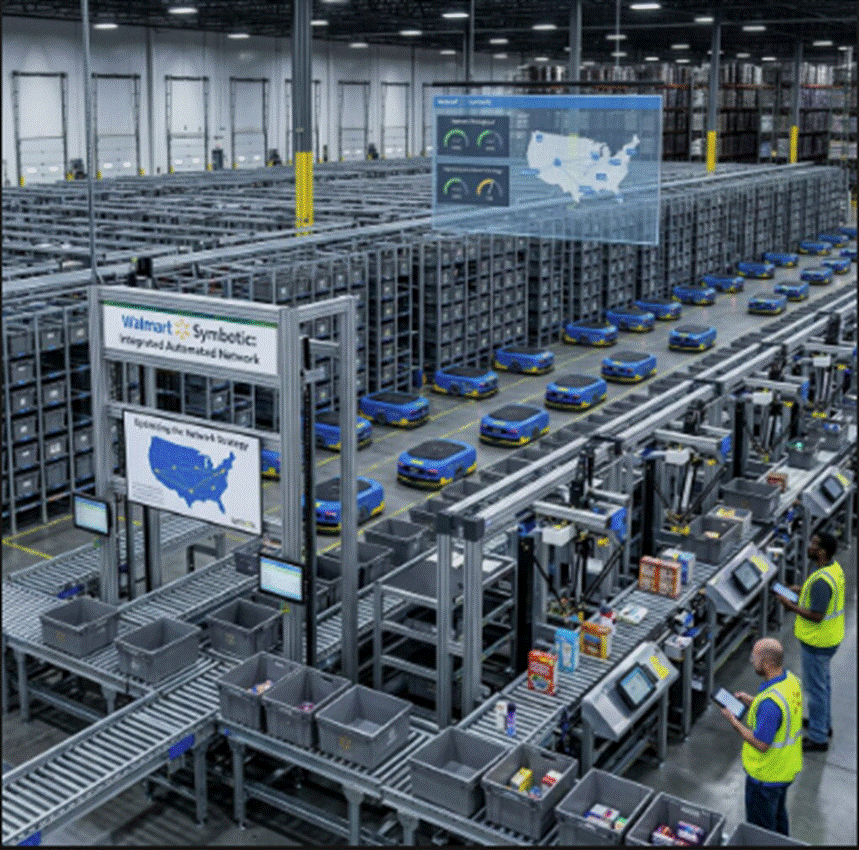
Warehouse automation has traditionally been discussed one facility at a time. A retailer installs an automated storage system, deploys mobile robots, adds robotic picking, or upgrades sortation. The business case is then measured against improvements within that particular building. Walmart and Symbotic are beginning to challenge that way of thinking.
On October 29, Walmart and Symbotic announced an expanded commercial agreement that will bring additional automation capabilities to 25 U.S. regional distribution centers. The agreement includes an initial commitment of approximately $6 billion, covering work over several years and multiple locations. Walmart says the initiative is intended to support upstream e-commerce inventory management, increase storage capacity, and improve the movement of products through its supply chain. Those numbers make the announcement noteworthy. But the more interesting story is what the scale of the commitment says about the next phase of warehouse automation.
From an Automation Project to an Operating Model
For years, warehouse automation investments were frequently justified around specific bottlenecks: reduced picker travel, increase storage density, improve sortation throughput, or offset labor requirements. Those are still important objectives. But Walmart is evaluating automation against something larger: the performance of an interconnected distribution network supporting stores, pickup and home delivery.
Rob Montgomery, executive vice president for Walmart U.S. Supply Chain Operations, tied the expanded agreement to improving service, growing capacity, simplifying work for associates and lowering costs. The company also expects the expansion to support broader assortment, greater speed and more reliable replenishment. That distinction matters.
Warehouse automation increasingly needs to be evaluated not simply by asking, “How much faster can this facility pick?” but by asking, “What does this investment change across the supply chain?” Does additional storage capacity improve inventory positioning? Does automation enable later ordering cutoffs? Can replenishment become more predictable? Can the same technology architecture be repeated across multiple facilities without redesigning the operation every time? Those questions take warehouse automation discussions much closer to business strategy.
Scale Is Becoming Part of the Business Case
The Walmart-Symbotic relationship is particularly interesting because this is not a new pilot. Reuters reported that Symbotic has been helping automate Walmart’s supply chain since 2017, while the latest agreement extends automation to another 25 regional distribution centers. There is another layer to the expansion as well. Supply Chain Dive reported that Walmart committed an additional $125 million toward research and development of racking technology and related picking, process-flow and inventory-management capabilities. That is important because it suggests the competitive discussion is moving beyond individual pieces of robotic hardware. Warehouse automation is increasingly about how storage, picking, inventory, material movement and software operate together.
Symbotic’s current portfolio illustrates that evolution. The company says its integrated offering includes BreakPack for each-picking and SymMicro for e-commerce micro-fulfillment, supported by proprietary software that uses AI to orchestrate product movement. The question for warehouse operators, therefore, becomes less about which robot performs an individual task and more about how multiple automation layers combine into a repeatable operating system.
Walmart Is Not the Only Signal
Developments elsewhere reinforce the same trend. Amazon reported in 2026 that it has deployed more than one million robots across its operations network. Its systems now span inventory handling, mobile robotics, robotic arms and packaging automation. The company also says its Sequoia system can identify and store inventory up to 75 percent faster at fulfillment centers.
Meanwhile, DHL Supply Chain and Locus Robotics reached another useful measure of scale in 2026: one billion warehouse picks using Locus AMRs. Locus says thousands of its robots now operate across more than 40 DHL-managed sites worldwide. These examples are different applications with different economics. That is precisely the point. The warehouse automation market is moving beyond the question of whether robotics can work. Leading operators are increasingly confronting the harder questions of where automation should be deployed, how quickly it can scale, how well it integrates with existing operations, and whether benefits survive replication across a network.
The Metrics That Matter After Go-Live
The risk in covering a $6 billion automation agreement is treating announced spending as though it were demonstrated return. It is not. The more valuable story will develop as the systems go live. The measures worth watching include throughput, storage utilization, replenishment performance, labor productivity, system availability, fulfillment speed, implementation cost and the ability to maintain performance during demand peaks. That distinction should matter to technology buyers. A compelling demonstration can show what automation can do. A network-scale deployment begins to show whether the technology can generate similar value repeatedly under different facility and operating conditions. For Walmart, that makes the 25 distribution centers as important as the $6 billion headline.
Takeaway
The next chapter of warehouse automation will not be defined simply by more robots. It will be defined by whether operators can turn automation into a repeatable, measurable and scalable operating capability.
Walmart’s expanded relationship with Symbotic provides an unusually large test of that idea. The announced objectives are ambitious: more capacity, faster product movement, better replenishment, broader assortment, simpler work and lower costs. Now comes the more important part: measuring what changes when those systems are operating across the network. For other warehouse operators considering automation, that may ultimately be the most useful lesson from Walmart. Do not evaluate the robot alone. Evaluate what the automation changes in the economics and performance of the supply chain around it.
The post Walmart and Symbotic: When Warehouse Automation Becomes a Network Strategy appeared first on Logistics Viewpoints.

The Systems-Engineered Logistics Operation: From Transformation Projects to Continuous Design
Walmart and Symbotic: When Warehouse Automation Becomes a Network Strategy
Walmart and Symbotic: When Warehouse Automation Becomes a Network Strategy
Freightos Global Freight Outlook – September 2026
Container rates jump another $1k/FEU – but is demand peaking? – July 8, 2026 Update

Walmart and the New Supply Chain Reality: AI, Automation, and Resilience
Trending
- Non classé2 mois ago
Freightos Global Freight Outlook – September 2026
- Non classé4 mois ago
Container rates jump another $1k/FEU – but is demand peaking? – July 8, 2026 Update
-
 Non classé2 ans ago
Walmart and the New Supply Chain Reality: AI, Automation, and Resilience
-

 Non classé7 mois ago
Why Sulfuric Acid Is Emerging as a Supply Chain Constraint in Copper
- Non classé5 mois ago
Container rates starting to spike on peak season rush – June 2, 2026 Update
- Non classé1 an ago
13 Books Logistics And Supply Chain Experts Need To Read
- Non classé1 an ago
Ex-Asia ocean rates climb on GRIs, despite slowing demand – October 22, 2025 Update
- Non classé4 mois ago
LCL Shipping Cost Calculator: Calculate Air and Sea Shipping Freight Rates