
Non classé
Oil and Gas Supply Chain Strategy: Why Energy Flows Are Now Strategic Infrastructure

Published
3 mois agoon
By
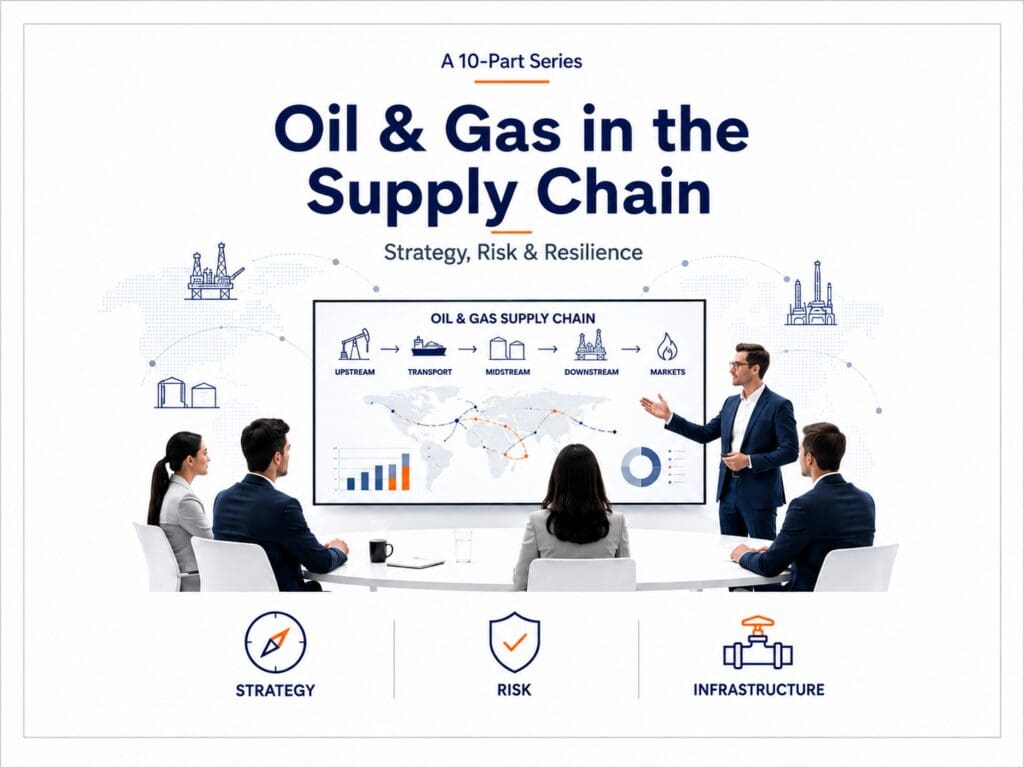
Oil and gas is commonly described in terms of commodities, prices, reserves, and production volumes. Those measures still matter. But they do not fully describe the operating reality facing energy companies, industrial buyers, logistics providers, and governments. In practical terms, oil and gas is one of the most complex supply chain systems in the global economy.
Oil and Gas in the Supply Chain: A Strategic Framework for Building Resilient and Responsible Supply Chains.
This system connects reservoirs, drilling programs, service companies, gathering networks, pipelines, gas processing plants, LNG terminals, refineries, petrochemical assets, tank farms, ports, rail networks, truck fleets, industrial customers, and consumers. It also spans multiple regulatory environments, asset classes, geographies, operating time horizons, and commercial models. Few industries have to coordinate so many physical, financial, digital, environmental, and geopolitical variables at once.
For many years, the oil and gas supply chain was organized around scale, asset control, reliability, and access to markets. The central operating questions were direct: where is the resource, how can it be produced efficiently, how can it be transported safely, how can it be processed profitably, and how reliably can it reach the customer? These questions remain fundamental. But they are no longer enough.
Today, oil and gas supply chains are being reshaped by geopolitical volatility, energy security concerns, infrastructure constraints, emissions accountability, cyber risk, capital discipline, and customer demand for transparency. These forces are not external considerations sitting outside the operating model. They now influence network design, investment decisions, supplier relationships, asset management strategies, commercial contracting, and investor communications.
A refinery disruption can change regional fuel balances. A constrained pipeline can strand production or alter basis differentials. An LNG cargo delay can become an energy security concern. A methane incident can create regulatory, financial, and reputational exposure. A cyberattack on a terminal, pipeline operator, or refinery can interrupt product flows across a region. Oil and gas supply chains have become strategic infrastructure.
From Commodity Flow to Systemic Supply Chain Risk
The traditional view of oil and gas emphasized production and price. The modern operating view must also emphasize flows, constraints, optionality, and risk. Crude oil, natural gas, LNG, refined products, natural gas liquids, petrochemical feedstocks, drilling materials, field chemicals, catalysts, compressors, valves, pumps, spare parts, and maintenance services all move through interdependent networks.
Those networks are exposed to physical disruption, weather events, regulatory change, cyber intrusion, capacity shortages, supplier failures, contractor constraints, and market volatility. In many cases, a disruption in one node of the network has consequences far beyond the affected facility. A delayed compressor part can reduce gas throughput. A missed turnaround milestone can constrain refinery output. A shortage of tankage can limit commercial flexibility. A fragmented logistics network can turn market volatility into margin leakage.
The exposure is not only operational. It is financial, digital, environmental, and reputational. A company may be able to produce or process product, but still lose value if it cannot move it through the right channel, document its emissions profile, protect its digital infrastructure, or respond quickly to a market disruption. In this environment, supply chain performance is not a back-office concern. It is a strategic management discipline.
The companies that outperform will be those that treat the oil and gas value chain as an integrated operating network rather than a collection of disconnected assets. That requires stronger visibility into physical flows, better coordination across commercial and operational functions, disciplined asset management, and more resilient logistics execution.
Energy Security Is Now a Supply Chain Requirement
Energy security has returned to the center of industrial strategy. Governments want reliable access to oil, gas, refined products, LNG, and petrochemical feedstocks. Industrial customers need predictable supply to support production. Consumers expect fuel availability. Investors expect disciplined capital allocation. Regulators expect lower emissions and more credible transparency.
These expectations create a difficult operating mandate. Oil and gas supply chains must maintain reliability, reduce avoidable emissions, strengthen infrastructure resilience, protect critical assets from cyber and physical threats, provide credible product-level and asset-level data, respond faster to disruptions, and preserve commercial optionality in volatile markets.
That is a significant management challenge because the goals can be in tension. Maximizing short-term throughput may not always align with emissions reduction. Optimizing logistics cost may reduce optionality. Centralizing digital control can improve visibility but also expands the cyber risk surface. Capital discipline can defer investments that would otherwise improve resilience. The supply chain organization must help leadership understand these trade-offs in operational and financial terms.
Energy companies that do this well will not merely move molecules from source to destination. They will orchestrate supply chain systems. That means using data, contracts, assets, logistics capacity, operational planning, and risk management in a coordinated way to serve customers and protect enterprise value.
The Data Layer Behind Every Barrel and Molecule
Oil and gas operations generate enormous amounts of data. Production volumes, pressure readings, flow rates, tank levels, vessel positions, crude assays, refinery unit performance, pipeline nominations, maintenance histories, emissions measurements, supplier status, inventory levels, and market prices are all part of the operating picture.
The problem is rarely a lack of data. The more common problem is fragmentation. Upstream systems may not connect cleanly with midstream logistics. Refinery scheduling may sit apart from crude procurement and product distribution. Maintenance systems may not align with spare parts planning. Emissions reporting may occur after the fact, rather than being embedded in operational decisions. Commercial teams may see exposure differently than operations teams see constraints.
This fragmentation limits the ability to make fast, informed decisions. It can also create hidden risk. For example, a logistics planner may see available transportation capacity, but not the maintenance constraint that will affect a key asset. A commercial team may pursue a market opportunity without a full view of terminal capacity. An emissions reporting team may document performance after the fact, but not provide the operational insight needed to reduce emissions at the source.
The next stage of oil and gas supply chain performance depends on connecting data into a usable operating fabric. This does not mean simply building a larger data lake or deploying dashboards for their own sake. It means creating a decision environment where physical flows, commercial exposure, asset health, emissions performance, and risk can be understood together.
What an Integrated Operating Fabric Should Enable
End-to-end visibility: Leaders need a practical view of materials, products, assets, and constraints across upstream, midstream, downstream, and customer-facing operations.
Resilience planning: Companies need to model disruptions, identify bottlenecks, and evaluate alternative routes, suppliers, terminals, or processing options before a crisis occurs.
Commercial optionality: Better visibility into storage, transportation, quality, and demand enables companies to respond more effectively to market shifts.
Asset and maintenance coordination: Turnarounds, spare parts, field service capacity, and production plans must be aligned to avoid avoidable downtime.
Emissions credibility: Product-level and asset-level emissions data must become more operational, timely, and auditable.
Cyber-aware operations: As supply chains become more connected, critical infrastructure protection must be built into operating models, not treated as a separate technical issue.
The value of this operating fabric is not limited to efficiency. It supports better capital allocation, stronger customer commitments, improved regulatory confidence, and more disciplined risk management.
Implications for Supply Chain Leaders
For supply chain and operations executives, the message is clear: the oil and gas value chain can no longer be managed as a linear sequence of extraction, transportation, processing, and delivery. It must be managed as a dynamic network of assets, flows, data, constraints, and risks.
This requires stronger cross-functional alignment. Procurement, logistics, operations, maintenance, commercial, finance, sustainability, cybersecurity, and regulatory teams all influence supply chain performance. When these functions operate in silos, the organization loses speed and optionality. When they operate from a shared view of constraints and trade-offs, the company is better positioned to protect margins and serve customers.
It also requires a broader definition of supply chain performance. Cost and service remain important, but they are not sufficient. Modern oil and gas supply chains must also be measured by resilience, emissions data quality, asset reliability, response speed, cyber preparedness, and the ability to preserve commercial choices under stress.
The companies that succeed will be those that understand the strategic role of the supply chain in energy markets. They will invest in visibility where it supports decisions, build redundancy where it protects value, integrate emissions data where it affects market access, and treat cyber and physical resilience as part of supply chain design.
Oil and Gas as Strategic Infrastructure
Oil and gas will continue to be discussed as commodities. But operationally, the industry is better understood as a strategic supply chain system. It connects physical assets, commercial commitments, national priorities, regulatory expectations, and customer needs. The performance of that system has consequences for industrial competitiveness, energy security, environmental accountability, and financial results.
The central argument is straightforward: oil and gas supply chains are no longer linear commodity flows. They are integrated operating networks that connect production, processing, transportation, storage, refining, distribution, emissions data, and commercial risk. Companies that manage those networks with greater visibility, resilience, and optionality will be better positioned than those that treat them as disconnected assets.
For executives, the practical challenge is to make this shift visible inside the organization. Oil and gas supply chain excellence is not just about moving product reliably. It is about creating the operating intelligence and flexibility needed to manage complexity in an era of volatility.
To explore this topic in greater depth, Download the full ARC Advisory Group white paper on oil and gas as a supply chain discipline.
Download Oil and Gas in the Supply Chain.
The post Oil and Gas Supply Chain Strategy: Why Energy Flows Are Now Strategic Infrastructure appeared first on Logistics Viewpoints.
You may like
Non classé
Supply Chain Technology Markets Are Converging Faster Than Vendor Categories
Published
9 heures agoon
1 octobre 2026By
The New Logistics Advantage — Part 6 of 9
Supply chain technology markets are usually described as categories. WMS, TMS, planning, visibility, control towers, order management, warehouse automation, decision intelligence, and other segments each have established buyers, competitors, and functional boundaries.
Those categories remain commercially useful. But strategically, the boundaries are moving faster than the labels. Providers are expanding into adjacent workflows, intelligence, orchestration, and automation, while buyers increasingly assemble architectures that cut across the traditional category map.
Convergence Is Happening From Multiple Directions
Execution vendors are adding intelligence. Planning vendors are moving closer to operational workflows. Visibility providers are extending toward exception resolution. Automation vendors are building software layers. Enterprise platforms are embedding AI. Specialized AI providers are attacking decision processes that historically lived inside application categories.
The four current MarketMaps make this movement visible. The 2026 Warehouse Management Systems Market Map examines a mature execution category expanding around automation and intelligence. The 2026 Transportation Management Systems Market Map shows a durable market becoming more connected to networks, visibility, and orchestration. The 2026 Autonomous Exception Management Market Map captures an emerging category between visibility and coordinated response. The 2026 Supply Chain Decision Intelligence Market Map addresses the broader shift toward systems organized around decisions.
The same pattern appears in buyer expectations. A warehouse platform is increasingly judged on automation connectivity and intelligence. A TMS is judged on network data, visibility, and response. A planning system is judged on whether recommendations can be operationalized. The category still defines the core job; differentiation increasingly comes from the adjacent layers.
The Competitive Battleground Is Shifting to Control Points
Products are expanding along several dimensions: workflow, data, intelligence, orchestration, automation, user experience, and ecosystem connectivity. Those dimensions matter because each can become a control point in the architecture.
A provider that owns the system of record controls authoritative transaction state. A provider with unique network data may control context. A decision-intelligence layer can shape which alternatives are considered. An orchestration platform can determine how work moves among systems. An automation platform can control the final physical action.
Two vendors can therefore compete even when analysts place them in different categories. A WMS provider and a warehouse-automation software platform may both seek to own task orchestration. A visibility provider and an exception-management platform may both seek to own disruption response. A planning provider and a decision-intelligence provider may both seek to own the cross-functional recommendation.
This is why convergence does not necessarily mean that one suite replaces everything. It means more vendors are competing for the same strategic control points from different starting positions.
The Buyer Problem Becomes Architectural
Traditional category evaluation begins with feature completeness. That remains necessary, especially for systems of record. But as markets converge, buyers need a second question: Which layer of the operating architecture is this provider attempting to control?
The market-research executive summaries provide category depth that remains essential: WMS, TMS, Supply Chain Planning, and OMS each explain the structure and capabilities of important markets. The strategic challenge is to interpret those markets as parts of a changing architecture rather than as permanent silos.
A buyer may select the strongest product in a category and still create a weak portfolio if the product traps data, duplicates decision logic, constrains adjacent workflows, or makes future substitution prohibitively difficult. Architectural fit therefore becomes part of product value.
This creates a useful distinction between functional depth and architectural leverage. Functional depth answers whether the product can perform its core job. Architectural leverage answers whether the product improves or constrains the larger system around it.
Convergence Changes Vendor Strategy Too
For providers, adjacency strategy needs discipline. Expanding into every neighboring function can increase surface area while weakening differentiation. The more important question is which adjacent capability reinforces an existing control point.
A TMS with strong transportation state may have a credible path into exception intelligence because it already sees important network events. A WMS with deep execution state may have a credible path into warehouse orchestration. A planning platform with broad enterprise context may have a credible path into decision support. The logic of expansion should follow the asset the provider already controls, not simply the size of the adjacent market.
That also raises the importance of interoperability. In a converging market, customers will resist architectures that require every adjacent capability to come from one supplier. Providers that can participate in a heterogeneous system may create more strategic value than providers that maximize suite breadth at the cost of flexibility.
The Executive Implication
Technology strategy should separate two questions that are often conflated: Which product is strongest inside a category? and Which architecture will remain adaptable as categories converge? The first is a product-selection problem. The second is a portfolio and operating-model problem. Organizations that solve only the first can end up with excellent applications that constrain future change. Organizations that solve both can preserve functional depth while creating room for new forms of intelligence, automation, and orchestration.
For buyers and providers alike, category labels still matter. But the more strategic question is increasingly about control: who owns the record, the context, the decision, the workflow, and the path to execution?
Explore the Related Logistics Viewpoints Research
2026 WMS Market Map
2026 TMS Market Map
2026 Autonomous Exception Management Market Map
2026 Supply Chain Decision Intelligence Market Map
WMS Executive Summary
TMS Executive Summary
Supply Chain Planning Executive Summary
The New Architecture of Logistics
The post Supply Chain Technology Markets Are Converging Faster Than Vendor Categories appeared first on Logistics Viewpoints.
Non classé
Kinaxis Extends Concurrent Planning Toward Continuous Response
Published
9 heures agoon
1 octobre 2026By
Kinaxis built its reputation around concurrent planning: the idea that demand, supply, inventory, capacity, and other planning decisions should be evaluated together rather than through a series of disconnected batch processes. That architecture is becoming more relevant as supply chains move toward continuous response.
The company’s Maestro platform emphasizes rapid scenario analysis, constraint-aware planning, and the ability for multiple users to understand the downstream effects of a change on a shared data model. This makes decision speed a central part of the product proposition. The objective is not simply to create a better plan, but to help planners evaluate alternatives quickly enough for the response to matter operationally.
Exception management is a natural extension of that model. A supply disruption or demand change creates value only if the organization can understand the consequence, compare choices, and coordinate action before the problem propagates through the network. Kinaxis’ emphasis on explainability and human-in-the-loop decision-making is also important as AI agents begin to monitor conditions and perform bounded tasks under defined oversight.
The important buyer question is how effectively planning intelligence connects to execution. Concurrent analysis can surface a better answer quickly, but organizations still need integration, decision rights, and workflows capable of translating that answer into action across functions and systems.
Kinaxis is included in the Logistics Viewpoints Supply Chain Decision Intelligence MarketMap and Autonomous Exception Management MarketMap. Together, the two MarketMaps frame the company both as a decision-intelligence provider and as a participant in the emerging exception-management layer.
The post Kinaxis Extends Concurrent Planning Toward Continuous Response appeared first on Logistics Viewpoints.
Non classé
Webinar: Five MarketMaps. One Emerging Supply Chain Technology Architecture
Published
12 heures agoon
1 octobre 2026By
Article 1 of 4 — Convergence
Supply chain technology buyers still purchase software in categories. The supply chain itself stopped operating that way.
For years, the boundaries were understandable. A Warehouse Management System ran the warehouse. A Transportation Management System planned and executed freight. Supply Chain Planning balanced demand, supply, inventory, capacity, and production. Visibility, analytics, and exception management sat around those core applications. When reality diverged from the plan, people reconciled what happened across the different systems.
This is the first in a four-part Logistics Viewpoints series leading to ARC Advisory Group’s October 29 webinar, “Beyond the Silos: Five MarketMaps Shaping the Next Supply Chain Technology Architecture.” Register for the October 29 webinar.
That architecture is changing because the systems themselves are moving. WMS platforms now coordinate complex execution environments that combine people, automation, robotics, labor, yard activity, and changing priorities. TMS platforms are extending beyond planning and tendering into continuous execution, visibility, exception response, and network control. Supply Chain Planning is operating on shorter feedback loops. Decision Intelligence is moving closer to operational action. Autonomous Exception Management is creating a new layer between recognizing a disruption and resolving it.
Individually, each of those developments is logical. Together, they create a different problem for technology buyers: several systems can now participate in the same decision.
From Applications to Decisions
Consider a critical inbound shipment that will arrive eight hours late. The TMS understands the shipment and the transportation consequence. The warehouse may need to change a dock appointment, labor plan, or receiving sequence. The planning environment may determine that the delay threatens inventory, production, or customer service. An exception-management capability can decide whether the event is material enough to require intervention. A Decision Intelligence layer may evaluate alternative responses.
Every one of those systems may be functioning exactly as designed. The harder question is not whether the applications are intelligent. It is who owns the decision.
One system may detect the event. Another may understand its broader business impact. Another may recommend the preferred response. Still another may execute it. That means software selection is no longer only a question of capabilities and features. It is also an architecture decision about authority, handoffs, and control.
Where should one system stop and another begin? Which application should be authoritative for a particular class of decision? What information must cross system boundaries? When should a human approve a recommendation, and when should software be allowed to act? Those questions become more important as AI and agentic capabilities spread across the supply chain stack.
One Architecture Does Not Mean One Platform
The answer is not necessarily to consolidate everything into a single application. Specialized systems exist for good reasons. Warehouse execution and transportation execution require different domain models. Planning operates across different horizons and constraints. Exception management has a different responsibility from execution, while Decision Intelligence may need to evaluate conditions that cut across several platforms.
The more realistic opportunity is coordinated specialization: systems remain strong within their domains, but events, context, recommendations, and actions move across the architecture with clearly defined ownership.
One useful way to frame the operating loop is: Plan → Sense → Identify the Exception → Decide → Execute → Learn.
Different systems may own different parts of that loop. The important point is that the ownership is deliberate rather than accidental.
Why Five MarketMaps Belong in One Conversation
ARC MarketMaps help technology buyers understand supplier capabilities, market direction, and relative positioning. Looking at these five markets separately still matters because each has different requirements, architectures, suppliers, and maturity curves. Putting them together, however, reveals something that separate evaluations can miss.
The boundaries between supply chain technologies are moving faster than many enterprise buying processes. Companies may still run separate WMS, TMS, planning, analytics, and exception-management evaluations while vendors move into adjacent operational territory. As a result, one technology decision can constrain another.
A WMS choice can influence automation orchestration and downstream transportation workflows. A TMS choice can shape visibility and exception-management architecture. A planning decision may determine where recommendations originate. A Decision Intelligence investment can affect which system ultimately has authority to recommend or initiate action.
That is why the October 29 webinar will not treat the five MarketMaps as five unrelated supplier landscapes. We will put them on the same architectural canvas and examine where planning, sensing, exception management, decision-making, and execution should reside.
The question is no longer simply which software category an application belongs to. The more important question is who owns the decision when the supply chain changes.
The post Webinar: Five MarketMaps. One Emerging Supply Chain Technology Architecture appeared first on Logistics Viewpoints.

Supply Chain Technology Markets Are Converging Faster Than Vendor Categories
Kinaxis Extends Concurrent Planning Toward Continuous Response
Webinar: Five MarketMaps. One Emerging Supply Chain Technology Architecture
Freightos Global Freight Outlook – September 2026
Container rates jump another $1k/FEU – but is demand peaking? – July 8, 2026 Update

Walmart and the New Supply Chain Reality: AI, Automation, and Resilience
Trending
- Non classé1 mois ago
Freightos Global Freight Outlook – September 2026
- Non classé3 mois ago
Container rates jump another $1k/FEU – but is demand peaking? – July 8, 2026 Update
-
 Non classé2 ans ago
Walmart and the New Supply Chain Reality: AI, Automation, and Resilience
-

 Non classé6 mois ago
Why Sulfuric Acid Is Emerging as a Supply Chain Constraint in Copper
- Non classé4 mois ago
Container rates starting to spike on peak season rush – June 2, 2026 Update
- Non classé1 an ago
13 Books Logistics And Supply Chain Experts Need To Read
- Non classé11 mois ago
Ex-Asia ocean rates climb on GRIs, despite slowing demand – October 22, 2025 Update
- Non classé3 mois ago
LCL Shipping Cost Calculator: Calculate Air and Sea Shipping Freight Rates