
Non classé
When a Custom Market Research Study Is the Right Tool for Supply Chain Technology Strategy

Published
3 mois agoon
By
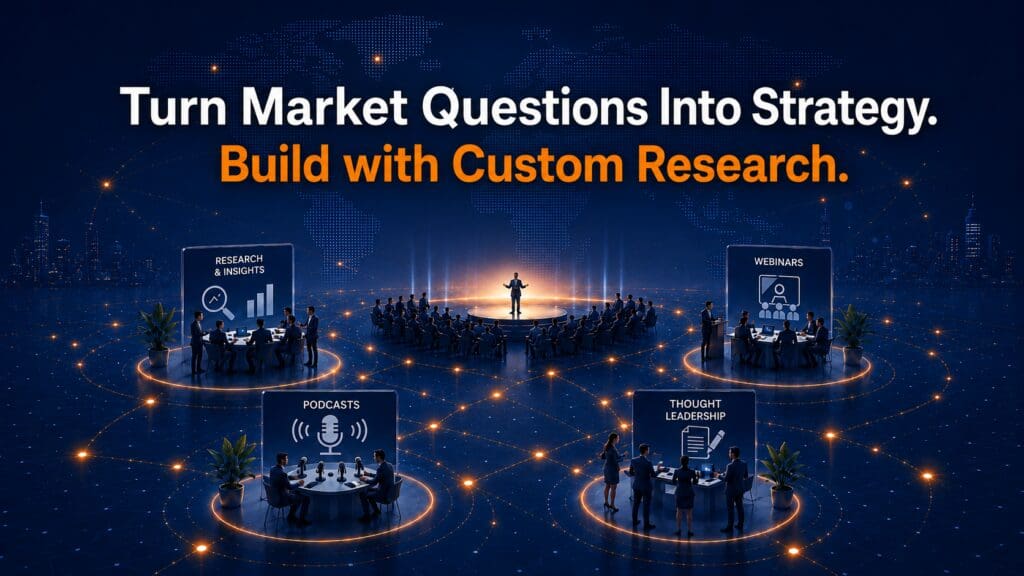
Supply chain technology providers often face strategic questions that cannot be answered through general market commentary. A company may need to understand how buyers are evaluating a specific category, how competitors are positioned, which use cases are gaining traction, or whether a new market opportunity is large enough to justify investment.
These are not simple marketing questions. They are strategy questions. They affect product direction, messaging, sales enablement, partnership strategy, investor communication, and go-to-market planning.
That is where a custom market research study can be especially valuable.
When General Market Insight Is Not Enough
Standard reports, analyst commentary, customer conversations, and sales feedback all have value. But they do not always answer the exact question a leadership team is trying to resolve.
A company may be trying to determine whether to enter an adjacent category. It may need to understand how a specific buyer persona defines value. It may want to compare its positioning against a set of competitors. It may be trying to determine whether a market is ready for a new technology approach or whether adoption is still too early.
In these situations, generic insight can leave important gaps. A custom market research study can focus directly on the question that matters most to the business.
Strategic Questions Custom Research Can Help Address
Custom research can support many types of strategic decision-making. It can help companies assess market opportunity, buyer priorities, competitive positioning, technology maturity, category definition, use-case adoption, and demand drivers.
For example, a transportation technology provider may want to understand how shippers are thinking about the future of transportation management systems as they become more connected to inventory, warehouse operations, procurement, and customer service. A warehouse automation company may want to understand how labor constraints are changing investment priorities. A visibility provider may want to understand how buyers distinguish between tracking, orchestration, risk management, and decision support.
In each case, the value of custom research is that it can be designed around a specific business decision. The research is not simply informational. It is actionable.
Supporting Market Positioning
Many supply chain technology markets are crowded. Buyers may see multiple providers making similar claims around AI, automation, resilience, optimization, visibility, orchestration, or end-to-end execution.
Custom research can help a company sharpen its positioning by identifying what buyers actually care about, where confusion exists, which claims are overused, and where differentiation may be strongest. It can also reveal whether the market language used by providers matches the language used by buyers.
This is especially important in emerging categories. When a market is still forming, providers often compete not only to win deals, but to define the category itself. Research can help clarify whether the market understands the problem the provider is trying to solve.
Informing Product and Commercial Strategy
Custom research can also help connect market strategy to product and commercial decisions. A leadership team may need to know which capabilities buyers consider essential, which features are seen as differentiators, which integrations matter most, or which buying triggers are creating urgency.
This insight can support roadmap planning, sales messaging, content strategy, pricing discussions, and channel development. It can also help align internal teams around a more disciplined view of the market.
That internal alignment is often one of the most valuable outcomes. When product, sales, marketing, and executive leadership are working from the same market understanding, the company can move with more confidence.
Research as a Foundation for Thought Leadership
Custom research can also become the foundation for stronger market education. A study may generate insights that support articles, webinars, executive briefings, sales conversations, or customer-facing narratives.
This does not mean turning research into promotion. The strongest research-driven thought leadership is credible because it begins with real market questions. It helps the audience understand what is changing, why it matters, and how decision-makers should think about the issue.
For supply chain technology providers, this can be a powerful way to move beyond product messaging and contribute to the broader market conversation.
When to Consider a Custom Study
A custom market research study is most appropriate when the question is important, specific, and tied to a business decision. It is especially useful when a company is entering a new category, refining positioning, preparing for a major campaign, evaluating market demand, supporting executive planning, or trying to better understand buyer priorities.
It can also be valuable when leadership teams are working from assumptions that need to be tested. In fast-moving technology markets, assumptions can become outdated quickly. Custom research provides a more disciplined way to evaluate whether the market still behaves the way the company believes it does.
For companies operating in supply chain, logistics, transportation, warehousing, automation, planning, visibility, and decision-intelligence markets, that discipline matters. The market is too complex for guesswork.
CTA: Download the Custom Market Research Study overview to learn how tailored research can support strategic planning, market positioning, and growth decisions.
If you have questions about whether a custom research study fits your company’s current market objectives, reach out to me directly at jfrazer@arcweb.com. I’d be glad to discuss where your priorities align with the Logistics Viewpoints and ARC Advisory Group research and market engagement calendar.
The post When a Custom Market Research Study Is the Right Tool for Supply Chain Technology Strategy appeared first on Logistics Viewpoints.
You may like
Non classé
Infor Builds More Intelligence Into Logistics Execution
Published
15 heures agoon
2 octobre 2026By
Warehouse and transportation systems have traditionally been judged on execution reliability: receive the inventory, build the wave, pick the order, plan the shipment, tender the load, and record the transaction correctly. Those requirements have not disappeared, but the competitive frontier is moving toward systems that can interpret operating conditions and help improve the work while it is happening.
Infor’s logistics portfolio reflects that shift. Infor WMS combines core warehouse execution with labor management, yard capabilities, 3PL billing, visualization, and connectivity to automation. The broader Infor cloud environment adds analytics, workflow, integration services, machine learning, robotic process automation, and digital-assistant capabilities that can increasingly influence operational decisions rather than simply report them.
The result is a useful example of how mature execution software is being modernized. Warehouse operations are becoming more automated, transportation networks more dynamic, and labor more constrained. Systems therefore need to coordinate people, inventory, equipment, automation, and external logistics partners while also providing enough intelligence to prioritize exceptions and adapt plans during the day.
The critical issue is execution discipline. AI features are valuable only when they improve an already dependable operating process. Buyers should validate core functional depth, automation interfaces, cloud architecture, and the quality of the recommendations generated from operational data before treating AI as a differentiator by itself.
Infor can be viewed in both the Logistics Viewpoints Transportation Management Systems MarketMap and Warehouse Management Systems MarketMap. Those two MarketMaps provide a useful way to assess how the company is evolving across the connected transportation and warehouse execution environment.
The post Infor Builds More Intelligence Into Logistics Execution appeared first on Logistics Viewpoints.
Non classé
Global Trade Management Is Becoming a Real-Time Supply Chain Control System
Published
18 heures agoon
2 octobre 2026By
Executive thesis. Global trade management is moving from compliance transaction processing toward real-time supply chain control. Trade rules now alter sourcing, routing, inventory, landed cost, and customer commitments before goods move.
Trade decisions now change network economics
Global trade management was once treated primarily as a compliance and documentation layer around cross-border transactions. That view is incomplete. Classification, origin, duties, sanctions, export controls, customs rules, and regulatory content can change the economics or feasibility of a sourcing, routing, inventory, or customer decision before the shipment ever moves.
Compliance data is operational data
A product classification affects duty. Origin affects eligibility and tariff treatment. Screening can stop a transaction. Customs documentation can determine whether freight clears or waits. These are not administrative attributes detached from the physical network. They are operating constraints that need to be available to procurement, order management, planning, transportation, and finance when decisions are made.
Auditability is part of automation
The more trade processes are automated, the more consequential it becomes to preserve the evidence behind the result. A classification, screening decision, origin determination, or duty calculation should be traceable to the data, rule set, version, and workflow that produced it. Automation without defensibility creates risk because the enterprise may be unable to explain why a transaction was approved, blocked, or costed a certain way.
Integration determines whether GTM can influence execution
GTM value is constrained if it operates as an isolated compliance application. The platform needs reliable connections to ERP, PLM, procurement, orders, transportation, brokers, and content providers. Those integrations allow trade rules to influence decisions before commitments are made and allow executed transactions to be reconciled against what was planned.
The category is moving toward control
This is why GTM is becoming more than a recordkeeping system. The strategic opportunity is to turn changing trade conditions into controlled operational responses: identify exposure, understand the economic consequence, evaluate alternatives, update the transaction, and preserve the evidence. That is the same signal-to-decision-to-execution pattern appearing elsewhere in modern supply chain architecture.
The Logistics Viewpoints Global Trade Management (GTM) Software: Buyer’s Guide covers classification, origin, screening, export controls, customs, duty, landed cost, brokers, regulatory content, auditability, and enterprise integration as parts of one operating system.
Executive implication
GTM should be designed as an operational control system with auditable rules, enterprise context, and direct integration into planning and execution decisions.
Go deeper: provides the durable buyer, architecture, and implementation reference for this topic. Global Trade & Compliance connects this analysis to the broader Logistics Viewpoints research architecture.
Related Logistics Viewpoints research
Download the Global Trade Management (GTM) Solutions Executive Summary
Risk & Resilience in the Supply Chain
Go Deeper
Read the full Global Trade Management (GTM) Software: Buyer’s Guide.
Explore the broader Global Trade & Compliance domain for related Logistics Viewpoints research and analysis.
The post Global Trade Management Is Becoming a Real-Time Supply Chain Control System appeared first on Logistics Viewpoints.
Non classé
Supply Chain Technology Markets Are Converging Faster Than Vendor Categories
Published
2 jours agoon
1 octobre 2026By
The New Logistics Advantage — Part 6 of 9
Supply chain technology markets are usually described as categories. WMS, TMS, planning, visibility, control towers, order management, warehouse automation, decision intelligence, and other segments each have established buyers, competitors, and functional boundaries.
Those categories remain commercially useful. But strategically, the boundaries are moving faster than the labels. Providers are expanding into adjacent workflows, intelligence, orchestration, and automation, while buyers increasingly assemble architectures that cut across the traditional category map.
Convergence Is Happening From Multiple Directions
Execution vendors are adding intelligence. Planning vendors are moving closer to operational workflows. Visibility providers are extending toward exception resolution. Automation vendors are building software layers. Enterprise platforms are embedding AI. Specialized AI providers are attacking decision processes that historically lived inside application categories.
The four current MarketMaps make this movement visible. The 2026 Warehouse Management Systems Market Map examines a mature execution category expanding around automation and intelligence. The 2026 Transportation Management Systems Market Map shows a durable market becoming more connected to networks, visibility, and orchestration. The 2026 Autonomous Exception Management Market Map captures an emerging category between visibility and coordinated response. The 2026 Supply Chain Decision Intelligence Market Map addresses the broader shift toward systems organized around decisions.
The same pattern appears in buyer expectations. A warehouse platform is increasingly judged on automation connectivity and intelligence. A TMS is judged on network data, visibility, and response. A planning system is judged on whether recommendations can be operationalized. The category still defines the core job; differentiation increasingly comes from the adjacent layers.
The Competitive Battleground Is Shifting to Control Points
Products are expanding along several dimensions: workflow, data, intelligence, orchestration, automation, user experience, and ecosystem connectivity. Those dimensions matter because each can become a control point in the architecture.
A provider that owns the system of record controls authoritative transaction state. A provider with unique network data may control context. A decision-intelligence layer can shape which alternatives are considered. An orchestration platform can determine how work moves among systems. An automation platform can control the final physical action.
Two vendors can therefore compete even when analysts place them in different categories. A WMS provider and a warehouse-automation software platform may both seek to own task orchestration. A visibility provider and an exception-management platform may both seek to own disruption response. A planning provider and a decision-intelligence provider may both seek to own the cross-functional recommendation.
This is why convergence does not necessarily mean that one suite replaces everything. It means more vendors are competing for the same strategic control points from different starting positions.
The Buyer Problem Becomes Architectural
Traditional category evaluation begins with feature completeness. That remains necessary, especially for systems of record. But as markets converge, buyers need a second question: Which layer of the operating architecture is this provider attempting to control?
The market-research executive summaries provide category depth that remains essential: WMS, TMS, Supply Chain Planning, and OMS each explain the structure and capabilities of important markets. The strategic challenge is to interpret those markets as parts of a changing architecture rather than as permanent silos.
A buyer may select the strongest product in a category and still create a weak portfolio if the product traps data, duplicates decision logic, constrains adjacent workflows, or makes future substitution prohibitively difficult. Architectural fit therefore becomes part of product value.
This creates a useful distinction between functional depth and architectural leverage. Functional depth answers whether the product can perform its core job. Architectural leverage answers whether the product improves or constrains the larger system around it.
Convergence Changes Vendor Strategy Too
For providers, adjacency strategy needs discipline. Expanding into every neighboring function can increase surface area while weakening differentiation. The more important question is which adjacent capability reinforces an existing control point.
A TMS with strong transportation state may have a credible path into exception intelligence because it already sees important network events. A WMS with deep execution state may have a credible path into warehouse orchestration. A planning platform with broad enterprise context may have a credible path into decision support. The logic of expansion should follow the asset the provider already controls, not simply the size of the adjacent market.
That also raises the importance of interoperability. In a converging market, customers will resist architectures that require every adjacent capability to come from one supplier. Providers that can participate in a heterogeneous system may create more strategic value than providers that maximize suite breadth at the cost of flexibility.
The Executive Implication
Technology strategy should separate two questions that are often conflated: Which product is strongest inside a category? and Which architecture will remain adaptable as categories converge? The first is a product-selection problem. The second is a portfolio and operating-model problem. Organizations that solve only the first can end up with excellent applications that constrain future change. Organizations that solve both can preserve functional depth while creating room for new forms of intelligence, automation, and orchestration.
For buyers and providers alike, category labels still matter. But the more strategic question is increasingly about control: who owns the record, the context, the decision, the workflow, and the path to execution?
Explore the Related Logistics Viewpoints Research
2026 WMS Market Map
2026 TMS Market Map
2026 Autonomous Exception Management Market Map
2026 Supply Chain Decision Intelligence Market Map
WMS Executive Summary
TMS Executive Summary
Supply Chain Planning Executive Summary
The New Architecture of Logistics
The post Supply Chain Technology Markets Are Converging Faster Than Vendor Categories appeared first on Logistics Viewpoints.

Infor Builds More Intelligence Into Logistics Execution
Global Trade Management Is Becoming a Real-Time Supply Chain Control System
Supply Chain Technology Markets Are Converging Faster Than Vendor Categories
Freightos Global Freight Outlook – September 2026
Container rates jump another $1k/FEU – but is demand peaking? – July 8, 2026 Update

Walmart and the New Supply Chain Reality: AI, Automation, and Resilience
Trending
- Non classé1 mois ago
Freightos Global Freight Outlook – September 2026
- Non classé3 mois ago
Container rates jump another $1k/FEU – but is demand peaking? – July 8, 2026 Update
-
 Non classé2 ans ago
Walmart and the New Supply Chain Reality: AI, Automation, and Resilience
-

 Non classé6 mois ago
Why Sulfuric Acid Is Emerging as a Supply Chain Constraint in Copper
- Non classé4 mois ago
Container rates starting to spike on peak season rush – June 2, 2026 Update
- Non classé1 an ago
13 Books Logistics And Supply Chain Experts Need To Read
- Non classé12 mois ago
Ex-Asia ocean rates climb on GRIs, despite slowing demand – October 22, 2025 Update
- Non classé3 mois ago
LCL Shipping Cost Calculator: Calculate Air and Sea Shipping Freight Rates