
Non classé
U.S. – China Trade: Trump – Xi Meeting Produces Temporary Stabilization, Soybean Deal Key for Midwest Supply Chains

Published
11 mois agoon
By
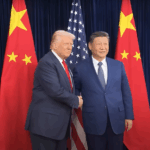
President Donald Trump and President Xi Jinping met in Busan this week for a 90-minute summit that resulted in a temporary easing of trade tensions between the United States and China. While not a comprehensive agreement, the outcomes mark a shift in tone and the beginning of what U.S. Treasury Secretary Scott Bessent described as a “framework for broader cooperation.”
Agricultural Commitments
The most specific commitment came in the agricultural sector. According to Bessent, China will purchase a minimum of 25 million metric tons of U.S. soybeans annually for the next three years. In addition, other nations are expected to acquire an additional 19 million metric tons during the same period. Initial purchases, starting with 12 million metric tons from this year’s harvest, have already been confirmed by China’s state-owned buyer COFCO.
This represents a critical development for U.S. farmers, particularly in the Midwest, following multiple years of uncertain market access and erratic pricing conditions.
Supply Chain Impact:
Increased volumes through Gulf and Pacific Northwest export terminals are expected in the near term.
Domestic logistics firms may face tighter seasonal capacity as shipments ramp up.
Input suppliers, seed, fertilizer, and farm equipment, are expected to benefit from improved forward purchasing confidence.
Fentanyl and Tariffs
In exchange for Beijing’s commitment to further reduce the export of fentanyl precursor chemicals, the United States has agreed to cut its fentanyl-related tariffs on Chinese goods from 20 percent to 10 percent. Bessent described this as part of a targeted effort to address the domestic fentanyl crisis, which remains a significant public health issue in the United States.
The U.S. will also suspend a pending rule that would have expanded the Commerce Department’s Entity List to include additional Chinese firms. The gesture is intended to signal restraint rather than a change in long-term policy.
Supply Chain Impact:
Chemical and pharmaceutical supply chains may experience modest cost relief due to the tariff cut.
Export controls and scrutiny on Chinese technology firms remain in place, though no new firms will be added for now.
Rare Earths and Critical Materials
China has agreed to suspend its recently imposed export controls on rare-earth materials for one year. These materials are essential for a range of industries, including defense, clean energy, and electronics manufacturing.
Supply Chain Impact:
Short-term relief for U.S. and allied industries dependent on lanthanides and other critical inputs.
However, no indication was given that China plans to lift restrictions permanently or expand rare-earth output quotas.
Technology and TikTok
China has approved a framework for the transfer of TikTok’s U.S. operations to a new corporate structure. The agreement involves American investors holding six out of seven board seats, with ByteDance retaining less than a 20 percent ownership stake. The algorithm will be operated under U.S. security supervision.
No final implementation date has been confirmed, but Bessent indicated that progress should be visible “in the coming weeks and months.”
Supply Chain Impact:
Minimal immediate effect on physical supply chains.
Digital infrastructure providers and content oversight entities may see increased activity as the transition unfolds.
Energy Cooperation and Nuclear Strategy
In a development that was not anticipated by U.S. negotiators, Xi Jinping expressed unilateral interest in a U.S. pipeline project in Alaska. No formal proposal has been submitted.
Separately, Bessent acknowledged that the U.S. currently trails China in nuclear power development, but stated that plans are underway to scale up domestic capacity. The Biden administration had also pursued advanced nuclear initiatives prior to the current administration’s term, but most have remained in pilot stages.
Supply Chain Impact:
Potential future activity in nuclear component supply chains, particularly for reactor fuel and structural materials.
No immediate infrastructure commitments were announced.
Market and Policy Outlook
Reactions from financial markets were muted. Analysts noted that while the tone was constructive, few substantive changes have been finalized. According to commentary from Goldman Sachs, the meeting produced “expected outcomes, but little beyond that.” Some initiatives, such as TikTok and rare earths, appear to be tactical delays rather than long-term resolutions.
Trump indicated plans to visit China in April 2026 to pursue a broader trade agreement. Both sides have agreed to continue discussions, with Bessent suggesting that the coming months will determine whether temporary arrangements can evolve into formal trade policy changes.
Conclusion
The Trump-Xi meeting delivered a short-term de-escalation of specific trade and security tensions, notably in agriculture and pharmaceuticals. For U.S. supply chains, the soybean purchase agreement provides meaningful clarity for producers and exporters. However, on core structural issues, such as technology access, industrial policy, and critical materials, the agreement amounts to a pause rather than a resolution. Whether this develops into a stable trade framework will depend on progress over the next several months.
The post U.S. – China Trade: Trump – Xi Meeting Produces Temporary Stabilization, Soybean Deal Key for Midwest Supply Chains appeared first on Logistics Viewpoints.
You may like
Non classé
The Warehouse Is Becoming an Orchestrated, Cyber-Physical System
Published
6 heures agoon
21 septembre 2026By
The modern warehouse is becoming a cyber-physical system: software, inventory, labor, sensors, robotics, conveyors, docks, and transportation constraints increasingly operate as one connected execution environment. That framing is more useful than treating orchestration as a feature. The design question is how digital state and physical state remain synchronized closely enough for people and machines to coordinate work in real time. That evolution builds on the earlier observation that the WMS category itself is becoming something more as execution, automation, orchestration, and intelligence converge inside the facility. The phrase “warehouse automation” can make a modern distribution center sound like a collection of equipment projects: install an AS/RS, add autonomous mobile robots, deploy sortation, introduce goods- to-person picking, and automate selected packaging tasks.
That description is increasingly incomplete. As more of the facility becomes automated, the warehouse begins to behave like an integrated machine. Its performance depends less on the theoretical capability of any individual subsystem and more on whether storage, movement, labor, software, and equipment remain synchronized.
Automation Changes the Unit of Optimization
A conventional warehouse can absorb inefficiency through human improvisation. Experienced supervisors reroute work. Forklift drivers compensate for congestion. Pickers change sequence. People notice exceptions that systems miss.
Automation can improve speed, consistency, density, and labor productivity, but it can also reduce the amount of informal flexibility available to the operation. If one automated subsystem feeds another at the wrong rate, congestion can propagate quickly. If replenishment falls behind, highly productive picking equipment can become starved for work. If outbound staging is constrained, upstream automation may continue producing inventory that has nowhere useful to go. The facility therefore has to be optimized as a flow system.
WMS, WES, and WCS Have Different Jobs
The software architecture reflects this change. WMS remains central to inventory, work, locations, orders, and warehouse processes. Warehouse control systems interact more directly with automated equipment. Warehouse execution systems have emerged in many environments to coordinate work across automation and labor and to dynamically sequence activity. The exact boundaries vary by vendor and implementation, but the architectural direction is clear: increasingly automated facilities need software capable of orchestrating work at a finer time scale. A static wave planned hours earlier may not be enough when equipment availability, order priority, labor, and downstream transportation are changing continuously.
Robots Are Part of a System, Not the System
AMRs have made warehouse robotics more flexible and accessible. AS/RS technologies can dramatically increase storage density and goods-to-person productivity. Sortation can move enormous volumes. Computer vision can improve identification and quality control. None of these technologies guarantees a high-performing warehouse.
The operational question is how each technology changes the constraints of the total system. Faster picking can shift the bottleneck to packing. Dense storage can create replenishment requirements. More robots can create traffic-management challenges. Automated receiving can expose variability in inbound transportation. Every improvement changes the shape of the bottleneck.
People Remain Part of the Architecture
The “lights-out warehouse” remains an appealing image, but most real operations contain variability that makes human capability valuable. Damaged goods, unusual packaging, equipment faults, inventory discrepancies, rush orders, maintenance, safety events, and countless edge cases still require judgment and dexterity.
The more useful question is not whether people disappear. It is which tasks should be performed by people, which by machines, and how work should move between them. That makes human-machine orchestration a core warehouse design problem.
Observability Becomes Essential
An integrated machine needs state awareness. Managers need to know not only how many orders remain, but where congestion is developing, which subsystem is constrained, whether equipment performance is degrading, whether labor is positioned correctly, and whether outbound transportation can absorb the planned flow. Computer vision, equipment telemetry, WMS events, robot data, and execution-system signals create a much richer picture of the facility. The challenge is turning that picture into action before a small deviation becomes a throughput problem.
Warehouse automation business cases are often built around labor savings. Labor remains important, but system-level economics are broader. Automation can affect storage density, throughput, order cycle time, accuracy, safety, building footprint, peak capacity, energy consumption, and the ability to operate during labor scarcity.
It can also change the cost of downtime. A highly integrated automated facility may be extremely productive when operating normally and unusually sensitive to failures in critical subsystems. Resilience therefore becomes part of automation economics.
The Warehouse Cannot Be Optimized Alone
The final step is connecting the facility back to the logistics network. A warehouse can only receive what transportation delivers and ship what transportation can remove. Its labor plan depends on arrival patterns. Its staging space depends on pickup performance. Its throughput targets depend on order priorities and downstream capacity. The more automated the facility becomes, the more important those external signals become because automation increases the speed at which mismatches can accumulate.
From Automated Equipment to an Orchestrated Facility
The next generation of warehouse performance will come less from adding isolated automation and more from coordinating the entire facility as one cyber-physical system. That requires clear software roles, reliable data, dynamic execution, human exception handling, and connection to transportation and order signals outside the four walls.
The warehouse is becoming a machine, but not a simple one. It is a machine made of software, equipment, inventory, infrastructure, and people.
Transportation is undergoing a parallel transformation. It has fewer fixed walls, far more external variables, and an operating plan that can become obsolete minutes after it is created.
Related Logistics Viewpoints research
The New Architecture of Logistics
Systems Engineering in Logistics
2026 Warehouse Management Systems Market Map
Why Warehouse Orchestration Is Becoming More Important Than Warehouse Automation
Previous in this series: From Systems of Record to a Logistics Control Layer
Request The New Architecture of Logistics Client Edition
If your organization is assessing connected execution, orchestration, AI, observability, decision velocity, or selective autonomy, I would be glad to provide the complete client edition and discuss the implications for your logistics operating model and technology architecture.
The post The Warehouse Is Becoming an Orchestrated, Cyber-Physical System appeared first on Logistics Viewpoints.
Non classé
Trump-Xi in Washington: The Supply Chain Stakes Behind the Summit
Published
10 heures agoon
21 septembre 2026By
When President Donald Trump meets Chinese President Xi Jinping in Washington on September 24, most of the attention will be on geopolitics. For supply chain executives, however, the more important question is considerably more practical: will the meeting produce a more stable set of operating assumptions for global trade?
Trump and Xi are scheduled to meet for their second summit of the year, with trade, tariffs, critical minerals, semiconductors, artificial intelligence, Taiwan and Iran among the expected subjects. Trade negotiations are expected to include an extension of the existing tariff truce, possible additional Chinese purchases of U.S. goods and U.S. efforts to improve access to critical minerals.
Viewed separately, these can look like a collection of diplomatic issues. From a logistics perspective, they are increasingly one interconnected system. Tariffs change landed cost and sourcing economics. Rare-earth restrictions can stop manufacturing. Semiconductor controls affect technology supply chains. Energy instability moves transportation costs. What happens in Washington therefore matters because it could help determine the constraints under which global supply chains operate next.
The Real Question Is How Fast Supply Chains Must Change
Companies have already spent years adapting to the reality that U.S.-China economic competition is structural. Manufacturing and sourcing have diversified toward Mexico, Vietnam, India and other markets, while many companies have added suppliers, reconsidered inventory policies and begun examining dependencies several tiers below their immediate vendors.
One summit is not going to reverse that process. The more important question is how aggressively companies will need to continue restructuring their networks.
Reuters reports that extending the current trade truce is expected to be a central issue in Washington. The United States is also seeking additional access to Chinese critical minerals, while Beijing continues to push for changes to U.S. technology restrictions. For a manufacturer deciding whether to move a component to a second supplier elsewhere in Asia, the economics look very different if tariffs, licensing requirements and export controls remain reasonably stable versus changing every few months.
That makes policy uncertainty a supply chain cost in its own right. The factory may not have changed. The supplier may not have changed. The transportation network may not have changed. But if the constraints surrounding the network change, the supply chain plan changes with them.
Rare Earths Expose the Dependency Problem
Tariffs attract much of the political attention, but critical materials may provide the more important supply chain lesson. China remains central to global production and processing of many rare-earth materials used in automotive, electronics, aerospace, energy, robotics, semiconductors and advanced manufacturing.
This issue was already prominent during Trump’s May visit to China. The White House said China agreed to address U.S. concerns surrounding shortages of rare earths and critical minerals, including yttrium, scandium, neodymium and indium, as well as restrictions involving rare-earth production and processing technologies. China also agreed to an initial purchase of 200 Boeing aircraft and additional agricultural purchases as part of the broader economic package.
Four months later, critical mineral access remains part of the discussion. Reuters reports that rare-earth availability continues to challenge U.S. companies and that additional export licenses are among Washington’s objectives surrounding the September summit.
There is a broader lesson here. Supply chain risk is not proportional to spend. A material representing a tiny percentage of the cost of a finished product can stop an entire production line if there is no substitute. Procurement organizations that concentrate primarily on Tier-1 cost and supplier performance increasingly need to understand dependencies at Tier 2, Tier 3 and sometimes much deeper into the network.
That is fundamentally a systems-engineering problem. The question is no longer simply whether each individual node performs properly. It is whether the dependency structure connecting those nodes contains failure points that the organization cannot work around.
AI and Semiconductors Are Also Physical Supply Chains
Artificial intelligence is expected to be part of the Washington discussions as well, including competition over advanced semiconductors, technology controls and AI governance. It is easy to think of AI primarily as software, but at supply chain scale AI is enormously physical.
Advanced AI depends on semiconductor fabrication, semiconductor manufacturing equipment, memory, servers, networking infrastructure, data centers, electricity and the materials required to build all of it. Restrictions placed anywhere inside that architecture can propagate across multiple industries, making semiconductor policy increasingly inseparable from product architecture, manufacturing strategy, supplier selection and capital investment.
The operational questions quickly become familiar supply chain questions. Can a component legally move into a particular market? Can a supplier continue producing it? Does the alternate supplier depend on the same constrained material? Can engineering substitute another component without redesigning the product? Can production move without recreating the same upstream dependency somewhere else?
This is where the distinction between technology strategy, geopolitical strategy and supply chain strategy begins to disappear. Companies cannot optimize one of these domains without increasingly understanding the constraints imposed by the others.
This Is Not Simple Decoupling
At the same time, the U.S.-China relationship is not simply a story of supply chains being dismantled. During the May summit, China approved the initial Boeing purchase and committed to additional U.S. agricultural purchases, while the two governments established a U.S.-China Board of Trade intended to manage bilateral trade in non-sensitive goods.
USTR subsequently opened a public process examining how that Board of Trade should operate and which categories of non-sensitive products might qualify for tariff modifications. Its stated purpose is to create an ongoing government-to-government mechanism for managing portions of bilateral commerce even as tariffs and other controls remain part of the broader relationship.
This is why I have never found decoupling particularly useful as a description of what is happening. Some supply chains are separating. Others are diversifying. Some are regionalizing. Still others continue operating across the Pacific because the economics remain compelling.
What is emerging looks more like segmented globalization. A company may eventually operate one network architecture for strategically sensitive products, another for ordinary consumer goods and yet another for products incorporating controlled technologies or critical materials. Instead of one global optimization problem, supply chain executives increasingly face several overlapping optimization problems governed by different constraints.
Energy Connects the System Again
Iran and the Middle East are also expected to feature in the Trump-Xi discussions. The connection to logistics becomes apparent as soon as energy and maritime transportation enter the equation. Reuters reports that agriculture, energy, sanctions and critical minerals are all being closely watched heading into the summit.
During the May U.S.-China meeting, Trump and Xi also agreed on the importance of reopening the Strait of Hormuz and opposing attempts to charge tolls for passage through it, according to the White House. For supply chain organizations, instability affecting a major energy chokepoint can quickly alter tanker markets, bunker costs, diesel prices, insurance, transportation rates and ultimately landed cost.
Again, something categorized as a geopolitical event becomes an operating constraint inside the supply chain. Tariffs connect to sourcing. Critical minerals connect to manufacturing. Semiconductors connect to product strategy. Energy connects to transportation. None of these relationships operates independently.
That is the systems view supply chain leaders increasingly need.
Resilience Is No Longer Enough
For years, supply chain strategy was dominated by efficiency. Then resilience moved to the center of the discussion. I think the next requirement is optionality.
Resilience asks whether the network can withstand disruption. Optionality asks whether the enterprise has several executable responses when the underlying conditions change. Can production move? Can another supplier be qualified? Can freight be rerouted? Can inventory be repositioned? Can a component be substituted? Can the network continue operating under a different tariff, export-control or regulatory regime?
Those capabilities do not suddenly appear when the disruption arrives. They have to be engineered into the supply chain beforehand, which means thinking differently about redundancy, supplier qualification, inventory, product design, transportation capacity and even the data required to understand dependencies across the network.
This does not mean abandoning China. For many industries, that would be enormously expensive, operationally difficult and potentially unrealistic. It means reducing architectures in which one policy decision, one export license, one critical material, one supplier or one transportation chokepoint can stop the system.
What I Would Watch After Washington
I would spend less time examining the ceremony around the summit and more time watching what changes operationally afterward. Does the tariff truce extend? Does access to rare-earth materials improve? Do semiconductor restrictions stabilize or tighten? Does the Board of Trade become a functioning mechanism for managing non-sensitive commerce? And perhaps most importantly, do companies gain enough visibility into the rules to make multi-year sourcing and capital decisions with greater confidence?
The Trump-Xi meeting will not eliminate the structural competition between the United States and China, nor will it restore the relatively uncomplicated model of globalization companies operated under decades ago. What it may do is provide a clearer indication of the operating boundaries inside which supply chains will have to function.
That distinction matters. Supply chains now have to be engineered for an environment in which tariffs, technology controls, strategic materials, energy security and geopolitics can change the constraints around the network while the network is still running.
The cheapest supply chain under today’s rules is therefore not necessarily the best supply chain.
The better architecture is the one that can keep operating when the rules change.
The post Trump-Xi in Washington: The Supply Chain Stakes Behind the Summit appeared first on Logistics Viewpoints.
Non classé
Körber Launches K.AI Assistant for Trusted AI in GxP Life Sciences Operations
Published
10 heures agoon
21 septembre 2026By

Körber has introduced K.AI Assistant, a generative AI-based assistant designed for regulated pharmaceutical and life sciences environments. The solution is intended to help operators, engineers, and quality teams access information from Körber product knowledge and customer-specific GxP documentation while reducing the risk of inaccurate or unverifiable responses.
The assistant is designed for use in Good Practice (GxP)-regulated processes, where generative AI tools must meet higher requirements for validation, traceability, and reliability than general-purpose AI systems. K.AI Assistant uses Körber’s PharmaGuardrails to limit inaccurate and out-of-scope responses and support the use of AI within controlled manufacturing and quality workflows.
Körber’s K.AI Assistant provides natural-language access to product knowledge and customer-specific GxP documentation for regulated life sciences operations
Addressing AI Use in Regulated Environments
Life sciences manufacturers are under pressure to improve productivity while maintaining compliance with Good Manufacturing Practice and other GxP requirements. Operators and quality personnel often need to search through standard operating procedures, batch records, product documentation, and other regulated content to resolve questions or complete routine tasks.
Generic AI tools can be difficult to use in these environments because generated responses may not be sufficiently traceable or reliable for validated processes. Körber developed K.AI Assistant to provide responses grounded in approved product knowledge and customer-specific documentation rather than relying on unrestricted generative output.
The solution is intended to support several operational needs:
Provide natural-language access to product and customer-specific GxP documentation.
Reduce the time spent searching through procedures, records, and technical documentation.
Apply PharmaGuardrails to restrict inaccurate or out-of-scope responses.
Support onboarding and training by providing contextual information through a conversational interface.
Help manufacturing and quality teams prepare for audits by improving access to relevant documentation.
Körber’s existing PAS-X K.AI capabilities already provide a chat-based interface for retrieving information across PAS-X MES documentation, with support for customer-specific documents.
Expanding K.AI Assistant Capabilities
The latest release adds document upload, simplified onboarding, improved communication management, and an updated user experience.
These capabilities are intended to make it easier for manufacturers to incorporate their own controlled documentation into the assistant and allow users to query that information through natural-language interaction.
For life sciences manufacturers, the usefulness of this approach depends not only on how quickly AI can retrieve information, but also on whether the information source, response boundaries, and validation process can be controlled. These requirements are especially important in pharmaceutical manufacturing, where explainability, auditability, and data integrity are central to AI adoption. ARC has similarly identified validation and governance as key considerations as industrial AI moves further into regulated pharmaceutical operations.
Integration with PAS-X MES
K.AI Assistant can be integrated natively with Körber’s PAS-X MES, allowing users to access the assistant within an existing manufacturing environment.
Embedding the assistant into PAS-X MES is intended to reduce the additional validation and integration effort associated with introducing a separate AI application. Körber also provides headless integration capabilities that allow K.AI Assistant functionality to be incorporated into other applications, workflows, and digital environments.
This integration approach is consistent with Körber’s broader development of the PAS-X ecosystem. Recent additions include PAS-X Neo, designed as a cloud-native MES option for smaller life sciences manufacturers, as well as certified integrations intended to connect PAS-X MES with industrial data platforms and shop-floor systems.
Bringing Guardrails into Operational AI
The introduction of K.AI Assistant highlights an important distinction in life sciences AI deployments: access to a generative model is only one part of the architecture. Manufacturers also need mechanisms for controlling what information the system can use, defining acceptable response boundaries, maintaining traceability, and validating how the application behaves within regulated workflows.
For pharmaceutical manufacturers, these controls will be central to moving generative AI beyond experimental use and into day-to-day manufacturing and quality operations.
The post Körber Launches K.AI Assistant for Trusted AI in GxP Life Sciences Operations appeared first on Logistics Viewpoints.

The Warehouse Is Becoming an Orchestrated, Cyber-Physical System
Trump-Xi in Washington: The Supply Chain Stakes Behind the Summit

Körber Launches K.AI Assistant for Trusted AI in GxP Life Sciences Operations
Freightos Global Freight Outlook – September 2026
Container rates jump another $1k/FEU – but is demand peaking? – July 8, 2026 Update

Walmart and the New Supply Chain Reality: AI, Automation, and Resilience
Trending
- Non classé3 semaines ago
Freightos Global Freight Outlook – September 2026
- Non classé2 mois ago
Container rates jump another $1k/FEU – but is demand peaking? – July 8, 2026 Update
-
 Non classé2 ans ago
Walmart and the New Supply Chain Reality: AI, Automation, and Resilience
-

 Non classé5 mois ago
Why Sulfuric Acid Is Emerging as a Supply Chain Constraint in Copper
- Non classé4 mois ago
Container rates starting to spike on peak season rush – June 2, 2026 Update
- Non classé1 an ago
13 Books Logistics And Supply Chain Experts Need To Read
- Non classé11 mois ago
Ex-Asia ocean rates climb on GRIs, despite slowing demand – October 22, 2025 Update
- Non classé3 mois ago
LCL Shipping Cost Calculator: Calculate Air and Sea Shipping Freight Rates