
Non classé
At St. Luke’s, Supply Chain Excellence Depends Upon Doctor Involvement

Published
2 ans agoon
By

President Obama signed the Affordable Care Act into law in 2010. The new law meant that the way medical systems operated had to change. Expanded health insurance coverage led to increases in the demand for care. The ACA led to a move away from fee-based services and toward compulsory value-based payment initiatives. This lowered hospitals’ margins and created an impetus for hospital chains to begin to tackle costs, but to do so in a manner that did not compromise patient outcomes. Procurement became a logical place for leading healthcare systems to focus.
Adrian Wengert joined Saint Luke’s Health System in 2014. There are several St. Luke’s hospitals across the nation. Mr. Wengert works at the St. Luke’s system headquartered in Boise. This is Idaho’s only not-for-profit, community-owned, and community-led healthcare system. With 16,000 employees, it is the largest private employer in the state. The system runs 8 acute care hospitals and has 300 ambulatory medical centers across the state.
As vice president of supply chain and procurement, Mr. Wengert was brought in to drive change. Hospital chains’ approach to procurement lagged far behind the practices employed by manufacturers, retailers, and distributors.
“We didn’t have enough strategic personnel,” Mr. Wengert said. “We added about 20 positions, all strategic hires largely from outside healthcare. That was by design to help us solve problems that needed a different lens.”
Procurement was a natural place to focus. In healthcare, large, powerful distributors sell hospitals medical supplies and deliver those supplies right to individual medical facilities. In many healthcare systems, the costs of these supplies and services were not closely examined. The costs were passed down the line to patients and insurers. As a result, hospital chains largely lacked competence in sourcing. And yet, after labor costs, medical supplies are the second largest cost.
St. Luke’s began to build new supplier relationships. “We built strategic supplier partnerships.”
The net result of that was about $100 million in savings over the course of 10 years.
These are great results. For those who know healthcare systems, they are astounding. Physicians have traditionally had large amounts of autonomy in what they prescribe and what medical supplies they use. My wife, who worked as a vice president in different hospitals, has told me that one key to hospital executives retaining their leadership positions was following a simple rule, “Don’t piss off the docs!”
Mr. Wengert was more diplomatic. “In manufacturing, engineers are typically at the top of the food chain. In healthcare, physicians are.”
How did St. Luke’s accomplish this? “We reestablished strong collaborative relationships with our internal stakeholders, which largely are comprised of clinicians and physicians,” Mr. Wengert said.
“How do you begin to build those relationships so that you can drive item standardization? You can have meaningful decisions that are not purely based on cost. They have to be based on product efficacy. You have to look at outcomes, quality, complications, all of those things. So, we started working on clinical integration as one path” to drive procurement savings.
Mr. Wengert explained that medical chains have two types of procurement models. “The first is the command-and-control model.” In this model, “the supply chain goes out and negotiates a contract on spine implants and says to doctors, ‘You’re now going to use Medtronic.’ We did it because we saved a couple of million dollars. And while the savings hit the bottom line quickly, over time, it erodes physician engagement and, even more importantly, physician alignment.”
“You cannot sustain that” model. “No physician wants to lose their autonomy. They don’t want a businessperson telling them how to practice clinical medicine.”
The other model, Mr. Wengert explained, is the influence model. In this model, you are presenting the surgeons with all the options. “One option is we do nothing; we stay status quo. This is what it looks like.”
“Option two is always standardization. If we go from six suppliers down to three, this is how it affects price and ultimately helps you build a deeper partnership.”
Why should physicians care about a deeper relationship with a supplier? During COVID, there were many shortages that made it difficult to practice good medicine. Better supplier relationships help ensure that goods will be delivered in full and on time. Doctors may not care about costs, but they do care about achieving certainty of supply.
This model empowers decision-making committees focused on specific spending categories like spine implants or knee replacements. “We’ll be strategic about how we form the membership. So, if we’re asking them to standardize to one brand or another, we try to identify surgeons who use both brands to ask them for their clinical feedback. ‘What do you think about this?’”
“But you always have some surgeons who say, ‘This is what I want to use.’ We have really strong physician champions in our organizations. Sometimes they’ll lean in, and have a discussion, and it usually resolves itself.”
St. Luke’s also has six nurses embedded in the supply chain team. “They speak the clinical language. That helps us have a greater degree of success.”
“Then lastly, we onboarded a medical director of supply chain. And she’s just been fantastic.” She explains to the physician community the “total benefit of what we’re trying to achieve for our patients.”
St. Luke’s is not resting on their laurels. They are moving to a self-distribution model that further lowers their reliance on costly distributors. They have built a warehouse with material handling systems and a warehouse management system from Tecsys. Inbound supplies will flow into the warehouse and then be delivered to medical facilities across the state. The warehouse will be operational by the end of the year.
The post At St. Luke’s, Supply Chain Excellence Depends Upon Doctor Involvement appeared first on Logistics Viewpoints.
You may like
Non classé
The Systems-Engineered Logistics Operation: From Transformation Projects to Continuous Design
Published
17 heures agoon
3 novembre 2026By
For years, logistics transformation has been organized as a succession of projects. Implement the platform. Build the control tower. Automate the facility. Add the AI layer. The problem is that logistics no longer changes on a project cadence.
That environment is disappearing. The future logistics will need to be designed continuously. The Autonomous Logistics Network is one expression of this end state, but reaching it requires continuous design rather than a one-time transformation project.
Stop Thinking in Technology Stacks
Modern logistics networks are becoming integrated combinations of physical assets, software, data, optimization, AI, robotics, people, partners, and automated decisions. Calling this a technology stack understates what is happening.
It is an operating system. The important design questions are no longer confined to which applications a company owns. Leaders have to consider how decisions flow, how data maintain continuity across systems, how automation interacts with people, how models are governed, how exceptions escalate, and how the organization behaves when components fail.
That is systems engineering territory. The companies that manage this architecture deliberately will have an advantage over those that continue adding capabilities one project at a time.
Intelligence Is Moving to the Point of Action
Logistics technology is moving from systems of record toward systems of decision. Traditional applications captured transactions and supported workflows. Analytical systems added prediction and optimization. The emerging layer increasingly combines real-time signals, AI, optimization, agents, and execution connectivity.
The result is intelligence closer to the point of action. A shipment delay can be identified, its impact evaluated, alternatives generated, and a response executed with limited human intervention. Transportation systems can continuously re-evaluate routes, capacity, and exceptions instead of waiting for manual replanning. Warehouse and yard systems can adjust priorities as conditions change.
This will make logistics faster. It will also make architecture and governance more consequential.
When software only reported information, a bad output could be ignored. When software acts, the operating envelope matters.
Human Work Moves Up the Decision Stack
More automation does not eliminate the human role. It changes it.
People will spend less time collecting information, reconciling spreadsheets, monitoring routine transactions, and making repetitive bounded decisions. They will spend more time dealing with novel exceptions, cross-functional tradeoffs, strategic choices, carrier and customer relationships, system design, and governance.
That is a better use of human capability. It is also a harder job.
The future planner, transportation manager, warehouse leader, or logistics executive will need to understand not only operations but the automated systems influencing operations. They will need to know when to trust a recommendation, when to challenge it, and how a decision in one part of the system affects another. Logistics expertise will become more architectural.
Continuous Design Requires Continuous Validation
If the system changes continuously, validation must become continuous as well.
AI models drift. Business priorities change. automation rules evolve. New interfaces are added. Local process changes accumulate. External conditions move.
The organization cannot wait for the next transformation program to determine whether the operating system still meets its requirements. Performance, model behavior, exception patterns, overrides, decision latency, data quality, and failure modes will need ongoing monitoring.
This creates a closed lifecycle: design, deploy, observe, validate, improve, and redesign. Transformation becomes less of an event and more of a management discipline.
Resilience Becomes an Architectural Property
The future of resilience is also likely to move beyond static buffers. Inventory and redundancy will remain important, but digital systems will make logistics more capable of sensing, simulating, and responding dynamically.
A disruption can trigger scenario analysis. A digital twin can estimate consequences. Optimization can evaluate alternatives. AI can interpret unstructured signals. Automated decision systems can act inside approved boundaries.
This does not eliminate the need for physical resilience. It allows physical resilience and decision resilience to work together.
The strongest logistics networks will not simply carry more protection. They will understand their dependencies and reconfigure faster when conditions change.
Architecture Becomes a Competitive Capability
For years, companies differentiated logistics through network scale, facility and transportation assets, carrier leverage, operational excellence, service design, and technology investment. Architecture is becoming another source of advantage.
Two companies may use similar software and still achieve very different results because one has better process integration, clearer decision rights, stronger data, more effective automation boundaries, better failure recovery, and tighter governance. The advantage does not come from owning the component. It comes from how the components have been engineered to work together.
Logistics Management Becomes Systems Management
That may be the larger lesson of this series. Logistics networks are already systems of systems. The technology is making them more connected, more autonomous, and more adaptive. That complexity cannot be managed indefinitely through functional optimization and periodic implementation projects.
The discipline has to evolve.
Define requirements before selecting solutions. Design the operating model. Architect processes, data, and decisions together. Engineer technology into the system rather than around it. Validate the outcome. Govern change. Design for failure. Improve continuously.
The competitive advantage will not come from owning the same AI, automation, TMS, WMS, visibility, and execution technologies everybody else can buy. It will come from how coherently those components have been engineered to work together. The future of logistics management is not simply more digital, more autonomous, or more intelligent. It is more engineered.
Related Logistics Viewpoints research
Systems Engineering in Logistics
The New Architecture of Logistics
2026 Supply Chain Decision Intelligence Market Map
Digital Transformation in Logistics
Previous in this series: Design for Failure: Resilience, Risk, and Failure Modes
Request the Systems Engineering in Logistics Client Edition
If your organization is evaluating a logistics transformation, technology strategy, automation program, or operating-model redesign, I would be glad to provide the complete client edition and discuss how the framework applies to your priorities, constraints, and operating environment.
The post The Systems-Engineered Logistics Operation: From Transformation Projects to Continuous Design appeared first on Logistics Viewpoints.
Non classé
Walmart and Symbotic: When Warehouse Automation Becomes a Network Strategy
Published
17 heures agoon
3 novembre 2026By
Warehouse automation has traditionally been discussed one facility at a time. A retailer installs an automated storage system, deploys mobile robots, adds robotic picking, or upgrades sortation. The business case is then measured against improvements within that particular building. Walmart and Symbotic are beginning to challenge that way of thinking.
On October 29, Walmart and Symbotic announced an expanded commercial agreement that will bring additional automation capabilities to 25 U.S. regional distribution centers. The agreement includes an initial commitment of approximately $6 billion, covering work over several years and multiple locations. Walmart says the initiative is intended to support upstream e-commerce inventory management, increase storage capacity, and improve the movement of products through its supply chain. Those numbers make the announcement noteworthy. But the more interesting story is what the scale of the commitment says about the next phase of warehouse automation.
From an Automation Project to an Operating Model
For years, warehouse automation investments were frequently justified around specific bottlenecks: reduced picker travel, increase storage density, improve sortation throughput, or offset labor requirements. Those are still important objectives. But Walmart is evaluating automation against something larger: the performance of an interconnected distribution network supporting stores, pickup and home delivery.
Rob Montgomery, executive vice president for Walmart U.S. Supply Chain Operations, tied the expanded agreement to improving service, growing capacity, simplifying work for associates and lowering costs. The company also expects the expansion to support broader assortment, greater speed and more reliable replenishment. That distinction matters.
Warehouse automation increasingly needs to be evaluated not simply by asking, “How much faster can this facility pick?” but by asking, “What does this investment change across the supply chain?” Does additional storage capacity improve inventory positioning? Does automation enable later ordering cutoffs? Can replenishment become more predictable? Can the same technology architecture be repeated across multiple facilities without redesigning the operation every time? Those questions take warehouse automation discussions much closer to business strategy.
Scale Is Becoming Part of the Business Case
The Walmart-Symbotic relationship is particularly interesting because this is not a new pilot. Reuters reported that Symbotic has been helping automate Walmart’s supply chain since 2017, while the latest agreement extends automation to another 25 regional distribution centers. There is another layer to the expansion as well. Supply Chain Dive reported that Walmart committed an additional $125 million toward research and development of racking technology and related picking, process-flow and inventory-management capabilities. That is important because it suggests the competitive discussion is moving beyond individual pieces of robotic hardware. Warehouse automation is increasingly about how storage, picking, inventory, material movement and software operate together.
Symbotic’s current portfolio illustrates that evolution. The company says its integrated offering includes BreakPack for each-picking and SymMicro for e-commerce micro-fulfillment, supported by proprietary software that uses AI to orchestrate product movement. The question for warehouse operators, therefore, becomes less about which robot performs an individual task and more about how multiple automation layers combine into a repeatable operating system.
Walmart Is Not the Only Signal
Developments elsewhere reinforce the same trend. Amazon reported in 2026 that it has deployed more than one million robots across its operations network. Its systems now span inventory handling, mobile robotics, robotic arms and packaging automation. The company also says its Sequoia system can identify and store inventory up to 75 percent faster at fulfillment centers.
Meanwhile, DHL Supply Chain and Locus Robotics reached another useful measure of scale in 2026: one billion warehouse picks using Locus AMRs. Locus says thousands of its robots now operate across more than 40 DHL-managed sites worldwide. These examples are different applications with different economics. That is precisely the point. The warehouse automation market is moving beyond the question of whether robotics can work. Leading operators are increasingly confronting the harder questions of where automation should be deployed, how quickly it can scale, how well it integrates with existing operations, and whether benefits survive replication across a network.
The Metrics That Matter After Go-Live
The risk in covering a $6 billion automation agreement is treating announced spending as though it were demonstrated return. It is not. The more valuable story will develop as the systems go live. The measures worth watching include throughput, storage utilization, replenishment performance, labor productivity, system availability, fulfillment speed, implementation cost and the ability to maintain performance during demand peaks. That distinction should matter to technology buyers. A compelling demonstration can show what automation can do. A network-scale deployment begins to show whether the technology can generate similar value repeatedly under different facility and operating conditions. For Walmart, that makes the 25 distribution centers as important as the $6 billion headline.
Takeaway
The next chapter of warehouse automation will not be defined simply by more robots. It will be defined by whether operators can turn automation into a repeatable, measurable and scalable operating capability.
Walmart’s expanded relationship with Symbotic provides an unusually large test of that idea. The announced objectives are ambitious: more capacity, faster product movement, better replenishment, broader assortment, simpler work and lower costs. Now comes the more important part: measuring what changes when those systems are operating across the network. For other warehouse operators considering automation, that may ultimately be the most useful lesson from Walmart. Do not evaluate the robot alone. Evaluate what the automation changes in the economics and performance of the supply chain around it.
The post Walmart and Symbotic: When Warehouse Automation Becomes a Network Strategy appeared first on Logistics Viewpoints.
Non classé
Walmart and Symbotic: When Warehouse Automation Becomes a Network Strategy
Published
17 heures agoon
3 novembre 2026By
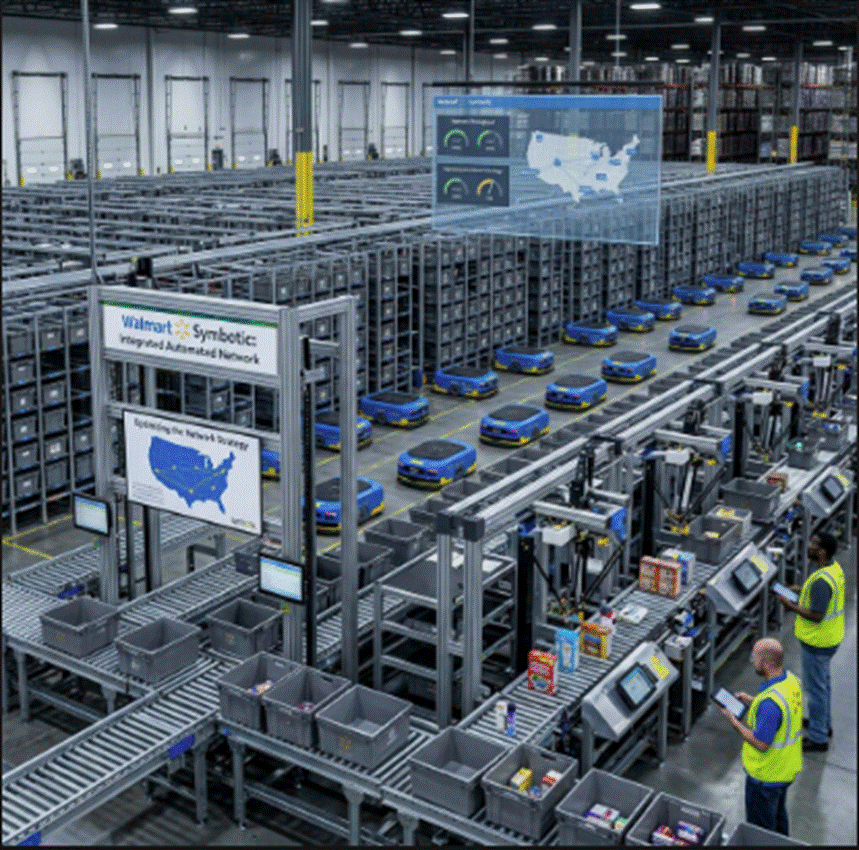
Warehouse automation has traditionally been discussed one facility at a time. A retailer installs an automated storage system, deploys mobile robots, adds robotic picking, or upgrades sortation. The business case is then measured against improvements within that particular building. Walmart and Symbotic are beginning to challenge that way of thinking.
On October 29, Walmart and Symbotic announced an expanded commercial agreement that will bring additional automation capabilities to 25 U.S. regional distribution centers. The agreement includes an initial commitment of approximately $6 billion, covering work over several years and multiple locations. Walmart says the initiative is intended to support upstream e-commerce inventory management, increase storage capacity, and improve the movement of products through its supply chain. Those numbers make the announcement noteworthy. But the more interesting story is what the scale of the commitment says about the next phase of warehouse automation.
From an Automation Project to an Operating Model
For years, warehouse automation investments were frequently justified around specific bottlenecks: reduced picker travel, increase storage density, improve sortation throughput, or offset labor requirements. Those are still important objectives. But Walmart is evaluating automation against something larger: the performance of an interconnected distribution network supporting stores, pickup and home delivery.
Rob Montgomery, executive vice president for Walmart U.S. Supply Chain Operations, tied the expanded agreement to improving service, growing capacity, simplifying work for associates and lowering costs. The company also expects the expansion to support broader assortment, greater speed and more reliable replenishment. That distinction matters.
Warehouse automation increasingly needs to be evaluated not simply by asking, “How much faster can this facility pick?” but by asking, “What does this investment change across the supply chain?” Does additional storage capacity improve inventory positioning? Does automation enable later ordering cutoffs? Can replenishment become more predictable? Can the same technology architecture be repeated across multiple facilities without redesigning the operation every time? Those questions take warehouse automation discussions much closer to business strategy.
Scale Is Becoming Part of the Business Case
The Walmart-Symbotic relationship is particularly interesting because this is not a new pilot. Reuters reported that Symbotic has been helping automate Walmart’s supply chain since 2017, while the latest agreement extends automation to another 25 regional distribution centers. There is another layer to the expansion as well. Supply Chain Dive reported that Walmart committed an additional $125 million toward research and development of racking technology and related picking, process-flow and inventory-management capabilities. That is important because it suggests the competitive discussion is moving beyond individual pieces of robotic hardware. Warehouse automation is increasingly about how storage, picking, inventory, material movement and software operate together.
Symbotic’s current portfolio illustrates that evolution. The company says its integrated offering includes BreakPack for each-picking and SymMicro for e-commerce micro-fulfillment, supported by proprietary software that uses AI to orchestrate product movement. The question for warehouse operators, therefore, becomes less about which robot performs an individual task and more about how multiple automation layers combine into a repeatable operating system.
Walmart Is Not the Only Signal
Developments elsewhere reinforce the same trend. Amazon reported in 2026 that it has deployed more than one million robots across its operations network. Its systems now span inventory handling, mobile robotics, robotic arms and packaging automation. The company also says its Sequoia system can identify and store inventory up to 75 percent faster at fulfillment centers.
Meanwhile, DHL Supply Chain and Locus Robotics reached another useful measure of scale in 2026: one billion warehouse picks using Locus AMRs. Locus says thousands of its robots now operate across more than 40 DHL-managed sites worldwide. These examples are different applications with different economics. That is precisely the point. The warehouse automation market is moving beyond the question of whether robotics can work. Leading operators are increasingly confronting the harder questions of where automation should be deployed, how quickly it can scale, how well it integrates with existing operations, and whether benefits survive replication across a network.
The Metrics That Matter After Go-Live
The risk in covering a $6 billion automation agreement is treating announced spending as though it were demonstrated return. It is not. The more valuable story will develop as the systems go live. The measures worth watching include throughput, storage utilization, replenishment performance, labor productivity, system availability, fulfillment speed, implementation cost and the ability to maintain performance during demand peaks. That distinction should matter to technology buyers. A compelling demonstration can show what automation can do. A network-scale deployment begins to show whether the technology can generate similar value repeatedly under different facility and operating conditions. For Walmart, that makes the 25 distribution centers as important as the $6 billion headline.
Takeaway
The next chapter of warehouse automation will not be defined simply by more robots. It will be defined by whether operators can turn automation into a repeatable, measurable and scalable operating capability.
Walmart’s expanded relationship with Symbotic provides an unusually large test of that idea. The announced objectives are ambitious: more capacity, faster product movement, better replenishment, broader assortment, simpler work and lower costs. Now comes the more important part: measuring what changes when those systems are operating across the network. For other warehouse operators considering automation, that may ultimately be the most useful lesson from Walmart. Do not evaluate the robot alone. Evaluate what the automation changes in the economics and performance of the supply chain around it.
The post Walmart and Symbotic: When Warehouse Automation Becomes a Network Strategy appeared first on Logistics Viewpoints.

The Systems-Engineered Logistics Operation: From Transformation Projects to Continuous Design
Walmart and Symbotic: When Warehouse Automation Becomes a Network Strategy
Walmart and Symbotic: When Warehouse Automation Becomes a Network Strategy
Freightos Global Freight Outlook – September 2026
Container rates jump another $1k/FEU – but is demand peaking? – July 8, 2026 Update

Walmart and the New Supply Chain Reality: AI, Automation, and Resilience
Trending
- Non classé2 mois ago
Freightos Global Freight Outlook – September 2026
- Non classé4 mois ago
Container rates jump another $1k/FEU – but is demand peaking? – July 8, 2026 Update
-
 Non classé2 ans ago
Walmart and the New Supply Chain Reality: AI, Automation, and Resilience
-

 Non classé7 mois ago
Why Sulfuric Acid Is Emerging as a Supply Chain Constraint in Copper
- Non classé5 mois ago
Container rates starting to spike on peak season rush – June 2, 2026 Update
- Non classé1 an ago
13 Books Logistics And Supply Chain Experts Need To Read
- Non classé1 an ago
Ex-Asia ocean rates climb on GRIs, despite slowing demand – October 22, 2025 Update
- Non classé4 mois ago
LCL Shipping Cost Calculator: Calculate Air and Sea Shipping Freight Rates